Bishkek’s fountains
There was an announcement last week that today, April 29th, (Dehn Goroda), the fountains in Bishkek would be turned on once more following their winter shutdown.
Since ancient times fountains have been used to decorate cities. In early times water would cascade under the force of gravity form mountain springs and descend to the towns and settlements below where it would be used by the populace for drinking, washing, and irrigation. The Romans were able to design and construct extensive systems using aqueducts which transformed the landscapes and land usage of the ancient world of the Roman Empire.
Over the course of time, engineers developed techniques and employed considerable ingenuity in designing fountains – where the hydraulic pressure did not simply produce a flow of water from a spout – but under pressure were able to deliver a jet of water which could drive automata and, according to some accounts, even musical organs. The picturesque displays not only delivered water, they provided a cooling element in the heat of the day, (cooling the atmosphere as well as offering a place to “take a dip”), and were aesthetically pleasing.
The technology available in the modern world means that hydraulic engineers can be even more imaginative and inventive in their designs.
Bishkek is endowed with a number of fountains – thirty two of them – some simple, others more majestic. Unfortunately they do not operate all of the time, and many are in need of restoration, or renovation. Some of the pipe work and pumps are in need of repair, and several have been painted from time to time according to the fashion of the times. When they are working, however, they can add a special charm – especially on a warm summer’s day.
Amongst the fountains of Bishkek are:
At the heart of Panfilov Park: The park stands on the site of what once an orchard planted in 1879. Known at one time as the “State Garden” it suffered considerable damage in the heavy frosts experienced in the years from 1916 to 1921. As a result it was transformed into a park and was called “Red Star Park” because of the pattern made by its network of pathways. In 1938, part of the park was given over to the construction of a sports complex – now the Spartak Arena. In 1942 it was reconstructed and renamed in honour of the war hero, Ivan Vasilyevich Panfilov, whose statue can be found at the Eastern end of the park, behind the White House. The park is filled with amusement rides for children and a small Ferris wheel. In 1949 a small fountain was constructed in the center of the park. Over the years it has been painted several times, and now sports a coat of yellow and blue … as a sign of friendship with the people of Ukraine.
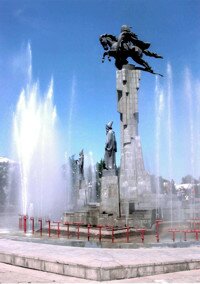
The Manas Sculptural Complex in front of the Philharmonia building, on the corner of Prospects Chui and Manas: Completed in 1981, it depicts the legendary hero is placed on a plinth, riding his magical horse Ak-kula, in a pose resembling St. George slaying a dragon (or winged snake). Below him are statues of his wife Kanykei and of the wise man and counsellor, Bakai. Around the square carved in red granite are busts of several 20th century manaschi. Before the hero and his companions are fountains which spurt jets high into the air.
In front of the White House – Government House – on Prospect Chui:
Outside the Historical Museum in the Central Square, Ala Too Square: flanking the courtyard in front of the museum are pools with small fountains in the form of stylized flowers. The square was established in the mid-30′s but the fountains were originally installed in the 1950′s. The square was reconstructed again in the 1960′s when the marble fronted buildings were constructed. The bowl is created from granite – but the original pink colour of the stone has long since changed to a black over the years as the stone has been covered with the grit and grime of a modern city.
The square was renovated in 2009 and new fountains, offering a “son et luminaire” (light and music) experience were installed.
In Oak Park – beside the Russian Drama Theater: the fountain, which consists of 25 jets in a 5×5 matrix, was constructed in 1972, and for some time was a popular site for positioning summer cafes.
In the grounds of the Hyatt Regency Hotel: A recent construction, the fountain which stands between the hotel and Opera and Ballet Theater was once the site of a wooden mosque (which burnt down in the 1960′s).
Outside the TsUM department Store: a series of fountains decorate the square to the east of the store, and to the north there are a number of open air cafes.
On Sovietskaya – between Kievskaya and Toktogul streets: the “fairy tale” fountain in front of the apartment block on the Western side of Sovietskaya, was constructed in 1978 and is decorated with multicoloured mosaic tiles of different colours and features fish spouting jets of water.
.
Unfortunately, given their origins in providing a supply of fresh water and the fascination that they seem to generate, it is perhaps ironic that fountains can sometimes also present hazards. The children frolicking in the jets of water in the heat of the mid-day summer sun may not just catch a chill, water can also harbour microbes and other organisms dangerous to health; rubbish can accumulate and lie hidden under the surface and those pose risks – and it is not unknown for people to drown even in a bathtub, (in fact about two thirds of the children who die by drowning in the home do so in the bath – sometimes in as little as 1inch – 2.5 cm - of water). As a result, it is probably better to stand and admire the spectacle from a distance than to submit to the temptation to “dive-in” – no matter how inviting and refreshing the waters look.
.



 Bishkek
As it happens – we didn’t need the fountains … the heavens opened up and there was a torrent of rain …