Zoroastrianism
|
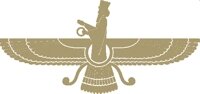
| Faravahar (or Ferohar), is one of the primary symbols of Zoroastrianism, and is believed to be the depiction of a guardian spirit – called a Fravashi |
I mentioned yesterday that Norus is an ancient Zoroastrian festival.
Zoroastrianism is a pre-Islam religion founded by the ancient Persian prophet Zoroaster (sometime in the second millennium BC – although there is some doubt about the exact dates, I have seen references to him which range from 1700BC to 500BC (!)), and still practised by the Parsees in India. It sees the world as dualistic – Good and Evil in conflict.
It is sometimes claimed that the Wise Men who visited the infant Jesus with gifts were Zoroastrian.
Perhaps one of the reasons why there are few examples of the Zoroastrian heritage in Kyrgyzstan, and throughout Central Asia generally, is that the adherents to faith have suffered considerable persecution over the centuries at the hands of both Christians and Moslems, with their Fire Temples often burned down or converted into mosques, (for example in Bukhara).
The Zoroastrian Sassanid dynasty in Persia was conquered by Arab invaders in the seventh century – but the religion had already spread to Northern China along the Silk Road, apparently gaining official recognition in some states. There were still some existing Zoroastrian temples in service as late as 1130AD, but by the 13th century it had disappeared completely as a force in China.
In the eighth century, Zoroastrian refugees fled to India where they were given sanctuary on the basis that they did not engage in missionary work – and marry only within their own community. Although these conditions are centuries old, their descendants, the Parsees, largely still adhere to them.
Apparently, in Iran, it is still possible to find small communities living and practicing this ancient faith. There are small, but growing communities in the United States, England, Australia and Canada. Perhaps the most famous modern adherent was the lead singer of Queen, Freddie Mercury.
Perhaps the most lasting contribution made by Zoroaster, however, is the festival of Noruz – often claimed (incorrectly) to be a Muslim “New Year” festival. It was (is) held on the vernal equinox – March 21st.
Here in Kyrgyzstan, archaeologists have discovered several sites and objects, (for example, in Bishkek – which used to be known as Jul during the 6th to 12th centuries and the site of the Silk Road city of Nevkat at Krasnaya Rechka), which suggest that Zoroastrianism was one of the religions that was once practised during the heyday of the Great Silk Road, although to what extent is not clear.
Suleiman Too in Osh, a large mountain rising up right in the city centre and dominating the city, has a long history as a holy site and some scholars think it might have been the site of an ancient Zoroastrian temple. There are suggestions that there was once a Fire Temple here, (some indentations in the rock are suggested by some to be the marks made by the hands, knees and forehead made by Solomon whilst praying but some scholars claim that they are places where lamps were lit as part of Zoroastrian fire worship). One theory is that the most visited spot on the hill (Babur’s House) was once the spot where the bodies of the dead were left for the dogs and birds to pick at, before the boners were then taken away to be buried – a typical Zoroastrian practice.
There are more connections to Zoroastrianism to be found in Tajikistan which is, perhaps, not surprising remembering that the Tajiks are an Iranian people and the Tajik language is similar to Farsi, the language of Iran. The Tajik flag even incorporates two Zoroastrian symbols: the seven stars and a crown (taj in both Tajik and Iranian).





 Bishkek