Computing
My move into computing came about like so many of the big events in my life – by accident.
It all began when a teacher left the school. She taught one of the two computing classes, and as they were timetabled at the same time, the other teacher couldn’t take it over, so someone else was needed. I was asked. Up to this point I knew nothing about computers. My “computing” experiences were limited to log tables, slide rule, hand operated, rotary, mechanical calculating machines and simple electronic calculators. I had the summer to prepare, so I took home a set of text books and worked through them during the summer holidays. It wasn’t much of a grounding, but it was before the days of microcomputers … and I got away with it.
I had to learn a lot of new topics. These included:
- the history of computing – which I found fascinating … I still do;
- the machine architecture of the central processing unit, including elementary circuitry, and a wide range of peripherals – input devices for capturing data in different formats, output devices for presenting the results of processing in different formats and memory devices;
- Problem solving techniques, including systems analysis and programming techniques – even how to count or sort a simple list can be quite quite a complex process;
- Coding techniques – from simple Binary encoding to complex database design;
- a variety of computer languages – stating with BASIC, but also PASCAL, LOGO, COBOL, Fortran, APL … and so on … even some examples of assembly code. I treated it a bit like learning foreign languages, and although I have never been particularly proficient at foreign languages, (it took me three attempts to get a basic O-level equivalent grade in French … and I only really learned a few basic phrases whenever I visited anywhere on holiday … thinks like “two beers, please”), I found that like once you learn one language then a lot of features of that language can be transferred to another. There are even families of languages like human languages;
- The uses of computers in business, industry, research and so forth – which seemed to an open-ended exercise and opened many new interests and as a result I learned a lot about business practices, industry, engineering and science;
- Communications systems, including security systems;
- Human issues such as: workstation design and ergonomics; working practices; light sensitive epilepsy;
- Legal issues related to computing, such as: contracts; export restrictions; licensing; data protection; Computer misuse; copyright protection and software piracy;
- A range of different types of proprietary software – word processors; spreadsheets; databases; Computer Aided Graphics; Music programs …
… all of which has been extremely useful in later life.
Often I had pupils in my class who were very talented and knew more than I did about some aspects of computing. To many people of my age, this would have been a real challenge. To me, on the other hand, I was guided by some research into Teaching Styles and Pupil Progress that I studied long before as a student teacher. This described a number of different approaches adopted by teachers from the old-fashioned “lecturer” approach where the teacher represents the fount of all knowledge – they lecture and impart information to their students, (this obviously wasn’t appropriate in my circumstances), to the collaborative work-group approach where the teacher is a facilitator, coordinator and “expert” (someone with a wider level of experience and knowledge – which fitted my approach more closely).
I also started to undertake work as an examiner in Computing and served in several capacities for several examination boards, but there is more about that in a separate post. I found this to be a valuable experience and would recommend it to any teacher.
I also joined the local branch of the British Computer Society as an Associate Member and met many people working in computing which was to prove very useful – especially in terms of learning more about how business work, and how computers were used in the “real world”, outside schools.
Practical work at the time when I started working in computing involved writing computer programs on sheets of paper and sending these “coding sheets” off to the local technical college, where they were types into a terminal and we received the results a few days later. They rarely ever worked first time, so even a simple program often took several weeks to complete. We then got a terminal installed in the school which speeded the process up – but it was with the introduction of the RM380Z microcomputer that things really started to take off. At first we worked with just one microcomputer – but the BBC launched a special educational programme complete with a specially designed, affordable, microcomputer. The Head saw the adverts for the special, limited offer, and decided to spend what little spare cash the school had to buy some … and things started to move rapidly.
Now, he was even less technically minded than I was – but he saw the future coming … and I congratulate him for that.
As a result we put together a programme – a pioneering programme. Up until that point, Computing was always seen as a specialist subject – very much maths-orientated with lots of programming … not much in terms of word processing, spreadsheets, design, etc. We talked about a new kind of course and I drew up a proposal for Computer Awareness course to be taught to all pupils … not computer studies or computer science but concentrating on the use of computers rather than the machines themselves and how they worked. No-one else in the neighbourhood was offering similar courses. We were pioneers, pathfinders. He asked me to become Head of Computing and introduce the course – and that’s I got my second promotion in the same school.
I am amazed when I think back at what we were able to achieve with so little … to start with just one room with ten simple computers which were in use from 7:30 in the morning until 5:50, or later in the evening. Later we got a suite of three rooms with PC’s but they were still very basic. They were heady days.
The school’s computers were always in great demand. Pupils would arrive well before the school day began, come to the computer rooms during the lunch hours and stay long after school finished. Obviously I couldn’t supervise the facilities all on my own. My colleagues helped me … but there was a limit to how much we could do … Fortunately there were always senior students who were more than willing to help supervise the facilities and we introduced a system of “Computer Room Prefects”. There were quite a band of them over the years and I still hear from them from some of them from time to time.
The greater availability and familiarization with computers meant that I was also involved to a greater and greater extent in supporting the teaching of other subjects. Computing had long been used as a tool in Mathematics but they began to a useful tool in many other subject areas as well, ranging from the sciences to art and design and in modern languages. Many students began to prepare their coursework on computers and I found myself being involved in many different areas of the curriculum.
The increasing role of computerization was also beginning to be felt in the administration of the school as an organization in itself. As a result I found that also assumed a role in greater role in school administration. School records were being computerized, I found myself assisting with the construction of the school timetable and other tasks. My summer holidays shrank from six weeks to two (if I was lucky … ) as we dealt with timetabling, creating group lists, recording and analyzing examination results. One of the tasks that this introduced was the need for Data Protection measures – especially after the enactment of the Data Protection Act.
When I eventually left teaching and came to Kyrgyzstan, I had a firm grounding in computing and the use of computers. Of course, with the passage of time, that grounding is obviously weaker now. There have been many advances in technology which have passed me by or had a passing influence on me and my developing career here in Central Asia. I tend to rely on local experts, who have more up-to-date information at their fingertips than I have, for advice … but I often surprise them with the breadth and depth of my knowledge, as a “layman”.


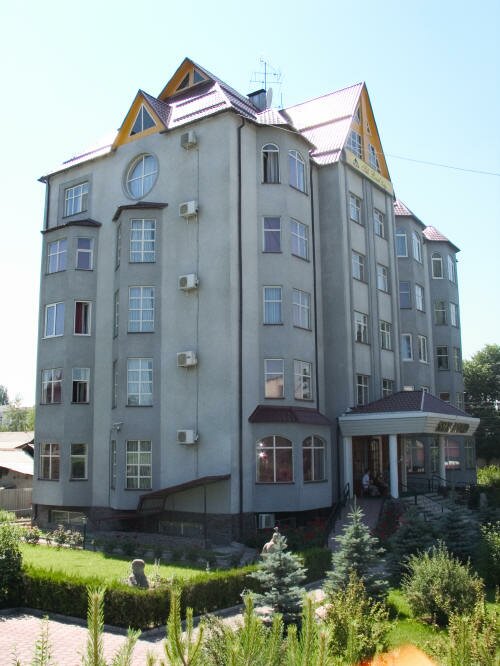
 Bishkek