What’s in a name?
When I first came here I often ran into problems over names. Back in the UK, for example, as a school teacher, I would have “hit the roof” if one of my pupils had dared to call me Ian. The correct form of address is “Sir” or “Mr. Claytor”. The use of the given name is restricted to friends, relatives or superiors, say a line manager. Here, on the other hand, the correct and respectful form of address is to use the imya followed by the ochestvo, the given name followed by the patronymic. So, Vladimir Putin would be addressed as Vladimir Vladimirovich, and no-one would be surprised, there is nothing disrespectful in this.
I have had to learn a whole host of name combinations: Tatiana Ivanovna; Vera Nikolaevna; Oleg Vladimirovich; Nikolai Stepanovich; Sergei Davidovich; Vladimir Anatolovich, Emil Satarovich and so on.
A few years ago I had to go and collect an official document and the young Russian who went with me as an interpreter was somewhat perplexed. The application form that we had to complete asked, as is usual here, got the Full name, “FIO”: Familiaya, Imya and Ochestvo, or in English: Family name, Given name and Patronymic. That wasn’t a problem, or at least it shouldn’t have been. This is how the conversation went:
Sergei: “Family name?”
Me: “Claytor.”
Sergei: “Given name?”
Me: “Ian.”
Sergei: “Patronymic?”
Me: “… aha … we don’t have them.”
He looked perplexed as I told him this. He thought for a while and said, “What was your father’s name?”, so I told him, “Robert” and he duly filled in the form with “Robertovich”. I asked if he was sure that we needed to do this, and he said, “No, but it’s better to be safe than sorry.” He wasn’t sure if the official would understand that in the West we didn’t use Patronymics. As it happens, there was a problem because when the official came to check the form against my passport, there was no mention of “Robertovich”, and as forms have to be completed “beeyez oshibok”, (“without mistakes”, you cannot correct something!), we had to take another form and fill it in all over again. It would have been easier to leave the patronymic out and write it in if the official had insisted, but there was no harm done.
On another occasion I had to go to court as a witness. Sitting up on the bench were three judges, busily scrutinizing the folder of documents describing the case in front of them. I was called to the stand and asked to identify myself: “Familiaya, Imya and Ochestvo”. So I said in my best pigeon Russian , “My Family name is Claytor, my given name is Ian, but I am a British citizen and we don’t use patronymics. However, if you need it for the official record then my father’s name was Robert and you can write “Robertovich.” The court fell silent, well it already was silent, but the judges stopped turning the pages in the folders in front of them and slowly looked up. It was clear that no-one had warned them that I was foreigner. One of them asked for my passport and decreed, “Forget the patronymic, in the passport it is just Ian Claytor. That will do.”
In those two cases the officials were happy to cope with the lack of a patronymic, but that is not always the case. The custom and practice is so ingrained, however, that some of the locals have difficulty coping with it. As a result some people actually do call me “Ian Robertovich”, whilst others will refer to me in full as “Ian Claytor”, (but they sometimes seem a little uncomfortable with this as it seems a little rude) and others fall back on the more formal ”Gaspodin Ian”, or “Mister Ian”. Some people even translate this into English and call me “Mister Ian” in everyday conversation, and it can be difficult to get them to drop the “Mister”.
It’s even more confusing when it comes to Kyrgyz names. I sometimes find it difficult to get my tongue around the names. To things more interesting, Family names, or surnames, were not common amongst the nomadic Kyrgyz, this was a practice adopted with the arrival of the Russians and increasing Russian influence. People were known by their given name followed by the father’s name. Men and boys often have a name like Almaz Jyrgal uulu. Uulu is like Mac, Mc, O’, and Ben meaning “son of” so this name reads “Almaz, son of Jyrgal”. For girls the equivalent of uulu is kyzy – for example: Ainura Ustanbek kyzy.
The Kyrgyz use a number of titles as a sign of respect. An older male may well be refered to as baike, (aka or ake) and an older person may refer to a younger one as uke or uka. My driver, for eample, is referred to as Sultan Baike. In pre-soviet times a number of titles were used – khan, bek, (as in ianbek … and this is still commonly used), bai and myrza were assigned to men, whilst ayim (= “madam”) to older women. The Kyrgyz word joldosh was the equivalent to the Russain “tovarisch”, or comrade, but is not used that much today, although it is a fairly common as a given name.
Now, when Kyrgyzstan declared Independence from the Soviet Union, it was at a time of rising interest in cultural and traditional culture and identity. As a result there was an increase in the use of uluu and kyzy when naming children. Some people even claim that they weren’t asked, and when they received the birth certificates for their newborn son or daughter, the officials had inserted the word automatically.
It a report that came out yesterday, it appears that there is a new trend for people to change to change their names, replacing the Kyrgyz epithet with a Russified patronymic, (Kyrgyzstan’s Name Game: Love Thy Neighbor, Ivan the Rich). As the report puts it: “it’s out with the “uulus” and in with the “-ovs.””
Given that many people in Kyrgyzstan sometimes seem to be obsessed with re-establishing their cultural identity and the need to strengthen their national heritage, this seems to be a strange trend. I am not certain how many people are changing their names, (the report claims that in Bishkek alone, there have been about 1,000 cases.) So, if it is happening, then why?
The report suggests that it is because of problems in Russia. Many Kyrgyz travel to Russia in search of work and it seems that a number of them have had problems with Russian authorities who “demand” that they change the uluu and kyzy in order “to register in schools and universities and more.”
I wonder what they would make of a Brit like me … with no ochestvo. Perhaps I would have to adopt Robertovich after all.
.
For the record:
Amongst the nomadic Kyrgyz it was considered important to find a suitable name for a newborn child.
A child was usually named after one of their relatives, (usually someone who had already died but who had lived a long life), but sometimes special consideration was given to their particular circumstances. For example:
- If there was a history of infant mortality in the family, then a child might be given a name like Toktogul, (meaning “Stop, slave”), or Toktosun, (meaning “let him stay alive”).
- A name indicating strength might be chosen, for example: Tashturghan, (meaning “Standing stone”), Omurbek, (“full of life”), Tashtanbek, (“Strong as stone”), or Bektemir, (“Strong as iron”).
- Sometimes children were given names as if to fool vengeful demons and evil spirits that the child was not really of any significant importance - for example: Asrankul (“Adopted slave”), Bokbasar (“Stepped on dung”), and Tezekchi (“Dung collector”). Likewise, children were sometimes given names to make them unnoticeable amongst everyday, household, items - for example: Tutkuch (“Potholder”), Tuzbay (“Man-Salt”), Kiyizbay (“Man-Felt”), Itybay (“Man-Dog”).
The character Beshkempir in the film of the same name, received his name because he was adopted – and was allocated to his adoptive family by a committee of “five grandmothers” (“Besh Kempir”). When he learns of this in his adolescence, and confronts his grandmother about it, she denies it and insists that he is “of her blood” and tells him that he was given the name as a charm: “To protect you from the evil eye.”
Many of the names are based on things found in nature. For example, a common girl’s name is Aigul (eye-GOOL), a combination of Ai, meaning “moon,” and gul, meaning “flower.”
Some years ago some Peace Corps volunteers have prepared a set of teaching materials based on Kyrgyzstan and Kyrgyz lifestyles. Unfortunately, they no longer seem to be available on their website, but here is an excerpt from their notes about Kyrgyz names: a list of some words that are combined to create some popular Kyrgyz names, along with their meanings.
Kyrgyz Word - English Meaning
Adilet – Justice
Ai – Moon
Almaz – Diamond
Alsu – Rose water
Altin – Gold
Azamat – Very good
Bak – Tree
Bakyt – Happiness
Bek – Male (masculine ending)
Cholpon – Venus (morning star)
Gul – Flower
Jildiz – Star
Jyrgal – Gladness
Mir – Peace
Nur – Ray of light
Sulu – Beautiful
.


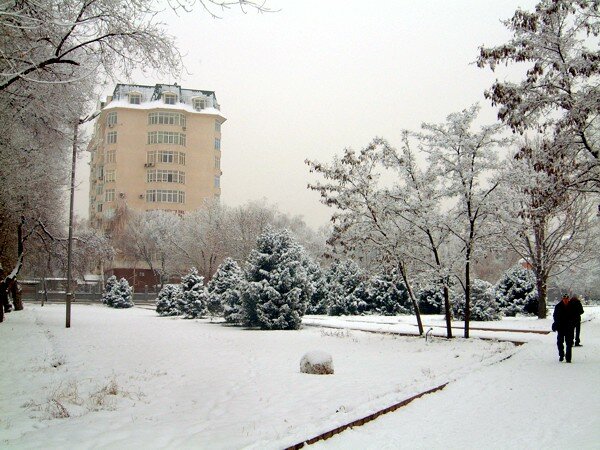


 Bishkek