Christmas is coming …
“Christmas is coming and the goose is getting fat”, goes the old seasonal children’s rhyme. Well, Christmas is definitely coming … and Goose was the traditional fayre for Christmas dinner in Victorian England – whilst, at the same time, it was a rare treat.
In A Christmas Carol, Charles Dickens wrote that in the poor Cratchit household, “you might have thought a goose the rarest of all birds; a feathered phenomenon, to which a black swan was a matter of course — and in truth it was something very like it in that house.”
When I was growing up, Christmas dinner was always Roast Chicken, with all the trimmings. Then, one year, my mother decided to have a change and bought a turkey. Turkeys were already becoming quite popular but, although I was intrigued by the change, quite frankly didn’t I wasn’t all that impressed and couldn’t see what all the fuss was about. I wanted my chicken.
Oddly enough, Dickens may have had something to do with the transition from goose to turkey as the “traditional” Christmas dinner when he had Scrooge give the Cratchits one on Christmas morning – and not a goose.
I dare say, on the other hand, that I had been an American, then my attitude might have been different. On the other side of the Atlantic, turkey has always been a staple fayre for the earlier festivities of Thanksgiving. There are historical reasons behind that and it would be nice if we could say with the same sort of certainty why the goose was traditionally associated with Christmas … but we just don’t know.
The Kyrgyz, themselves, don’t seem to be so keen on poultry – I suppose that one reason might be that the birds are is not really suitable adapted to traditional nomadic lifestyle – but quite a lot of people, especially in the villages, keep chickens, ducks and geese, it’s mostly for their eggs. Of course the birds themselves are also raised for their meat and in Bishkek it is possible to buy Chicken pieces and both roast and smoked chicken, but they don’t seem to be as popular as they are in the west. Although some of the meat is from local producers, a lot of it is imported from China or the US. During the Soviet period there used to be a thriving poultry industry in Kyrgyzstan with something like 16 poultry farms. Shortly after independence, however, most had closed and not one was working properly. Rising prices for medicines, foodstuffs, etc., coupled with the loss of subsidies from Moscow and several other factors had combined and toll – as they had with many other sectors to wreak havoc on Kyrgyz industry. Today there are a couple of poultry farms which operate on a reasonable scale, but a lot of the production is, apparently, still on the basis of smallholdings.
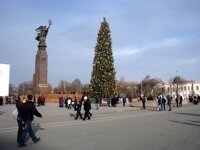
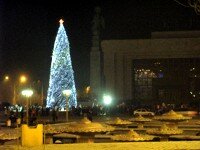
Well, Christmas is coming – it’s only one week away, and the big celebration here, New Year, is just two weeks away. Preparations are beginning to be more obvious, although a little bit more subdued than in previous years. The huge, (artificial), Christmas tree has been erected in the main Ala Too square, and lots of people dressed as Ded Moroz – Father Frost, the Russian equivalent of Santa Clause – and his granddaughter and helper Snegorochka pose for photos with passers-by. Ded Moroz sports a light blue gown not the traditional red one that is so common in the West that was inspired by a Coca Cola advertisement at the beginning of the twentieth century.
This week, we took delivery of our Christmas Turkeys. I ordered just one – for the kid’s family – although Maxim won’t be happy because he is fussy eater and turns his nose up at anything like Chicken. I am not sure what I will have for Christmas Dinner but there is plenty of choice if I want to go out … many places, such as the “Aussie Butcher”, (he’s really a Brit, but his predecessor was an Aussie), or the Hyatt, have got special do’s for those ex-pats who are staying in Bishkek. I think I will probably just a simple roast and spend a quiet day at home. I am off to Naryn on Boxing Day to close off the year.
If the preparations are a bit laggardly this year compared to precious years, then another difference is that there will be less fireworks for New Year. The fireworks are usually something to see. A few years ago a young Kyrgyz friend of mine, got a job in the States and was in New York to see the New Year in. He wrote on his blog that he had been expecting something spectacular – and although it was a great experience, “they do it better in Bishkek!”. Now that might have been Nationalistic Pride or simply reminiscing through “rose coloured spectacles”, but I think he might well have had a point. I remember the first time I saw it I was fairly astounded. Apart from the big central display over the main Ala Too square in Bishkek, virtually everyone seems to let off fireworks at midnight and the sky is lit up. Much better than the displays on Bonfire night.
Anyway, this year there is a ban on the sale of fireworks – especially in the south. The authorities are concerned that the fireworks might be mistaken for explosions, and in a time of heightened tensions and concerns about terrorism, it doesn’t seem to be wise to sell pyrotechnics. Still it might make for more subdued celebrations.
Given the number of suspect parcels that have been reported, (which have, fortunately all turned out to be false alarms), and the actual discovery of ordinance, the ban is probably a good idea.
.
Last week I mentioned the poor performance of Kyrgyz schoolchildren in the Program for International Student Assessment, (PISA) – a worldwide evaluation of scholastic performance organized by the Organization of Economic Cooperation and Development, (OECD). Well, you might expect that, as a former teacher and even a trade union representative, I would be particularly interested in the developments concerning teacher’s salaries that is currently simmering away and threatening to boil over.
At the beginning of the week, the teachers’ union called upon the authorities for a pay rise, “in order to avoid a mass strike”. Now I know that the Labour Code allows for industrial action but it is extremely rare for something to actually to actually happen. For example, the minibus drivers in Bishkek staged a strike last year, demanding an increase in fares, (which are regulated), because of the increase in fuel prices. Apart from most the other cases I have heard of have been have been at places like the Kumtor Gold Mine on specific issues. I wrote a few weeks ago how the workers at Kumtor were demanding a wage increase, though in comparison to teachers and many, (if not most), other workers they are quite well paid.
Anyway, the teachers have staged a number of protests around the country – starting in Djalal Abad in the south but quickly spreading to Talas and Issyk Kul in the north of the country. Protest meetings were held and roads blocked. Some protests seem to have been quite small –but reports of others suggest crowds in the thousands.
The teachers in Talas oblast, (which is an administrative region, like a county), state that the a teacher’s salary in the oblast is just 1500 som a month – 1900 if the are an “experienced” teacher – that’s about USD33, (or EUR23, or GBP17) to USD42, (or EUR29, or GBP27) – not enough to buy a sack of flour. I am not sure how this tallies with the union’s figures for the average salary of 4026 soms but their figure may well include Bishkek and some other places where the salary is higher because it is subsidized by the city. Even so, that’s still only USD87, (or EUR62 or GBP57), which is below nominal average wage for the country, (based on actual salaries reported to the tax authorities – which might well be an underestimate), of 6744 som and the “minimum subsistence basket” for the country which is 3,827som, or USD83, (or EUR59, or GBP55). So, according to these figures, it seems that teachers as a whole are paid about 40% less than other workers in the country – and below the minimum subsistence level.
The union’s figures for a new entrant to the profession are even worse – apparently they get just 1177 som.
The union is asking that teachers be paid at least on a par with the rest of the workforce – basically, for a 40% pay raise. Some of the rank and file, however, are not so modest in their claims which seem to range from 10,000 to 15,000 for the basic salary and the return of a number of other benefits which have been eroded over the years.
I am sorry to give you so many statistics, especially as you probably know from previous postcards that I am very wary of statistics and their use, but it seems that teachers are particularly poorly paid given their qualifications and experience – and also their position and role in society. Indeed the authorities don’t dispute the merits of the case. They do point out, however, that it is an issue that affects all government employees and not just teachers. The problem is that there just isn’t the money in the budget – which is already in deficit, and would be in even worse condition if the interim government hadn’t received budget support from grants from international donors following the April revolution and the other events that occurred during the summer. Still, they’ve agreed to look at it and are proposing to abandon the current system of uniform pay scales in order to create a new one with various components – a basic salary plus different allowances, including one which is performance related. In Djalal Abad, for example, (where the protests started), the governor has proposed increases for teachers in his area.
All this is fine but raises a couple of other crucial questions, such as: conversion from one scale or system to another can create anomalies, and how can it be ensured that no-one will be worse off?, (a particularly interesting and difficult question and one which I have had to deal with quite recently), what is the quid pro quo?, (what will be the requirements demanded in return for “performance related” component? – improvements in the PISA ratings for Kyrgyzstan?), and, of course, where’s the money coming from?
.
You’ll notice that I have kept away from the burning issue in most of the weekly postcards that I have dispatched since October 10th – the question of a government for the Kyrgyz Republic. Well, at long last we have one! … well, almost. A coalition agreement has finally been reached, between Respublica, Ata Jurt and the Social Democratic Party. The other two parties in the parliament, Ar Namys and Ata Meken, will form the opposition but separately and thus maintain their own identities. The agreement includes a provision that the parties will stay together for at least two years. The parliament has met and approved the nominations for speaker and Prime Minister, (actually by quite a large majority in each case – so they picked up some votes from the opposition, presumably because they felt that any legitimate government is better than none), and will consider the future the future structure and composition of the rest of the government.
So far, so good.
We wait to see how the scene will unfold further.
.
On a slightly different note – I have had a busy and difficult week. It may be the pressure is building up as we round off one year and prepare for the new one … lots of forms have to be completed, and we have been kept busy on this front. I was out of the office for nearly two and a half days at various meetings, judging business plans prepared by students at one of the local universities, the annual General Meeting of the Kyrgyz Association of Tour Operators, (KATO), and attending the celebration to commemorate the tenth anniversary of the International Business Council. When I came back on Friday my computer collapsed under a virus attack. Fortunately, I have virtually everything backed up – well, I did teach Computing and Information Technology – but I see that a lot of the emails in particular have been corrupted and are probably lost.
Oh yes, I know I have said a lot about Christmas and New Year, but this also the time of year for a number of other festivals … although there is a small Jewish community in Kyrgyzstan- Chanukah passed almost unnoticed. We did, however, celebrate Beethoven’s Birthday on Thursday, the 16th. Happy 240th, Ludwig!
I am not sure why the turkey is sometimes associated in English idioms with “a particularly stupid person”, (as in “which turkey voted for Christmas?”), but, I have to admit that the experience made me feel like a “right turkey”. Having, (hopefully), cleared the computer of viruses, however, I hope that I am the turkey that got the Presidential pardon just before Thanksgiving.
Finally, as the next postcard is likely to arrive after Christmas, can I take this opportunity to wish a Happy Christmas and a Prosperous New Year to everybody.


 Bishkek
Thanks, and best wishes for the oncoming season.
If you develop one of your themes, how about ‘cold turkey’ and ‘talking turkey’?
Best wishes for a prosperous New Year,
Quite simply your postcards have been refreshing, always compelling redaing and I think I might just award you correspondent of the year.
Have a peaceful 2011…
Maybe I might even meet you at some point…
I hope that the festive season is quiet and restful.
Now the family is heading our way for the season and we are definnitely not prepared!
I shall raise a glass of good Central Otago pinot in your honour during the celebrations.
and a happy belated hanukkah to you as well!
Joyeux Noël !
I hope your Christmas is a Merry one, no matter what poultry is gracing your table! At home when I was a girl we tended to have ham as the staple meat and of course because it is such a big lump of meat we ate ham on toast, ham fritters, ham surprise (ham with bubble and squeak) etc etc for several days. That made sure we didn’t want to see ham again for at least another year.
My mother still gets a ham (my brother is a butcher and he sends her the smallest one he has but it is still too much for her). Since my father died three years ago that means all the visitors are treated to ham sandwiches, ham fritters etc etc. As I am now a vegetarian i am spared these treats!
Speaking of butchers, I am most intrigued by the ‘Aussie Butcher of Bishkek’, the world is certainly a small place these days.
I have to say i have much enjoyed reading your emails. as you can imagine, Kyrgyzstan is far away from Australia in terms of news stories. After our own national news comes America, England, Europe and SE Asia. Your writing is always so interesting and I pass your emails on to a couple of friends who also enjoy your stories and observations.