Our Lady of Kazan – 4th November
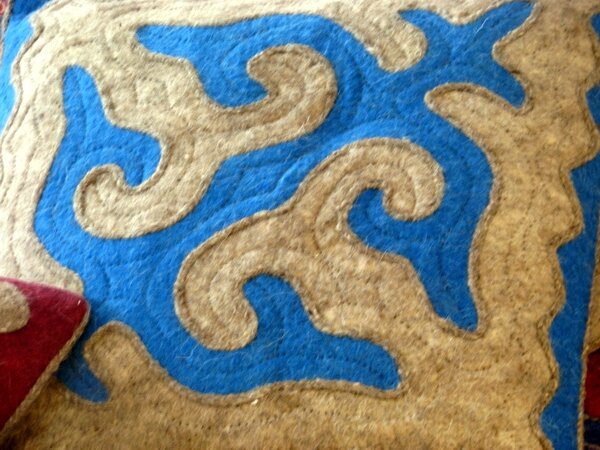
Sometimes, people get a little confused when they come to see me in my office. There are the things you might expect to see in an office: computers, papers and so on, but the decoration is, I admit, a strange and eclectic mix. As well Traditional Kyrgyz crafts, represented by a Shyrdak and a Mongolian Tush Kiyiz, there are photographs and an oil painting of an old women sleeping on the floor of a yurt. One item that seems to attract a lot of attention, however, is a small icon .
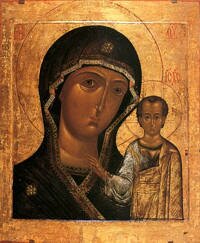
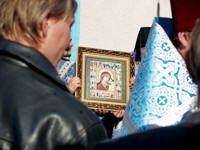
It’s a small travelling icon, about 6 cm square, in a blue velvet lined case. The case opens to reveal two images: on the tight is an image of Jesus and on the left is a Madonna and Child – a copy of a famous icon known as the Theotokos of Kazan or Kazanskaya Bozhermateriy - “Our Lady of Kazan”.
This icon has led to several people asking if I am “Orthodox” – a member of the Russian Orthodox Church to which I have to reply, “No” – and then explain that the icon was which was given to one Christmas me as a present by Tatiana, our accountant.
Now, I am no expert on icons – there seem to be so many of them. The Orthodox churches here, it sometimes seems to me, often resemble art galleries rather than places of worship as the walls are lined from floor to ceiling with religious paintings. Most, but not all, are stuck in what I would call a “primitive style” – the sort of early painting that you might see in the Medieval halls at the National Gallery in London, or the Louvre.
The original icon of Our Lady of Kazan was an extremely important and revered sacred image in Russia, far more important than it size might suggest – just nine inches by eleven, (or 23cm by 28cm).
It was slightly unusual in that the image of a diminutive Jesus is seen standing at the chest of the Virgin Mary, rather than as an infant cradles in the Virgin’s arms.
It is said to have come to Kazan from Constantinople in the thirteenth Century, but it disappeared from sight sometime around 1438 when the Tatars besieged and eventually captured the city, making it the capital of their Khanate. It is still the capital of Tartarstan, an autonomous Republic in the Russian Federation.
In turn, in 1552, Ivan the Terrible besieged and captured the city freeing some 100,000 Russians who were being held captive by the Tartars.
In 1579 a fire destroyed much of the city, but this event is said to have led to the icon’s rediscovery. The Virgin Mary is said to have appeared in a dream to a young girl in the city called Matrona, revealing its location. Matrona tried to get the local archbishop to search for the icon based on the information the Madonna had given her in the dream, but he resolutely refused to react. So the girl and her mother set out to search for it on their own – eventually finding it buried under a the ashes of a burnt out house – where it had been laid in order to protect it from the approaching Tartar army.
As so often in stories of this type, the image is said to have appeared fresh, “as if newly painted”.
The archbishop relented and installed the rediscovered icon in the Church of St. Nicholas, and on that same day a blind man was said to have been “cured” in the first of the numerous miracles attributed to the icon. On the basis of it’s reputation it was transferred to the city’s Cathedral of the Annunciation.
Perhaps the most important incident in its history, however, occurred in 1612 when Moscow was occupied by Polish troops. The Patriarch of All Russia at that time was a priest from Kazan and he called for the icon to be given to the Russian princes who were leading the opposition to the invaders. It was paraded before the regiments as they fought the Poles, eventually driving them from Moscow and liberating the city on October 22nd – according to the Julian Calendar, which is November 4th in the modern Gregorian Calendar. The victory was attributed to icon – hence its place as a national icon – and the date of the victory was declared as the feast day of Our Lady of Kazan.
November 4th is now the Day of National Unity in Russia.
The icon moved to different homes over the centuries, with cathedrals dedicated to it in Kazan, Moscow, (in the Kremlin), and St. Petersburg. It was often carried in solemn processions around the city and was called upon to act as protectoress of Moscow on several occasions. During the siege of Leningrad during the Second World War, a replica was walked around the city walls.
It is not known what happened to original icon. There were many copies made, and it wasn’t really clear which was the original. One of the best contenders was stolen by thieves in 1904 and probably destroyed as they dismantled it to get at the gold and jewels which adorned it. Another contender disappeared in the 1917 revolution and it is not known whether it was, as some people suggest, smuggled out of the country to protect it from the Bolsheviks, or if, as others suggest, the Bolsheviks captured it and hid it from the masses only to sell it abroad, in order to obtain valuable foreign currency, later.
The image is still extremely popular in Russia, and is sometimes seen as a symbol of Russian nationalism. Copies of it are often given as presents, as Tatiana gave me mine, and especially as Wedding gifts.
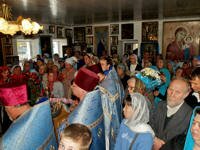
The Russian Orthodox Church in Kyrgyzstan is not very large. After all, the country is quite small – most of the Kyrgyz are nominally Muslim and just over 10% of the population of just over five million are Russians. Most of the adherents are Slavic, (Russians, Ukrainians, etc.) but very few Kyrgyz – those that do profess Christianity belong to one or other of the evangelical churches, such as Baptists of Jehovah’s Witnesses. The church does, however, play a significant role in the life of the life of the Russian community and the country as a whole.
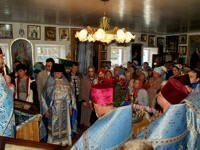
This is most obvious at times like Christmas and Easter when the forty four churches around the country become the center for a wide range of activities – primarily, of course, services.
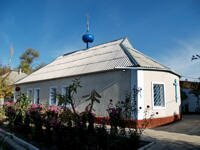
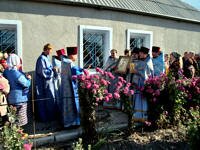
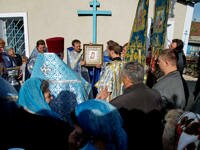
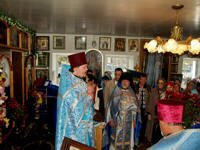
One of those churches, in the village of Vasilievka, about 60 kilometers North of Bishkek, is dedicated to and named after “Our Lady of Kazan” and has a number of icons painted in the same style as the famous original, miracle working, icon.
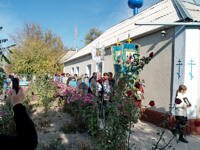
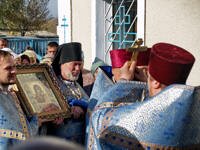
Each November, there is a service of dedication at the Church, and Tatiana together with other members of her family and some friends, make a sort of pilgrimage to the service which is normally well attended and a colourful spectacle.




 Bishkek