Location, location, location
There is an old maxim in Real Estate … the only thing that really counts is “location, location, location”. It is such an overriding principle that in 2001 it was used for the title for a TV programme on Britain’s Channel 4. The mantra basically encapsulates the idea that identical homes can increase or decrease in value due to location. It’s repeated three times for emphasis, and makes it easy to remember the phrase.
Over the years, I have come across several examples of the phrase in action. For example, one of the American websites which offers an explanation of the phrase lists several examples of how location can affect the value of a property and top of the list was being in a top-rated school district. When I taught in the Oxfordshire town of Thame, when properties in some of the local villages came onto the market, they were advertised as being in the school’s catchement area.
Another of the desirable features is a property with a view. When I was visiting New Zealand, one of the people I stayed with in Wellington, explained how her home was more valuable because a “sea view”. A little bemused, I went and stood by the window and looked out. “Where’s the sea?”, I asked. She walked over to the side of the window, stood on tip-toe and pointed down the side of the building – “There,” she said.
Once, a friend of mine changed jobs which entailed him moving from North London to West London – and he bought a house near to London’s Heathrow Airport. Planes would take off and land throughout the day and whenever I visited him and his partner, I was amazed at the noise they had to endure. I asked how they managed to sleep at night and was told that it was, basically, no problem because the airport basically closed from about midnight to six. “And, you get used to it,” they said. I am not sure that I would. Anyway, there was another advantage, in that when they lived in Suburban North London they couldn’t afford to buy a house close to work because the prices were so high, but the price of this house was eminently reasonable. I remember thinking that they would have to pay me to live there.
There are all sorts of other desirable locations: close to parks, outdoor recreational areas and nature; near to places of entertainment, shopping and health care facilities; in easy reach of public transportation; close to centers of employment – close to people’s place of work; in “conforming” areas, where the properties tend to be of the same age and type and in “economically stable” areas, where properties have maintained their relative values over the years. The more of the characteristics that a property has, then the better it will be in terms of commanding and maintaining it’s value.
Less desirable attributes for a property, on the other hand, include: being close to commercial or Industrial zones; near railway lines, busy motorways or under flight paths, (as above); in areas perceived to be ridden with crime or other social problems; in economically depressed areas and properties which are close to hazards. The fewer of the characteristics that a property has, then the better it will be in terms of commanding and maintaining it’s value.
This was brought to the fore of my mind when I reviewed a series of video clips on a website … one of which was about choosing a hotel. You might have been forgiven for thinking that the speaker might stress things like price, or the facilities available – but for her, these came in as secondary when compared to location.
A lot of our clients, for example, are concerned about price. Some are clearly on a budget and have to watch every penny. No-one likes to be overcharged, so the level of facilities and services are important to justify a price – after all, there is another maxim which says that “you get what you pay for.” In some case, of course, these are vital. A journalist on chasing a story and facing deadlines needs good quality communications, a disabled person needs to be assured of access to the property, some people want and expect the luxury of a five star hotel, and so on. The “experts” advice,. however, was to consider the location first of all.
I think that there is some logic in this. My list trip to London, back in 2005, was so that I could attend the WTM, (World Travel Market) exhibition which was being held at the Excel Center in East London. As I don’t get home very often, I took the opportunity to stay with some friends in Southgate, North London, where I had lived for some seventeen years. Although it was good to see them, and my old haunts, once again, it meant a journey of between one and half and two hours, each way – morning and evening, making for a very long and tiring day. In some ways it would have been much easier to take a room in one of the Conference Hotels near the exhibition Center. However, the choice involved a balance between work, work, work and work combined with renewing acquaintances – ands the latter won, despite the drawbacks.
When I went to Greece for a holiday, on the other hand, we chose an island which had its own airport. The fact that this meant the island was more populated by visitors, (tourists), and likely to be more built-up, outweighed the need for a long transfer to and from the airport – with the need to take long ferry rides. That’s one of the reasons I have some sympathy with the argument that says we need to upgrade the airport facilities at Tamchi on the Northern shore.
Talking of Issyk Kul, I was talking to a local person who took her family up to the lake during the summer. There, most of the resorts are spread along the Northern shore of the lake – in their own self-contained compounds. Most resorts have everything you need to keep you occupied and entertained – at least for most of the time – after all most are some distance from a town. Most people, however, like to get out of the resort, especially if they are staying for more than just a couple of days. So, some form of transport is desirable. As it happens, this year there weren’t as many visitors from Kazakhstan as there usually are. However, she did meet some, and they commented how they regretted coming to Kyrgyzstan by public transport instead of brining their own vehicle. Although driving long distances can be tiring, there doesn’t seem to be much difference between driving in your own vehicle and traveling as a passenger, they said. Also, public transport may be cheaper, but their reliance on public transport deprived them of the flexibility to come and go, which they said they would have welcomed. I know that when I took the kids to Issyk Kul, we were very grateful to have a driver and vehicle so that we could go off into the mountains.
Location was also important to us when it came to setting up here in Kyrgyzstan.
We felt that the office, for example, needed to be in the city center and we were lucky in that we found a building right in the center of the city, on one of the main thoroughfares, instead of having to locate ourselves on the periphery of the city, or out in the suburbs.
Downtown Bishkek is not like make many modern western cities with clearly defined Business, Commercial, Residential and Industrial zones. These are all spread throughout the city. Modern apartment blocks sit side by side with older buildings, factories and shops. The magnificent marble clad facade of the buildings surrounding the central, Ala Too Square, for example, is exactly that – a facade. The marble cladding was added to the existing Ilbirs clothing factory so that it would “fit in” with the new marble edifices, (the historical Museum, Government House – the White House), which were being constructed. As another example, the Head Office of one of Kyrgyzstan’s main banks is housed in a former shoe factory – and factory floor has been transformed into a banking hall.
The guesthouse in Naryn was our first venture into the hotel business here in Kyrgyzstan. Naryn was chosen because it was the main road to China, over the Torugart pass. The guesthouse is on the outskirts of the city, but only a couple of hundred yards off the main Bishkek-Torugart road. It normally takes two days to travel the 550km because you have to have to arrive there in the morning in order to cross before lunch and have time to travel the 100km to the Chinese border post at the bottom of the valley. Perhaps Naryn is not as close to Torugart as we would have liked, entailing an early morning start is necessary in order to achieve this – but it is a good location for an overnight stop.
When it came to building the Silk Road Lodge, we decided that we wanted to be more central, and found a site which is indeed fairly central – within easy reach of the main government buildings, parks, several of the sights and a wide variety of restaurants. It’s about ten minutes walk from the office, and I use that time profitably, thinking about the issues of the day whenever I go down there. When started construction, even though the site was in downtown Bishkek, it was still relatively undeveloped, but it was an up and coming, developing neighbourhood, with plenty of potential for future growth and prosperity.
So, what about the location of Kyrgyzstan, itself?
As the name of the region, Central Asia, indicates, Kyrgyzstan is located near the center of the Eurasian landmass. When I was in London and talking to people who said that they had no idea of where Kyrgyzstan was, I sometimes reached for an old school atlas and found a map of Asia – and there in the center was Kyrgyzstan.
For the record: this is a little inaccurate as the geographical center of Asia is actually in the Russian Republic of Tuva – some 320km North of Urumqi.
Indeed, there is some confusion over the term “Central Asia” and what it encompasses as there is no clear definition of what areas, regions or countries it should cover. . The Soviet Union defined Central Asia as comprising the constituent republics of Kyrgyzstan, Tajikistan, Turkmenistan and Uzbekistan. After the dissolution of the Soviet Union, a meeting of the Central Asian states decided to include Kazakhstan as well and these five “Stans” now seem to be generally accepted as the core of Central Asia. However, the UNESCO general history of Central Asia, (written just before the collapse of the USSR), defined the region based on climate and defined the region using far larger borders – including Mongolia and parts of Afghanistan, China, Northern India, Iran, Pakistan, and Russia.
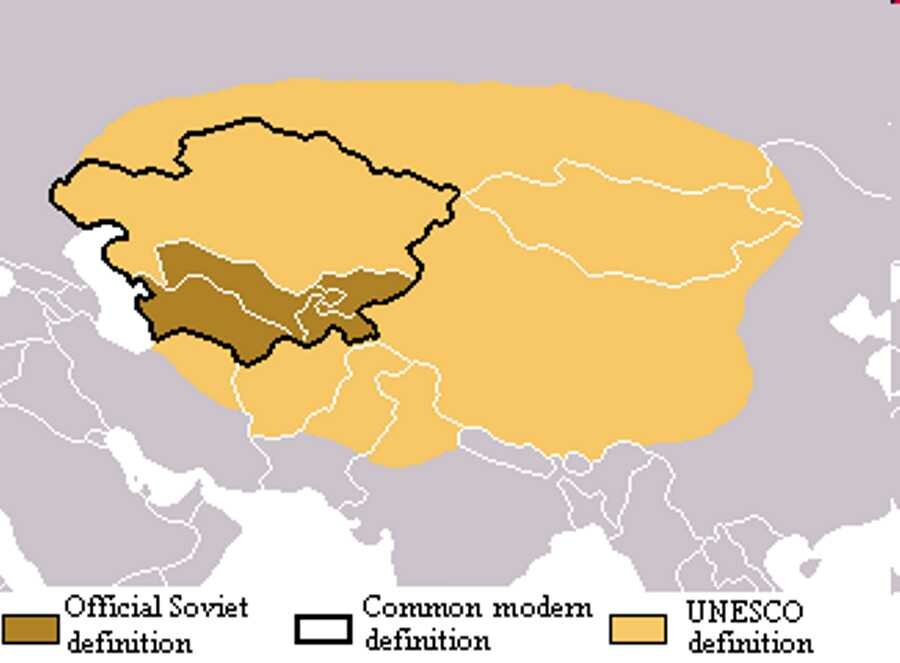
|
| http://en.wikipedia.org/wiki/Central_asia |
To make matters worse, several different names are also used interchangeably, as they refer to the same entity, such as Inner Asia, Middle Asia and Turkestan. (Turkestan was the name most commonly used prior to Stalin’s regime in the USSR – and Enver Pasha tried to revive in the Basmachi revolt of the 1920′s. There are political and religious groupings who still seek to recreate a unified Islamic state of Turkestan.)
Kyrgyzstan sits astride a number of thoroughfares that comprised the network of trade routes which is now known as the Great Silk Road. Over the centuries it has seen the passage of a large number of empires, ending with the Soviet Union. This has all meant that it has been a major crossroads at the center of the continent and become a melting pot of peoples, cultures, traditions, religions and philosophies – all of which have added to it’s eclectic “personality” – which, in turn helps to form its charm and attraction.
Being in the “Heart of Asia”, however, has it’s disadvantages. It is far removed from it markets, whether that be for its produce, (either agricultural or manufacturing – or for tourists) and access to the country can be difficult, crossing difficult terrain as well as long distances. Overland travel can involve journeys of several days – and even weeks. The journey by train from Moscow, for example, takes three days. There are few international flights and this has led to much discussion about the possibility of declaring an “open skies” policy.
To make matters even worse, there are sometimes problems due to differences of opinion with the countries that make up it’s immediate hinterland, (China, Kazakhstan, Uzbekistan and Tajikistan) which can lead to border closures. There are only a few border posts which are open to foreigners – the most commonly used ones: are Kordai – near Bishkek and Chaldovar whith Kazakhstan; Torugart and Irkeshtam with China; Doslik – near Osh with Uzbekistan and Kyzyl Art with Tajikistan. There are three “international” airports: Manas airport in Bishkek, Osh and Tamchi – on the northern shore of Lake Issyk Kul.
Even if access to the country is not as easy as it could be, there is plenty of access to most of the other facilities and services which enhance the value of a property.
The country is full of places which could count as parks, (indeed there are some sixteen national parks and reserves), and the country could be considered a “park” in itself as it is rich in outdoor recreational areas and nature. There are a wide variety of places of entertainment of all kinds. In these days of the “global village” there are a wide shopping facilities, and although there are sometimes difficulties in obtaining “just the item” that you were looking for, the shortages and queues everywhere which were, apparently a feature in the days of the Soviet Union, are no longer evident. Health care facilities may not be as readily available as in Western countries as the mountains make travel difficult and apart from the major cities, settlements tends to be small and remote – however, the medical services are adequate to meet most needs and there are a host of Sanatoria which offer medical treatment and as well as rest and relaxation.
When it comes to the more detrimental features that detract from a property’s value, then, to be honest, we have those as well. Although the country is not over developed, there are industrial and commercial centers, and less attractive settlements. There are signs of economic depression and poverty and incidences of crime and other social problems. There are also a number of hazards to bear in mind, such as the fact that Kyrgyzstan is located in a seismically active zone – in an earthquake zone – and in certain seasons of the year there are avalanches and landslides.
And, of course, in the last decade, we have also had problems with insurgents and two revolutions.
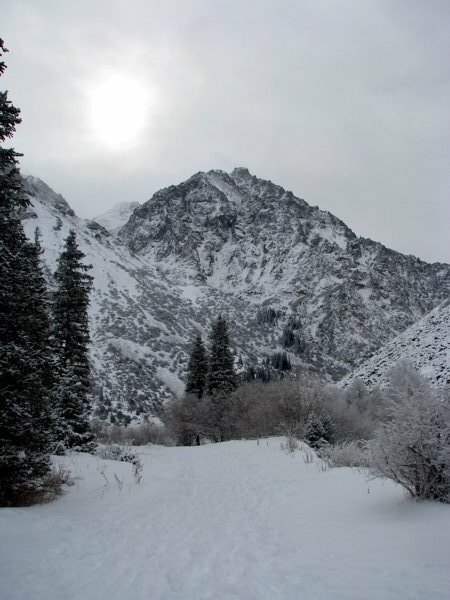
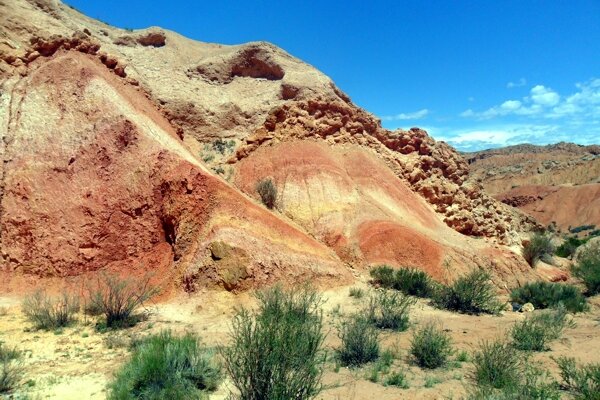
Having said all that, I return to the point that I have made several times – it’s a balance. Very few properties in the world have all of the advantages and none of the disadvantages. Kyrgyzstan is the same. When you come to balance out the “plusses” and the “minuses” then, to my mind at least, the landscape and pristine natural environment, coupled with the historical connection and traditional nomadic lifestyle far outweigh the disadvantages – most of which can be avoided anyway.
Of course, not everyone will agree with me – but, then, everyone is entitled to their own opinion.
To me, the location is pretty good!





 Bishkek