The blushing bride
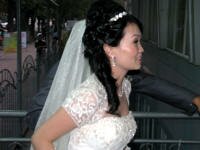
Zamira, who runs the tour department, got married on Saturday.
After the official registration ceremony, the “molodyosh” – “young people” – went on the traditional walkabout to several different spots around the city, parks, war memorial, etc., to promenade and be seen.
In the meantime the parents and other guests rushed to the restaurant where the reception was to be held to make sure all was prepared.
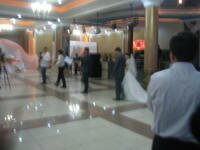
Some of us gathered in the office before setting off for the reception. As the appointed time approached some people wanted to head off – but others pointed out that the event wouldn’t start on time – it never does here – however, it would be rude for the guests to arrive late so we turned up on time … and, sure enough, waited, … and waited and waited.
We walked up and down the pavement outside the restaurant to take in the cool evening air – our own promenade. Eventually, we were ushered into the restaurant to take our places and continued our waiting comfortably sitting down. My seat was right by the window overlooking the street, so was able to see, an hour after the appointed time, when the a beribboned car drew up and from it emerged the happy couple together with the Best Man (Droog) and Maid of Honour (Podrooga).
The late start is customary here, par for the course, it’s expected – so much so that it’s almost de rigueur. Apart from the general trend for things to start late there are other, more practical, ways of explaining why they were delayed, (for example, there is a lot of traveling involved between each of the stops on the itinerary and they are at the mercy of the traffic …, or the parents need the time to make sure all the minute details of the preparations are in place), but, basically, this is the happy couple’s day and they will want to savour every moment of it.
So, the couple finally arrived and are paraded around the restaurant for all to see before being allowed to take their seats on the top table, mounted on a podium at one end of the hall – flanked by the droog and podrooga.
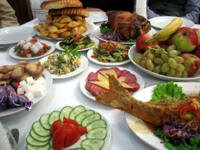
The tables were laden with salads, fruit, pieces of deep fried chicken, a whole fish, confectionery, bread and the Kyrgyz mainstay for ceremonies such as this – boorsok, (deep fried packets of dough – my favourite). There was also a selection of soft drinks, wine and, of course, the inevitable vodka and cognac. And this was just for starters!
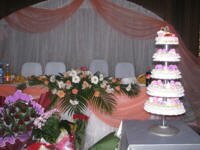
As the evening progresses, the starters are supplemented by soup and Samsa – a central Asian form of Meat Pasty – and later by Manti – steamed dumplings. Then, of course, there is the cake …
We start to serve ourselves whilst the master of ceremonies, (the Tomada), congratulates the couple over the PA system. As usual, it is turned up too loud for my liking and makes any attempt to hold a conversation difficult. This encourages the younger element, (and, of course, there are a lot of them), to boisterous banter and chatter.
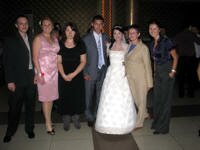
The Tomada announced that there will be several competitions during the evening and appeals for active participation. He needn’t have worried – the guests were exuberant and intent on making it a memorable evening. As he asked for words beginning with Z (for Zamira – the bride) and M (for Marat – the groom) to describe the happy couple, it seemed as if the list would be endless. In English there aren’t that many suitable beginning with Z but in Russian and Kyrgyz there are a lot more and the suggestions came in a veritable flood: zamichatelniy – excellent and zvesda – a star to name just two.
Throughout the evening people are called to the microphone to make a speech, a toast to the happy couple, their reminiscences and wishes for future happiness, after which they go up to the top table and add a few more personal words in private to the ones that they have publicly expressed. During the first, the groom’s grandmother placed a scarf over the bride’s head – a a traditional wedding symbol. Most of the speeches were in Kyrgyz, although some were in Russian. Although I normally try to speak in Russian on the occasions, this time I chose to do so in English – both Zamira and Marat, and quite a few of the guests, know English, and I knew that there was at least one other guest who would have to speak in English.
These speeches were interspersed with songs. Some were performed by well known local singers – but others by “amateurs”. Once again the guests showed their appreciation – in the traditional manner of whoops and cries during the traditional Kyrgyz numbers.
A couple of intervals in the formal proceedings gave guests the opportunity to take to the dance floor and “bop” away and/or sneak outside for a crafty cigarette or off to the toilet. The bride and groom also took to the dance floor.
Unlike most weddings that I have been to here in Kyrgyzstan, that weren’t really any formal toasts. Instead the parents of the happy couple and other well wishers went round from table to table drinking their health in individual toasts.
They weren’t the only doing the rounds … the photographers were also touring the dozen or sa tables, snapping the guests for the wedding album.
Another feature which is common at weddings here, there were no cries of “Gorka, gorka” – “bitter, bitter”, a signal for the bride and groom to embrace. In some of the more raucous weddings, the embrace is timed … “one, two, three, … forty five, forty six …” – the longer the embrace being symbolic of the happy times ahead which will be spent together.
All in all, a pleasant evening – to end off an important day in the lives of two young people – a day to remember.







 Bishkek