Treading water
I am not particularly good at sports, although I am willing to try my hand at most. Apart from needing a certain level of skill, most, if not all, sports also require a certain amount of dedication and a level of fitness. It won’t come as a surprise, therefore, if I say that I am not a particularly good swimmer.
It’s not for the lack of trying … I have tried to learn at least twice.
When I was young, my mother took my brother and I to the local swimming pool and tried to teach us to swim. There were organized classes on Wednesday evenings, but for some reason, she decided to teach us herself. I remember entering the water with an inflatable rubber ring around my waist and going through the motions as she walked along the side of the pool calling out encouragement and instructions. It was only many years later that I discovered that she couldn’t swim herself, but she thought it was important that we learn.
For the record, I found out about her subterfuge when she reached retirement age and started taking lessons. She seemed to enjoy her weekly outings to the pool but I don’t know how proficient she became.
I never really took to the water. I would go occasionally, but my brother was a different story. He was always the more sporting of the two of us. Anyway, each year he would buy a season ticket and every day during the summer months he could be seen either in the water, or lying on a towel soaking up the sun’s rays by the side of the pool.
One of the reasons that I took a different attitude was that early on, I was in the pool, about four feet away from the hand rail that ran along the side of the pool, and, for some reason, got into a little difficulty. I hadn’t mastered the art of treading water – or if I had, then, in a state of panic I had forgotten how to do it and started floundering, arms waiving in the air and spluttering cries as my head dipped under the surface of the water. A friend who happened to be passing by, put his hands under my armpits and lifted me towards the rail. I don’t think I am exaggerating if I say that I think he saved my life – and I don’t remember if I ever said “Thank you” – so let me do it now on the off-chance that he might read this one day: “Jonathan, Thank you!”
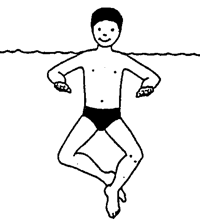
Treading water is the art of maintaining a stationary vertical position in the water keeping your head just above the surface. It’s normally achieved by rotating the arms in a sculling motion and kicking the legs back and forth – but there are, apparently, different ways of doing it.
Maintaining a stationary position, keeping the head just above the surface … not moving forward nor back but most importantly not not down either – not sinking, not drowning. That seems to be what we’ve been doing here in Kyrgyzstan this last week.
Last week’s postcard was written on the eve of the election. It was difficult to ignore the election as it had dominated everything for so long. However, it was difficult because by the time most people would read the postcard, the event itself would have already happened, and even the results would be known.
In Britain, most results are calculated overnight following the election. There is a race to see which constituency can declare their result first and all night long the results flow in. The TV stations run all night programmes with pundits and predictions and a device that Bob MacKenzie called his “swingometer”. In the west “exit polls” are conducted, where people are asked as they leave the polling station who they voted for, and these are used to make an initial prediction – and quite often these are pretty close … but not always.
Here, there were no exit polls and only a few polls carried out during the campaign itself. So, we were kept waiting on tenterhooks for the results as they trickled in. As they came in, there was a little shock. One of the parties, Ata Jurt, did well and went into the lead. This party has a number of people who were active in the previous regime, and it was always thought that they would do well in the South – and they did. As the evening progressed, however, their lead over the other parties narrowed. Even so, they emerged the “winners” in that they achieved the largest popular vote – even though it amounted to only just under 9% of the votes cast.
All in all another four parties, (The Social Democrats, Ar Namys, Republic and Ata Meken), also managed to clear the two thresholds – 5% of the overall national electorate and 0.5% of the actual vote in each of the nine polling districts – to be awarded seats in the parliament. One party, Butun Kyrgyzstan, passed the regional threshold but didn’t get enough votes to pass the 5% one … or did they? The Electoral Commission revised the figure after the election was over to take account of the voters who had somehow been missed off the list. If they hadn’t done that, Butun would have been awarded seats in the parliament. Something seems to have gone wrong – seriously wrong.
Butun’s supporters, of course, are crying foul, but so far things have remained reasonably calm and peaceful. None of the rallies and protests have got out of order. They are not the only ones to challenge the results – some of the other parties which “failed” to gather enough votes are also challenging the results, but few people seem to be taking much notice of their protests. Some of the other “losers”, on the other hand, have hailed the election as “free and fair” and said that they will stand by the declared results as the will of the people.
If they do represent the “will of the people” then there is a problem – because the five parties that will be represented in the parliament gathered only about 66% (*) of the overall vote – which was a on turnout of just over 56%. The rest of the votes being divided between the myriad of smaller parties – who, of course, have no seats. It is difficult to see any party being able claim a clear mandate.
Having said that, most observers, (there were over 800 International observers and there were 22 reported at just one polling station on the day), seem to agree that the elections were not only peaceful, but remarkably free and fair. An “open” election – the first election in Central Asia where the result wasn’t obvious before people went to the polls. Although some violations of electoral law and practice have been identified – and there may well be more that have/will yet come to light – but the process is being hailed as a success, as an historic landmark.
Abraham Lincoln’s election as President of the United States was also an historic landmark – and almost inevitably led to the American Civil War. Several more recent elections have also been claimed to be historic landmarks – I’m thinking in particular of Afghanistan, Iran and Iraq – but the post election period has turned out to be just as troubled as the pre-election one. Let’s hope and trust that Kyrgyzstan can learn from the lessons of history and avoid these pitfalls.
I suppose that history will decide if it really was a success, and that the judgment will depend on what now happens. The five parliamentary parties have to agree a coalition – and the arithmetic is such that it will take three parties to combine in order to achieve a majority in the 120-seat chamber. No easy task. Talks are underway, but it’s not clear what progress is being made in the negotiations. A lot of effort seems to be going into winning over public opinion – with a host of press conferences and interviews – and winning over the Russians. Several party leaders have left during the week for Moscow.
I am not sure who, if anyone, is talking to the Americans. The future of the Manas base is still wide open.
Anyway, it’s still not clear what is going to happen … who will form the government – and although some of the scenarios that I mentioned last week are now ruled out because of the events that have happened, others are still possible. Perhaps that is why Kyrgyzstan is also being described as “ungovernable”, “precarious”, “on the edge” and tense.
Whatever happens, whoever forms the government, they have a massive problem – no, massive problems – ahead of them. Everything is high: Inflation looks like it’s hit over 10% in the first nine months of the year, the country owes huge sums of money, unemployment is high, expectations are high – it’s only the growth in GDP that is down – having fallen into “negative territory”
And to top it all – we’ve had another earthquake. Not too massive, producing no casualties and little damage – but it is like the proverbial “adding insult to injury”.
So, we are in limbo whilst we wait for the various political leaders to come to some agreement – even if it ends up being an agreement to disagree. As I said, it feels like treading water – not moving forward, nor backward – and not sinking, although the possibility is still there.
Meanwhile, life goes on. On a personal note, for example, there have been several meeting during the week. There’s e-mails to answer, accounts to deal with, personnel issues at the hotel, work to do on the websites and preparations for next season. I am still behind with a lot of paperwork and struggling to catch up, I did manage, however, to take one evening out to go bowling, and I spent a couple of other evenings during the week watching films. This weekend there are two birthdays, a wedding and an an anniversary. One of the cats has to go the vets next week for a second round of treatment- a kidney problem.
A swimmer can, of course, lift their legs and swim off … head for shore or out into deeper water as they wish.
I said that I had tried learning to swim twice … and I described how my mother took my brother and I to the pool. Ever since that incident when I think I nearly drowned, I have had a fear of getting out my depth … hence my reluctance to enter the water and go swimming.
A few years ago, however, a young student was trying to learn English and was delighted to make my acquaintance because it meant that he had a native English speaker with whom he could practice. He offered me a deal … I would help him with his English and, in return, he would teach me to swim. To be honest, I wasn’t that keen, but I agreed and three times a week he would arrive at the office at 5 o’clock and we would trot off to the local pool. With incredible patience, Alex coaxed and coached me and in the end I was able to swim a length of the pool with no difficulty, and with a short breather at the end of each length I could turn and swim another, and another. Alex also took up on the diving board and got me to jump off … into the deep end.
I can’t say that I have overcome my fear of the depths … but I do feel more comfortable in the water.
We have to see if Kyrgyzstan can reach such a position after this period of treading water.
(*) It’s been pointed out to me that in the original postcard, which I sent out by email on Saturday, I said “just over 50%” and this is an error. Together the five parties actually got 66% of the votes cast according to the figures published on the official website: http://cec.shailoo.gov.kg/i-election.asp?ElectionID=137&DistrictID=- and if we add the sixth party, Butun Kyrgyzstan, together they got 77% of the votes cast.
As an aside: Margaret Thatcher became Prime Minister of the UK in 1979 on 43.9% of the popular vote – 35.6 of the electorate – she got over 40% in the other two elections that she won - so Ata Jurt at 16% is less than half of that … however any government involving three parties will have at least 38% of the vote.


 Bishkek
Thanks for the link to the article on the elections in Talas. I thought that your treading water image is a good one to encapsulate the current situation. Who would have thought that anyone at all would invite the fox back into the hen house, much less the hens themselves??
Hi Ian,
It does seem that Kyrtyzstan has gone in off the deep end.
Multiparty government is usually one of inaction. I am not at all convinced that ‘democracy’ is the best form of government for a resource-poor developing nation like Kyrgyzstan…or Nepal! They need a benevolent dictator (like Singapore). So…there’s a job for you!
Another nice distracting read, but you fell into the trap that most of the western media fell into. The results here are reported as a % of a list, not a % of the votes cast. So Ata-jurt got 8.8% of the combined list of the original voter list + the 200,000 or so who were added on the day. So if the turnout was around 56%, ata-jurt got a bit less than 20% of the votes cast, and the top 5 parties together got nearly 70% of the votes cast. Just another absurdity of the country. The 5% and the 0.5% are based on the same combined list – which is why Bhutan KR have a strong argument – since the 200,000 includes a lot of people who are also on the original list but names were spelt incorrectly or they are now living in a different place (or indeed do not really exist since they were just added to create votes for parties that controlled the local apparatus, using the ’roundabout’ method)
The election observers ‘free and fair’ is just political. None of the observers can do anything about ’roundabout’ voting when parties and election stations collude in not checking documents for people to be added to a new list or even be marked against the old list where the locals know the ‘person’ on the list is no longer in the area.
On GDP, it has to go negative to the end of the year. No politician wants it positive. They want things to look bad so the donors cough up the money and the lower GDP is this year, the easier it is to demonstrate improvement in coming years.
Fingers crossed for the outfall from the election.