Why should we care?
The days before the election proved to be quite busy for me. Each day I came to the office intending to tidy my desk and catch up on some of the backlog of work that has been steadily building up as I have had my attention distracted onto other matters – but it seems that each day I have left the office with my the piles on my desk untouched or, worse, growing and the backlog barely dented.
During the week I met with a number of visitors – including some of the international observers and journalists who had flown in for the “big event”. A little unusually, as if they they could read my mind, they all seemed to apologize for taking my time … but in actual fact I think that meeting them was almost as important as trying to beat the ever growing list of “things to do” on my bulletin board.
They all wanted some “background”: How did I, as a long time resident in Bishkek, see the current situation?, Who should they see?, What should they look for? … that sort of thing. One or two asked if we help fix up meetings … and one or two said they were interested in seeing a little bit of the country if there was sufficient time after their official duties were completed.
So, although it is easy to think of these meetings as being “interviews” they were, in fact, a two way process and very useful for helping me to keep a perspective on things – and, hopefully, bringing us a little business. Being based here in Bishkek it is all too easy to get immersed in local issues and see things from a local viewpoint and to forget the fact that there is a big wide world out there beyond Kyrgyzstan’s borders where interests and priorities are different.
For example, one of the journalists caught me off guard with a “throw away” remark. He works for a US paper and commented that his editor was looking for reasons “why Americans should care about what happens in the election.”
My immediate reaction was to point out that the result might well effect the conduct of their war efforts in Afghanistan. The “Manas airbase” is an important cog in the machinery that is conducting that military campaign. When President Bakiev threatened to close the base, there were a lot of comments about founding other routes which could be used to supply the forces in Afghanistan, but I got a very definite impression that the American authorities were relieved when a compromise deal was reached – even if cost them a lot more than it had a couple of years previously.
Indeed, many commentators think that it was the continued presence of the airbase that upset the Russians, and precipitated the massive anti-Bakiev, anti-Kyrgyzstan campaign in the Russian media which presaged the revolution in April.
After the revolution, the Interim Government announced that they would not in a position to cancel the lease which had been arranged by the previous regime – they had no mandate to do so – it was a question which would have to be addressed by the new government after the elections. Therefore, when the date for renewal of the lease fell due, they extended it for another year. However, the writing was on the wall – the future existence of the base beyond that could not be taken for granted.
The base has been controversial ever since it was established back in 2001 in the wake of the 9/11 attacks. At that time, President Putin of Russia apparently told his Kyrgyz counterpart, Askar Akaev, to offer George Bush whatever support he could – and that included permitting the establishment of an American military base on the territory of the former Soviet Union. It seems he came to rue that decision and, although there are lots of public statements to the contrary, put pressure on Akaev’s successor to evict the base.
In Kyrgyzstan, itself, despite the efforts of the Americans manning the base to reach out to the local community in a variety of humanitarian projects, in addition to providing employment to a large number of locals, the controversy has raged continuously. Questions over the amount of rent, (seen as too low); accidents and incidents such as discharging fuel onto agricultural land, road accidents and clipping the wings of the Kyrgyz President’s plane on the tarmac; the alleged abduction of an American officer, whose account seems to be disputed by almost everyone except her immediate family; the shooting of a driver (apparently in the back) at the gates by one of the guards who claimed that he was being threatened; the fact that serviceman are subject to the American legal proceedings, not Kyrgyz, for any infringements of the law; and apparent financial shenanigans and alleged irregularities over providing fuel supplies to the base … have all added to local resentment and distrust and campaigns to have the base closed. One imaginative local activist even ran a competition for the best rap song arguing for the closure.
During the election campaign, several of the parties have adopted differing approaches on the continued presence of the base, although few if any concrete positions have been defined … everyone isd waiting for the election results and for people to express their will. Some parties seem to favour closing the base, others for continuing the arrangement but increasing the rent demanded from the Americans. (The Russians have also agreed to rent hikes for their military establishments in the country, so there are precedents for such an approach.)
So, it seems to me, the future of the base is at least one reason for the Americans to watch the outcome of the election with interest.
Of course the fate of the base is just one aspect of the wider issue of international relations between Kyrgyzstan and the US, and as I sat and thought about the question further it seemed to me that the issue actually goes far beyond the single issue of the airbase – although I suspect that this is what it will all boil down to.
America was the first country to recognize the newly independent country following the break up of the Soviet Union and they opened the first foreign embassy in Bishkek – right next door to the KGB headquarters in Bishkek, as it happened.
The good relations between the two countries developed over the years. Economic and political aid flowed into the country and America gained influence in a part of the world where, before, it had little or none. That influence came at a cost – especially in terms of aid.
Accountability for the huge amount of aid that the American government poured into the country over the years since independence is another reason why the American should be interested in what happens here. Whether they were aware of it or approved of it as individuals, the American public have made a tremendous investment in the country and there must be questions about the wisdom of decisions taken in the past. There must be lessons to be learned from the experience – what was done well? and what “mistakes” it is necessary to prevent repeating, either here or elsewhere?
Then there is the question of stability – both globally and in the region. The election is being hailed as “historic” as Kyrgyzstan seeks to adopt a new, a different, a Kyrgyz form of democracy. As Kyrgyzstan moves away from a central, Presidential form of government to a form of Parliamentary democracy, Russia and our neighbours have reacted with anxiety and denounced the move as dangerous and inappropriate.
Kyrgyzstan could prove to be a Pandora’s box. It sits astride the ancient network of trade routes known as the Great Silk Road, and on the borders of influence of Americas two rival superpowers, China and Russia, as well as in close proximity to Afghanistan and other “trouble spots”. There are already difficulties in other parts of the former Soviet Union, for example Ukraine and Georgia, but the proximity of Kyrgyzstan to other trouble spots could spell disaster not just for Kyrgyzstan and her people, but could spill over to affect other countries and other regions. In these days of the “global village” we have to see the sense in John Donne’s words – “No man is an island …” – and even island states such as the United Kingdom have come to realize that they cannot ignore the rest of the world. We cannot ignore the “Butterfly Effect”: that a butterfly flapping it’s wings in one area of the world can cause a tornado in another remote area of the world.
The eyes of the world, not just America, will be on the Kyrgyzstan and will observe how the election is conducted, the results and the aftermath. They will draw inferences and apply the lessons learned in their future with the US – and other powers: national, regional and global.
In short: Kyrgyzstan has a strategic importance which is belied by its size, small population and distance from America, which America would do well not to belittle or ignore. Perhaps they need to listen to their baseball coaches and remember the importance of “keeping your eye on the ball”.





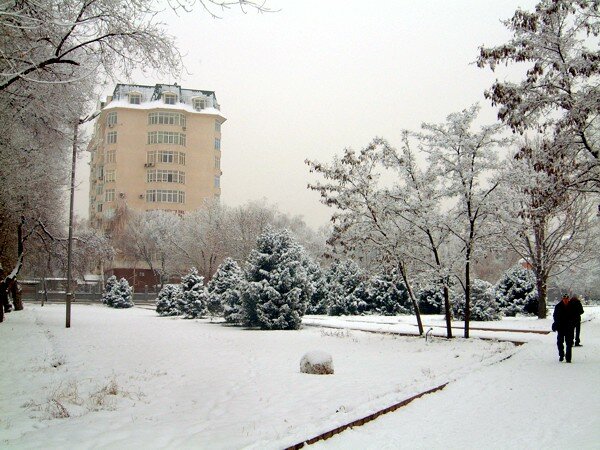
 Bishkek