A focus on Japan
Monday was one of Kyrgyzstan’s “Professional Holidays” – the International Day of Tourism.
This year, however, there weren’t any celebrations. Usually there is a banquet, or some other gathering of those of us working in tourism, to commemorate the day – but the season has been little to celebrate. The day didn’t go unmarked – some firms sent out congratulatory messages – like Telegrams that are read out at weddings from those who cannot, for one reason or another, be present.
As it happens, I spent the day in an appropriate way: thinking about Tourism. I spent most of the day preparing a speech.
Back in April, before the revolution, the Japanese Embassy and the Japanese Center for Human Resources, (KJRC), established a committee for the development of Tourism, with the purpose of developing tourism – particularly by increasing the number of tourists to Kyrgyzstan and by gaining an acquaintance with Japan.
Now, the Japanese have always been good friends of Kyrgyzstan. Their interest in Kyrgyzstan might well have been something to do with the Japanese prisoners of war who were sent her at the end of the second world war – many of them worked on building the military sanatoria at Tamga, and some of them actually returned recently to see the place where they had spent the last days of the war. On the other hand it could be as a result of their interest in The Great Silk Road – one of the first themes that is taught in History lessons in Japanese schools. It could be a more personal factor – most, if not all, of the official Japanese representatives that I have met have had a great affection for the place and one even wrote a book (in Japanese) on the Kyrgyz language. They have run a wide variety of courses for people here in Kyrgyzstan and a previous Japanese ambassador was one of the leading lights in raising awareness about the awful state of Kyrgyz toilets – but, probably the less that is said on that particular theme, the better. Maybe another time. On the other hand, it could be as a result of the fact that the Japanese are one of the world’s greatest traveling nations and this is a part of the world that they rarely visit, partly because it so difficult for them to get here.
The fact that there are so few Japanese visitors to Kyrgyzstan is something that causes some controversy. For many years we, in the industry have been trying to get the Kyrgyz visa regime simplified. We argue that the visa is a hurdle that tourists have to overcome and many find it a “burden to far” and decide to go a country where a visa is not required. It’s not just the cost, there is also the time and effort that is involved. There is also the psychological barrier that “they don’t want us”. So much for the fabled Kyrgyz Hospitality.
Now, back in 1999, the then President, Askar Akaev, decreed that he wanted to see a visa free regime for countries of the WTO – World Trade Organization. Kyrgyzstan had just become a member of the WTO – the first of the former Soviet Republics to do so. He issued his decree in September and gave the Ministry of Foreign Affairs until the end of the year to come up with a plan to fulfill this aim. Those of us working in the tourism sector were delighted. However, it didn’t work out quite as we had hoped.
In the last week of December the Ministry announced its plan. As from January 1st – citizens of Japan would not require a visa. After that, there was a rolling programme to be be implemented over three years. As from January 1st the following year, visas would not be required for citizens from a number of countries – holders of diplomatic passports. As from January 1st the next year, visas would not be required for visitors from another group of countries – holders of diplomatic passports. Finally, as from January 1st the next year , visas would not be required for visitors from another group of countries – holders of diplomatic passports. The Ministry fulfilled it’s obligations – there would be a visa free regime for citizens of the developed world – provided they were holders of diplomatic passports.
Japan was the “lucky nation” in that no Japanese citizen was required to obtain a visa.
In theory, there should have been an increase in the number of tourists from Japan – but, that didn’t happen. They didn’t come.
Now, whenever the vexed question of relaxing the visa regime is raised, the opponents of the reform retort: but a relaxation in the visa regime does not necessarily lead to an increase in the number of tourists … look at the Japanese, they enjoy a visa free regime, but there are precious few Japanese tourists.
We have to acknowledge that this is true. But, there are good reasons for this which may not apply in other cases. One of the reasons may well have been the difficulty in traveling to Kyrgyzstan from Japan. Another may well been that very few Kyrgyz Tour Operators actually worked in the Japanese market – cultivating relationships with Japanese partners and advertising Kyrgyzstan to the Japanese public – although, to be fair, over the years this situation has changed a little and Kyrgyzstan has, for example, been represented in tourism Trade Fairs in Japan. Another problem, however, is that Kyrgyzstan received bad publicity in Japan as a result of the Batken incidents – when four Japanese geologists were kidnapped in the south of the country. Not something that would encourage a mass influx of visitors.
It’s certainly a fact, however, that most of the Japanese that come here really like the place, the landscape, the sense of history, the people, the culture. It is said that their is some affinity between the Japanese and the Kyrgyz – the languages are supposed to have similarities, although I don’t speak either so I cannot comment on this suggestion.
Incidentally. as a separate aside: the fact that the Japanese enjoy a visa free regime regime but have not granted the same privilege to Kyrgyz citizens gives the lie to another argument that is often put forward by opponents to reform – that visa regimes are a reciprocal affair. If other countries agree to grant Kyrgyz citizens a visa free regime, then Kyrgyzstan can, in turn, grant them the same rights. But, although Kyrgyz citizens are still required to obtain a visa to visit Japan, Kyrgyzstan unilaterally granted Japanese citizens a visa free regime.
As it happens, I was invited to take part in the first meeting of the Committee. I won’t comment on the fact that the first meeting of the committee which was established on April 1st, was to take place on September 30th – apart from to say that the delay is probably understandable given the circumstances. I was asked if I would make a presentation and allocated 10 minutes. I was to be the sixth speaker on the provisional timetable – and knowing the others who were going to be speaking – and they are all all accomplished orators, well experienced in the subject – I wondered what I could say.
I was fairly confident that the thorny issues of visas would be raised by one speaker, and the question of marketing by another. Another would concentrate on investment, whilst another would talk about the development of “Rural Tourism”. Apparently, I was invited as the Chairman of the IBC’s Tourism Committee, who just happened to be foreigner, a tour operator and who ran two hotels. It looked as if I was meant to take a wider, business, view.
So, I sat down and thought, what can I say? I was hampered by the time limit, the theme of the meeting which was relatively narrow and the fact that it had to be in Russian. The embassy put extra pressure on me by phoning every other day asking me what my theme would be so that they could firm up the programme.
I know that we were supposed to be concentrating on Japan and Japanese tourists but I decided that we need to take a wider view. Is it simply a case of getting “bum on seats”? (if you’ll pardon the expression), or a wider one about ensuring that those that do arrive receive a quality experience, value for money? This latter approach is, I think, the best way forward – but it will take longer to achieve significant results and will involve a greater outlay in both finance and effort in the early stages. It should, however, create a more impressive result in the long run, revolutions not withstanding.
I the end I decided to take a leaf from the Japanese form of poetry, haiku. There was no way I could summarize what I wanted to say in just seventeen “syllables” in three lines, with a meter of 5-7-5, but I could be as esoteric, figurative, symbolic. I would pick up the idea of customer service – very important amongst Japanese customers – the importance of the tourist’s experience as well as the importance of the process whilst trying to combine the other themes which I felt sure would be adopted by others.
I don’t know if I was successful. Maybe I was simply trying to be too clever – and remember that I was working in English – but had to deliver the speech in Russian, so I had to choose something I felt reasonably confident in delivering in Russian. Of course, there was too much, but that was deliberate – so that I could miss bits out if they were covered by earlier speakers.
Anyway, here’s what I prepared:
Who am I? – and why listen to me?
I think you all know who I am – an Englishman who has been here for 15 years who runs a tour company ad two hotels: The Silk Road Lodge in Bishkek and a Guesthouse in Naryn.
Being a foreigner is sometimes an advantage – and sometimes a disadvantage. I come with a different background and a different outlook – a different perspective, Just as our Japanese partners do. It means that I can sometimes look at the situation a little more dispassionately, (although, after 15 years, the independence that gives me is perhaps tempered by a greater understanding).
It’s the same with our Japanese partners who have organised this meeting, and I need to thank them for giving me the opportunity to make this presentation, and to wish them success in the future with this committee.
My theme?
The theme I was asked to address was the development of tourism. A very wide theme with many different possible topics – none of the speakers will be able to the topic comprehensively – especially in the short timescale that we have. So I am going to pick just one aspect of the topic in the overall theme. Other speakers will probably concentrate on other aspects, other topics, within the overall theme: marketing, visas, training, rescue services, safety and security …. The fact I don’t mention some of these other topics does not mean that I don’t think they are important … just that I have a limited time.
Back in the 1930’s, the then Prince of Wales visited a small coal mining village in South Wales and he was so shocked by the poverty that he saw that he said: “Something must be done”. That’s how I feel about Kyrgyz Tourism. The question is: what is it that needs to be done?
That, it seems to me, is what we are here to consider. But, this is not a new question. Although this is the inaugural meeting of this particular body, it’s not the first time that we’ve attended such meetings to address such a theme. I have no idea how many times over the years I have asked to make a similar presentation; to talk with visiting consultants here on a project; or give an interview to journalists; or to write a paper; or read a report, – I have lost count.
Most of the reports – press reports, project reports, seminar reports, etc. – seem to have stressed the same sort of things: the need for marketing; the value of Tourist Information Centres; the need for Kyrgyz Embassies abroad to be proactive; the need for accurate statistics; the need to define priorities; the need for planning; the importance of concentrating on the tourists and their experiences; … and so on.
The fact that they all seem to repeat the same thing over and over again is worrying … after the problems experienced in this year’s season we need to make a definite decision to do something which will be effective – or else to recognize the fact the fact that it is going to be a case of “business as usual”, (and recognize what that means).
Assuming that we really want to “do something”, then the first thing is to do is to decide is what we want to achieve – where we want to be – and in order to do that, so that can make realistic decisions, then we need to know what the current situation is – where we are the moment and what we can realistically afford to do.
It’s a part of the standard decision making process – in business, in engineering, in whatever … you name it. Before you set out on a journey you should know where it is you want to go, you should know where you are starting from, and then can decide on the route.
Which road: for example the high road – concentrate, say, on alpinism – or the scenic route – say, Silk Road Tourism – or take the fast route – go for the highest volume, “mass” tourism, say recreational tourism on Issyk Kul in which case should we rely on traditional markets of think in terms of developing new markets, such as the Chinese and Indians … or the Japanese.
The Fork
One of our biggest problems is that there is so much choice, there are so many different aspects of tourism, both globally and in Kyrgyzstan in particular: Recreational, (beach tourism); Health tourism; adventure tourism (mountaineering, trekking, horse riding, rafting, …); Silk Road tourism; “cultural tourism”; domestic tourism; winter tourism; conference tourism (business tourism); religious tourism (pilgrimages) … the list goes on.
As a former schoolteacher, I know the importance of visual aids – and I have brought one – This! A fork. Each of these different types of tourism can be thought of as part of a fork – one of the prongs.
Each has their own peculiarities, their own market segment, Which one, or ones, should we concentrate on?
For example, should we as a nation and industry concentrate on recreational tourism based on Issyk Kul which has traditionally brought the vast majority of tourists to Kyrgyzstan, (mainly from Kazakhstan, but also from Russia and Uzbekistan). This form of tourism is obviously important to Kyrgyzstan, but, like one of the prongs of a fork, on its own it is not much use. It is part of something bigger and needs to be seen in context. Our firm, for example, doesn’t sell putevka for resorts on Issyk Kul, but it’s important to us that the resorts are there and thriving. (For one thing, it adds another facility and service that we can offer our other clients.)
This domination of tourism in Kyrgyzstan by one market, however, causes us many problems. Apart from the ecological issues which it raises, the reliance on a single market hits us hard when it fails for one reason or another – as we have discovered this year. Try eating with a fork that has only one prong – for example, relying on a single market – it’s possible, but difficult.
Thank heavens that this year domestic tourism helped to save the season, to some extent at least, and provide some employment opportunities for those working in tourism in Issyk Kul. This isn’t the first year that the season has failed … we know from bitter experience that something as simple a lorry falling off a bridge can have a disastrous effect. The existence of a second prong on our fork helped Kyrgyz Tourism to survive this year.
This concentration on Issyk Kul also means that the benefits of tourism tend to be felt in just one region of the country. What about the rest of the country – if we are looking to bring the benefits of tourism, (employment opportunities and improved standards of living) to the population then we shouldn’t forget the regions, for example: Talas, and Batken.
Concentrating on one form of tourism does not necessarily mean ignoring the others – just that we have to be realistic about what we can achieve.
We should avoid trying to do things because they are the easy option, because they are grandiose, because they look good or sound good. We should avoid overreaching ourselves. How many building projects have been started in Bishkek and then abandoned because the finance ran out? In some respects, image is important – but results are more important.
We need to consider How best to use our limited resources? – how to divide the resources that we have available in order to make the most effective use of them – to obtain the greatest benefit from them? We can’t do everything at once, so we have to prioritise and need to concentrate our efforts on those measures which will bring the greatest benefit – and that doesn’t necessarily mean investing huge sums of money on grandiose projects or getting ever more tourists. It can, for example, refer to the quality of the experience for those tourists that we do have.
For example, should we produce advertising material in just Russian and English – or should we consider other languages – for example Japanese? – and if so should that material be simply the same in each case or specifically adapted to the particular market. I am interested to hear from our Japanese what they think we should stress to attract Japanese clients.
We could organize a competition for the “Muesum of the Year”. Which museum offers the best experience, or improved the experience, for visitors, for example by providing a café or by simply labelling exhibits, (or producing leaflets), in different languages – Russian, Kyrgyz, English, (Japanese?), so that people know and can appreciate what they are looking at. This shouldn’t necessarily cost a lot, but could make a big difference to the value of the experience of visiting the experience.
I am impressed, for example with the Japanese project in the Issyl Kul region: “One village – one product” … one village concentrates on growing apples, another on apricots, a third on producing shyrdaks. Of course they don’t grow only apples, or only apricots, but the concentrate on this as their main product. They are given help and advice to develop and market their own particular specialty product. If someone wants to do something different then there is no reason why not … although they don’t necessarily receive the same help and support, and have to rely on their efforts, nothing is done to stand in their way. It doesn’t involve large investments, spreads the benefits of the results and gives people something with which they can identify.
Issyk Kul is like the fork – each village, concentrating on a single product, one of the prongs. Taken separately, the results will be mixed, but together they provide a coherent whole.
I think that the same approach could be applied to tourism, perhaps not on a Geographical basis but on a thematic basis.
Let’s look at, for example, developing a network, for example based on CBT, or what is sometimes called “Rural Tourism”. It doesn’t have to cost a lot of money, will bring benefits to local community and can be marketed to foreign tourists (both from the near and the far abroad) and to the Kyrgyz tourist alike.
Whatever we eventually decide to do, we need a vision. A comprehensive vision that looks at the subject as a whole, not at just one aspect – that see the fork as a whole, not just one of the prongs. What do we want to achieve? What has Kyrgyzstan to offer? What needs to be done (and can be realistically be done) to attract potential tourists, and provide them with a valuable, enjoyable and memorable experience? What can we learn from our Japanese partners and how can do we need to adapt it to meet the needs of all tourists.
| How many morsels can be lifted on the fork of Kyrgyz Tourism? |
|
Skolko kusochkov mozhno beet snyato vilkoi, Kyrgyzskiy Tourizm |
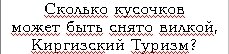
OK – the haiku was written in English – and it should have been in Russian, but it translated quite well.
It was difficult, all the same, to get it to exactly seventeen syllables
and the case of the last line is not quite right … it should be Kyrgyzskovo Tourizma!
Anyway, the meeting went quite well. I had thought it might end up being another “tick the box” exercise … the sort of event that is often put on by different organizations, the main point of which seems to be that someone can put a tick a box in a report to show that they have done something. In fact, although there was an element of that, it turned out quite different. Even the Minister said that the result was far better than could possibly have hoped for before the event.
Most people tended to stick to the time that had been allocated to them, and the main speeches were similar to the “tick box” type to which we have become so familiar … but there were a number of high spots and some concrete proposals.
One of the main speakers delivered what struck me as a “tick box” speech … but when it when it came to the general discussion, he didn’t have a script and he spoke from the heart. He commented on the paucity of signing at tourist attractions – directional signs and informational signs, which is something we have been talking about for some years. Then he dropped his “bombshell”, his agency would start work on this project – tomorrow. If he is true to his word and we actually see some results that will, indeed, represent a very useful result and a valuable contribution to the development of tourism in the country. Of course, it’s only a start, but it will hopefully show people that not everything has to cost a lot of money or take a lot of time but that some issues can be resolved quickly and effectively and provide a good example to be emulated at other places around the country.
Indeed, the Ambassador said that he was hoping to see other results arising from the suggestions put forward in the short term and people were actually named to take responsibility for individual activities.
One of the most valuable aspects of these events is not the formal activity of the planned programme. but the chance to socialize and network. During the coffee break I met several people, including one of the Japanese volunteers – a man who has now retired after forty years working in a Travel Agency in Japan. He has some ideas about what he might be able to achieve, but I was struck most by his story about why he chose to come to Kyrgyzstan. He had been to Bishkek once before – it must have been something like seven years ago – but was here for less than a day. He was so struck with Bishkek that he always wanted to come back and when this opportunity came up, he leaped at it. I keep saying – Kyrgyzstan does that to people!
The real high spot was the Japanese volunteer who delivered her contribution in Kyrgyz. Another gave hers in Russian, and a third in English, but it was the Kyrgyz speech which brought smiles to the faces … and not just because it was in Kyrgyz, but also as a result of the content. What she had say was practical, to the point and very effectively put. Molodetz! – Well done.




 Bishkek