When is a holiday not a holiday?

When is a door not a door?
There’s an old joke routine that goes:
When is a door not a door?
I don’t know, when is a door not a door?
When it’s ajar …
… which, when the ‘answer’ produces nothing more than a look of bemused confusion, is usually followed by something like:
Get it??? … when is a door not a door? … when it’s ajar … a jar … Boom boom!
If you don’t get it … then, I am sorry … here’s a link to a serious attempt to try and explain it … but don’t worry about it, a joke shouldn’t have to be explained … and if it needs to be explained, then it’s failed as a joke.
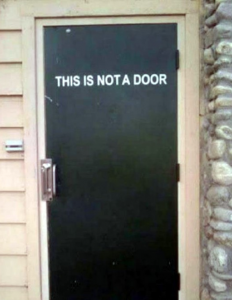
… but it certainly looks like a door!
I actually think there’s a better answer … several better answers, in fact … that does (do) not rely on puns and language skills, for example: When it says it’s not!
Well … maybe not.
But that’s the Mathematician and Philosopher in me. Both disciplines are very heavily linguistically based on linguistics and “it all depends on what you mean by ‘door’ – define your terms!”
A door serves two purposes: as as a barrier when it is ‘closed’ and as a gateway past a bigger barrier, (wall – or whatever), whenever it is ‘open’. If it can’t fulfill those two functions, then it’s no longer a door.
So, what am I getting at when I pose the conundrum: “When is a holiday not a holiday?” … well, the first rule is: Define your terms!
A Holiday in this context, (as opposed to vacation), is a day set aside as a non-working day …
A non-working day is one on which ordinary business is suspended and people have ‘free time’ to pass as they see fit … in recreation or whatever.
… but not all non-working days are Holidays. Sundays, for example, in most countries is a regular non-working day (… and also Saturdays if you happen to work in a job that has a five day working week).
The term Holiday is usually reserved for those non-working days, established by law, and set aside to commemorate or celebrate some event of significance from history and for traditional celebratory festivities or recreative activity.
All the Government Offices, Banks, schools and colleges and most other organizations will be closed for the day and the workers given the day off to relax and celebrate, to commemorate the day as they see fit.
Many places serving the public, (shops and restaurants, for example), will open … and there are rules and regulations governing how those called in to work should be compensated for giving up and working on their Holidays; on one of their official non-working days.
Now, today is not a Holiday. It’s a Monday, a weekday … a working day … that is, in most weeks it is.
… unless, for example, it happens to coincide with a holiday date – like when it is Monday 25th December, (Christmas – but here, of course, that should be Monday 7th January) or Monday 1st January, (New Year), or Monday, 31st August, (Independence Day here in Kyrgyzstan) or Monday 8th March, (International Women’s Day) … but today isn’t one of those.
But, tomorrow is a holiday: it’s International Women’s Day … and a public holiday here in Kyrgyzstan. You can look it up and it’s there, on all the lists of official Public Holidays in Kyrgyzstan … 8th March – International Women’s Day.
However, although today, Monday 7th March 2016, is not a holiday … it is a non-working day; an official day off … this year!
The shops and restaurants may well be open, but government offices, banks, schools and colleges … and many other establishments will be closed …
The catch is that most of the holidays are tied to specific dates in the calendar … and, as result, they fall on different days of the week each year. Some years they fall on a working day … so everyone get’s their day off – their holiday. Other years they fall on a non-working day … and so special arrangements are made so that no-one is ‘robbed’ of their day off. The Holiday, the non-working day is ‘moved’to the Monday making a ‘long weekend’.
Back in Britain, we don’t have this problem. Most of our holidays are tied to days of the week – Mondays – and so fall on different dates each year. I suppose Easter is the classic example. The public holiday falls on the Monday following Easter Sunday … and the dates of Easter Sunday each year is fixed according to a complicated formula tied to the Spring Solstice.
So, virtually every holiday in the UK involves a long weekend.
The Christmas and New Year holidays are tied to dates, (25th December and 1st January) … but the question of ‘long weekends’ becomes academic because almost everywhere closes for the whole week between these two dates …
Today, however, provides an interesting counter example. The International Women’s Day holiday falls on 8th March – and, this year, that falls on a Tuesday … normally a working day … so everyone gets their ‘day off’.
No Problem.
Somebody, however, decided that, because the holiday falls on a Tuesday, that means there is one working day (Monday) before it … and, according to Kyrgyz legislation, the day before a holiday is shorter, (by an hour), so not much work is going to get done that day anyway … so why not turn it into a ‘long weekend’ … but a Sunday-Monday-Tuesday rather than the more traditional Saturday-Sunday-Monday.
So, the government issued a proclamation, (a Postanivleniya), declaring that Saturday 5th of March would be a working day instead of Monday 7th March … and that’s how we ended up with a Monday, a working day, becoming a non-working day … a holiday.


 Bishkek