The Pamir Highway
 When the news broke on social media about the Mercer Quality of Life survey and Index … and how Bishkek had fared badly, being ranked in 210th place out of 230 cities – or as it appeared in some reports in “The 29 Worst cities in the world”, (as I wrote about in yesterday’s postcard), one bright spark commented something like: “… about time that we got into one top list”.
As it happens … that was a bit unfair – actually, it was very unfair – as Kyrgyzstan has been appearing in quite a few “Top” lists recently … especially when it comes to travel and tourism.
Issyk Kul regularly does well as a popular tourist destination in surveys of the CIS markets; for the last two year Karakol has featured among the best ski resorts in the countries of the former Soviet Union … and it’s not just in the former countries … Kyrgyzstan has been appearing in the fast emerging destination of choice in Western markets as well, as a result of its spectacular landscapes, historical and heritage of traditional culture and the vast range of opportunities for adventure holidays … and this week it also appeared in a list of the World’s most beautiful roads, published in the Russian language edition of National Geographic magazine.
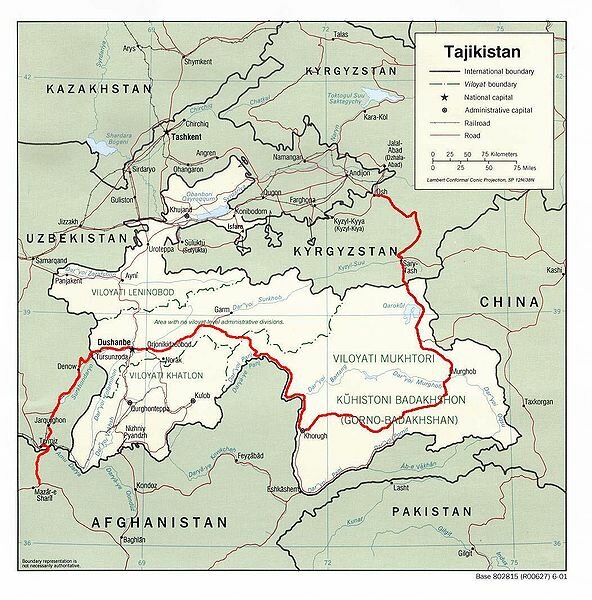
To be fair, the road in question is only partly in Kytgyzstan – it’s mainly in Tajikistan. It’s the 1250 kilometer long Pamir Highway – which wends its way through the Parmir mountain range between Osh and the Tajik capital, Dushanbe, (or even, according to some, as far Mazari Sharif in Afghanistan).
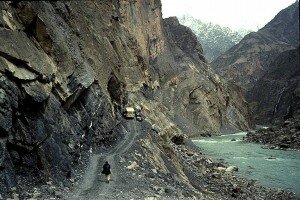
Along the Dushanbe–Khorog section if the highway
Like most of the roads in the list, The Pamir Highway may be beautiful … but it is far from an easy ride, (it has been called: The Road from Hell), is not necessarily for lovers of luxury or for the faint of heart … and, as such, it can be somewhat of a challenge.
Despite the difficulties it presents, lots of travelers accept the challenge in order to reap the rewards. Now, that I have never done the trip myself, but we have arranged tours for several groups over the years … and, (to date, at least), I am not aware of anyone who has undertaken the trip who has been disappointed by it.
It is one of the few routes through the difficult mountain terrain … and, is known as the second-highest altitude international highway in the world (reaching an elevation of 4655 m above the sea level at the “Roof of the World” – the Akbaital Pass).
As such, the route it takes has been in use for a long time … it was actually one of those taken by merchants and goods, travelling along the Great Silk Road from one trading post to another. It was little more than a track, or trail, until this region was incorporated into the Russian Empire, when work was undertaken as part of the Great Game … work that was later continued under the Soviets in the 1930’s to turn it into a supply route for the remote for the remote Gorno Badakhshan region
Even so, only parts of it are paved – or asphalted – most of it is a ‘dirt road’ … over gravel or sand … passing through a range of landscapes, from green foothills, through cliffs lined valleys and narrow gorges, over high passes and through tunnels … with interesting side trips to Zoroastrian fortresses and, remote villages and hot springs.
Although, technically, it is open all year round, it is usually attempted only during the summer and even then can be closed suddenly as a result of earthquakes, landslides and avalanches, flash floods, bad weather … and even roadworks.
Over the years, we have arranged several trips along this spectacular route … in both directions. Here is a description of one such itinerary:
A 14 day tour of Tajikistan (starting in Bishkek – Kyrgyzstan – and finishing in Dushanbe – Tajikistan)
Day 1. Bishkek
Arrive in Bishkek. Meet agent and transfer to hotel. Free time for rest and recovery after the flight. Lunch in downtown. Optional City Tour or free time to explore the environs. Dinner. Overnight in a hotel.
Day 2. Bishkek – Osh – Sary Tash
Breakfast. Then transfer to Airport for a mid morning flight from Bishkek to Osh. On arrival in Osh, meet the crew and drive 190 km to the village of Sary Tash in the Alai valley between 2 ranges of the Pamir mountains. Dinner with local family and overnight in a guest house.
Day 3. Sary Tash – Karakul Lake – Murgab
After an early Breakfast, take a 50km drive to the Kyrgyz-Tajik border at the Kyzyl-Art pass. Continue driving 95km to the shore of Lake Karakul which, at 3915m, is too high to support aquatic life. Karakul is the largest of a range of about 800 ancient lakes in the Pamirs which were created by earthquake, tectonic activity and glaciers. By the lakeside, there are some mysterious stone circles. After lunch, drive to Murgab (60km) over the Ak-Baital Pass (4,655m), the highest section of road in the former USSR. On the way up to the pass, stop briefly at a Great Game-era Russian military post. Murgab is a center of the most highest mountain region in CIS bordering China. Murgab is located in a valley at about 3000m above sea level and surrounded by high peaks. Also from this point it is possible to see Muztag Ata peak – the highest mountain in Pamirs of 7546m, which is actually across the border in China. Accommodation in a homestay and dinner with a family.
Day 4. Murgab – Yashilkul Lake
After Breakfast, continue driving along M41 towards the Yashilkul and Bulunkul lakes. On the way stop briefly at Bash Gumbez to visit the Abdullah Khan caravanserai and Sasyk Kol lake. Lunch on arrival. Here accommodation is on the shore of Bulunkul lake, at the house of local meteorologist. Dinner with the family.
Day 5. Yashilkul lake.
Breakfast is followed by the short drive to Yashilkul lake. From the small pass we travel to hot springs on the shore of the lake to take a bath. Return to the village in time for lunch. After lunch, take a hike to Bulunkul lake., where it is possible to go fishing. Dinner with a family.
Day 6. Yashilkul lake – Lyangar
After Breakfast, a long day’s drive through the picturesque Alichur valley to Lyangar (240km). The view is stark and desolate. We visit a Wratm fort overlooking upper Wakhan and local school At night the clear view of the Milky Way is unparalleled. Lunch on the way. Accommodation and dinner is in a homestay.
Day 7. Lyangar.
Full day in Lyangar. In the cool of the morning, after breakfast, make a steep climb above the village and see the petroglyphs carved into the rock, which depict mountain goats, caravans, horse riders with banners, and the Ismaili symbol of a hand. Return to the village and help to prepare a lunch with local women. In the afternoon, take a walk through the village; a chance to meet the people and enjoy the scenery.
Day 8. Lyangar – Ishkashim
Drive to Ishakshim (111km), a small town at the mouth of the Wakhan corridor, where the 19th century Great Game ended. Visit to ancient fortification Yamchun and the hot springs of Wrang. Lunch on the way. Continue down the north side of the river with amazing views of the Pamirs to the right and the Hindu Kush to the left; a number of peaks in view are over 6,000m. Overnight in a traditional Pamiri home.
Day 9. Ishkashim – Khorog
After Breakfast, drive to Khorog (110 km) – the center of Gorno Badakhshan. Stop to bathe at the hot, mineral filled springs at Garmchashma on the way. Lunch in Khorog. Dinner is accompanied by music, singing and dancing from a local Pamiri group. Dinner and accommodation in homestay.
Day 10. Khorog
Full day in Khorog. Free time to explore the environs. Short sightseeing and visit to the second highest botanical garden in the world.
Day 11. Khorog – Kalaikhumb
After Breakfast, set off on the 260km drive to Kalaikhumb – a small village – along the Afghan border. On the Tajik side, the road is asphalted and buildings have metal and glass in their construction, but on the other, Afghan, side, about 100m away, everything is mud, wood and donkey tracks. Here the people are Pamiris, not Tajiks, a number of separate tribal groups with their own languages. Overnight in basic guest house on the bank of the Pyanj river.
Day 12. Kalaikhumb-Dushanbe
After Breakfast, a full day’s drive (360 km) west from Kalaikhumb towards Dushanbe, the capital of Tajikistan. This region is much more strongly Muslim and this can be seen in the conservative dress and beards. Over a mountain pass to Dushanbe and the scenery and people change again. On arrival accommodation in the Dushanbe hotel and dinner.
Day 13. Dushanbe
After Breakfast, a Sightseeing tour of Dushanbe and a short drive to visit the nearby Hissor Fort, (the former capital of Eastern Bukhara province). The site has two fine 18th/19th century madrassas. After lunch under an ancient tree, head back to Dushanbe for shopping, additional sightseeing … or simply rest. Dinner and accommodation in the hotel.
Day 14. Departure
Breakfast. is followed by a transfer to the airport and the flight home.


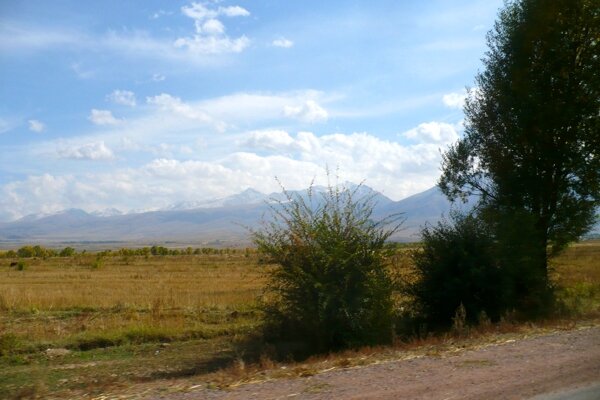



 Bishkek