A trip to Kashgar
A few weeks ago I wrote about an invitation I had received to attend an exhibition across the border in Kashgar, in China.
I was tempted – very tempted. It is over ten years since I was last in Kashgar and I have heard much about how the city has changed. The Chinese are developing much of the city – and demolishing much of the old city in the process. As well as reading reports on the internet and in the media, I sometimes get comments from clients and those who are returning, (some of them, maybe, after many years but others who have been back and forth repeatedly as Group Leaders or tour guides), who tell me that “it’s changing … maybe for the better, maybe not – who can tell?, Let’s wait and see.” I recently read a tweet on Twitter: “I was told that my second historical homeland (Kashgar) survive the boom in domestic investment in favor of world tourism.” Although providing modern amenities might be good for the population and welcomed by some tourists, I am not sure that destroying something like 80% of the old town and transforming the famous Sunday Market isn’t going to be like “killing the goose that laid the golden egg”.
I really enjoyed my previous visits. When I first crossed the Torugart pass from Kyrgyzstan into the Chinese province of Xinjiang, I wasn’t that sure what I would find there. It wasn’t the first time I had been to China, (if you can count Hong Kong and Macau when they still operated as European colonies), as part of China. Nor was it the first time that I had visited a communist country … Enver Hoxa was dead already, when I visited Tirana, in Albania, but it was before their revolution and the huge, hollow, monolithic statue of him still stood in the main square and the Party still held court. On the other hand, Yugoslavia was a series of independent republics when I landed in Montenegro, the Berlin Wall had fallen by the time I made it there and walked Unter den Linden and saw where Churchill Stalin and Truman met for the Potsdam Copnference at the end of the Second World War; the Warsaw Pact had dissolved by the time I got to its birthplace, Prague; The Soviet Union was no more when I walked through Red Square, visited Almaty, Yerevan and, of course, Bishkek.
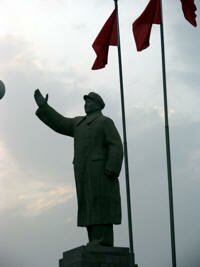
It was, however, so different from everything else I had experienced … so oriental and yet still a part of Central Asia. So modern and yet there were elements that were still like being cast back into the Middle Ages. It was bright and colourful … and yet also drab and dusty, the calm and peacefulness … but also the tension and bustle. I remember seeing my first “wind devil”; my first (and only) desert; the “photographer’s paradise” of faces and costumes representing different nationalities; the workers gathering outside the main department store to practice tai chi; the massive statue of Chairman Mao in the main square … and so on.
However, I decided not to go because it involved being away from the office for something like ten days, and in the present circumstances I thought that was unwise.
Instead, I decided to send one of my colleagues, Svetlana, who arranges and manages the tours. She’s young and vibrant, (which should go down with those attending the exhibition), a linguist who speaks fluent English and Russian (well, that is her mother tongue), knows Kyrgyz and has an understanding of German and French, (not Chinese, however, although an interpreter was promised if one was needed), and someone who knows her job well – Kyrgyzstan and tourism, potential and formalities. I felt that she would do an admirable job representing both the companies and the country as a whole.
Now, to be honest, I am not that keen on exhibitions. They do offer a wonderful way to promote the country and its potential, the company and our services, but they rarely bring much actual business. Their main importance lies not on the stand in the exhibition hall but in the networking and activities that surround the event. I thought that attending the exhibition would not only give us a chance to display ourselves but also give her the chance to contact people in Kashgar and explore some of the places which our clients visit in order to see what the current situation is there.
So, Svetlana gathered herself together … prepared a presentation, packed a laptop and two cameras, several books and notebooks, promotional materials and business cards, found some space in her bag for a change of clothes and made her way to Naryn where she was to meet the rest of the delegation and take the bus to Kashgar.
The first problem that she encountered was the road – which is currently under reconstruction, so there are roadworks everywhere, which meant it took much longer than usual, but once the work is complete, then the road will be much better allowing for a much faster transfer between the highlands of Central Asia and the Mysterious Orient.
She confesses to having mixed feelings about the place. At first, like for every tourist, everything was strange … no-one seemed to speak English or Russian, and the only maps of the city she could find were in Chinese, which wasn’t much help to her even if she is a linguist by training. She found the heat and the dust a little oppressive until she got used to it, but fortunately As time passed, however, she had plenty of things to do and found that she was able to settle in become accustomed to the city.
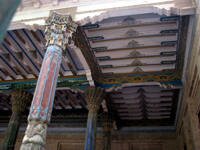
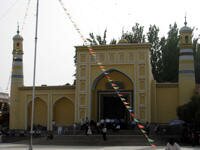
Despite having lots to do, there was still time for Svetlana to take a couple of City Tours … yes, that’s right, a couple … taking in the usual tourist sights: the Abakh Khoja Mausoleum, The Id Kah Mosque and, of course, the Sunday Market.
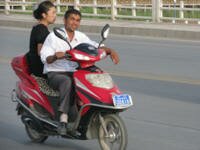
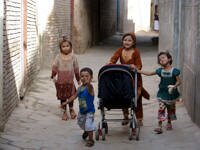
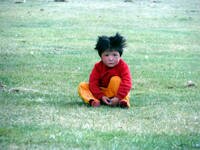
What she liked most of all was simply wandering and watching. The young people on their motor scooters – and she amazed at what they carried on them. The little three wheeled vehicles that seemed to be everywhere. And, of course, the kids who seemed to be everywhere, cheerfully occupying themselves in a myriad of different ways – playing and jumping.
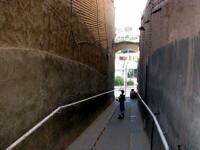
Almost everywhere you turn there is something interesting to see – but she noticed in particular the contrast between the old and the new – old buildings being demolished to be replaced by spanking new ones. And the new buildings rise so quickly. She saw three floors added in five days to one building that was being constructed near to her hotel. A picturesque riverside park wasn’t there five months ago, she was told by another member of the delegation.
Things are definitely changing!
She also managed to visit a couple of the more interesting nearby local beauty spots.
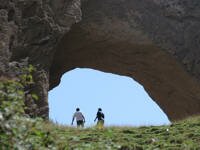
One was the remarkable geological feature known as Shipton’s Arch – or is that Shiptons’ Arch. The place of the apostrophe is an interesting conundrum, almost as interesting as the arch itself.
Known locally as Tushuk Tash, (which means “pierced rock”), is the world’s tallest natural arch and is located not far from Kashgar. The location is fairly remote and the Guinness Book of World Records dropped the reference to it in some editions because they couldn’t locate it and verify the fact. Apparently it lies in a different direction out of Kashgar than was originally reported.
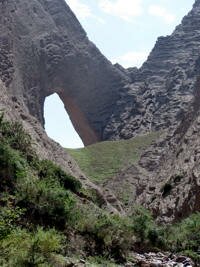
It is called Shipton’s Arch after Eric Shipton, a British diplomat who also doubled as a mountaineer and. In 1940 he was appointed to the post of Consul General in Kashgar, a post he held until 1942, and he also served a second time between 1946 and 1948. It was during a diplomatic mission from Kashgar to Tashkent in 1942 that he noticed an immense natural arch about 10 miles from the road. (This is where the apostrophe conundrum comes in … actually, according to account written by his wife, Diana – they both wrote books which included a description of their experiences in China – it was she, who first noticed it.) He was not able to explore further on that occasion – and it was only in 1947, on his fourth trip through the canyons of the Kara Tagh range searching for the route to the rock formation, that he finally arrived at the rock formation which is now commonly known as “Shipton’s Arch.”
Shipton estimated the height of the arch at “close to 1,000 feet.” – that is, just over 300 meters – and with a span of about 150 feet – that is about 46 meters. In May 2000, National Geographic organized an expedition to the base of the arch – and they discovered it was actually over 450 meters high – with an opening estimated at just over 365 meters (apparently they haven’t yet managed to measure it accurately).
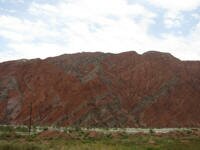
I never made it and when she told me that she was going, there and I was immensely jealous. I told her to take lots of photographs – which she did.
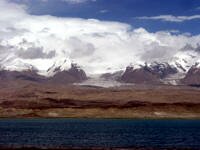
Another day she took a car to Lake Karakul, (on the road to Tashkurgan, (Stone City), and the Karakorum Highway into the Hunza valley of Pakistan – although she didn’t have a chance to go all the way, just to the lake itself. It’s a high mountain lake in a desolate, windswept, treeless basin with snow capped mountains ringing it.
Like me, Svetlana likes the journey as much as the arrival at a place – and she fell in love with the colourful mountains that line the road.
The local community of ethnic Kyrgyz, (the whole region is an autonomous Kyrgyz County. There are many ethnic Kyrgyz living here dating back to a time when the borders weren’t lined by barbed wire fences and people would come and go), has yurts there during the summer and offer food and accommodation and camel rides for those tourists whose itinerary allows them time to linger a little and experience the majestic beauty of the location and traditional nomadic lifestyle and hospitality. She managed to astound them as they touted for her business, when she started to converse with them in Kyrgyz.
Unfortunately, Svetlana didn’t have that flexibility as she had to be back in Kashgar to catch the bus home to Naryn.
A long trip, a tiring trip, but a fascinating trip.


 Bishkek