It’s raining in Moscow
In Britain, August is known as the “Silly Season” – the period during the summer months typified by the emergence of frivolous news stories in the media due to the “lack of hard news” as people are away on their holidays and governments and businesses close down for the holidays. It’s the same here. The place usually gets very quiet over August as everyone disappears up to Lake Issyk Kul or abroad.
This week, however, the news hasn’t been dominated by “frivolous” stories … and it was while I was contemplating the weeks events that I posed the question: “What’s the most important news this week?” I was a little surprised, however, with the answer that I got from Lisa, our Office Manager, who replied: “It’s raining in Moscow.”
It’s true that Moscow has had some rain, (about 4mm on Wednesday – the first rain for almost a month when only 1mm of rain fell – and about twice that today. There are signs that temperatures will fall in the next few days and the probability of precipitation is rising … to about 30%), however, it still seems like a strange choice of headline. Until, that is, you consider what Russia has been experiencing in recent months.
Records have been broken and new ones set: six new record daily temperatures for August by last Sunday – the 8th August; at least 26 days in a row have had temperatures exceeding 86 degrees Fahrenheit, (86F which is the equivalent of 30 Centigrade – 30C), which well exceeds the historical average daily high temperatures for both July., (just 74F or 28C), and August, (68F or 20C – yes, this is lower than the July figure … I was also surprised and double checked it) and the city has met, or exceeded, what had been its all-time record high temperature of 99F, (37.2C), five times.
The extreme temperatures have taken their toll, just as they did in France France in 2003. It’s estimated that about 5000 people may have died as a result of the relentless heat in Moscow alone, and there are reports in the press that doctors have received instructions not to record “heatstroke” as the cause of death on death certificates.
It’s not just the temperatures that have caused problems for the Russian capital. Fires have sprouted throughout the neighbourhood, creating smogs which have covered the city and caused other, less appealing, records for poor air quality and a doubling of the death rate. The wildfires have also damaged the country’s harvest, wiping out about about a quarter to the wheat harvest and leading to fears for what this may mean for world’s wheat supply and the cost of “bread” in the coming months.
It’s been hot in Bishkek as well … in the 13 days of August so far, 12 of them have seen temperatures of 30C or more, and one day in July it actually reached 40C. (That’s hot for me! British weather is not so extreme and, although Britain can experience “hot” summers where the temperature may get as high as 30C, that may elicit newspaper headlines like “Whew, what a scorcher!”) We’ve had some rain but, as in Moscow, not very much. It rained on eleven days in July, producing a total of 8.3mm – but compare that to the historical averages of 3 days and 19mm.
The question of the future price for wheat, however, has attracted some attention and the government have commissioned a review of “food security” – in other words how can we be sure that there will be sufficient to feed the population over the Winter. In view if what is happening to the harvest in Russia and Kazakhstan, I can understand the concern and am pleased to see that the officials are taking the question seriously and addressing the problem rather than “sticking their heads in the sand”.
There is also a review of “electrical security” – in other words how can we be sure that there will be sufficient energy to meet demand. At first glance, this is a little more difficult to understand. Two years ago it was, indeed, a distinct issue … but now?.
Two years ago the volume of water in the Toktogul Reservoir fell perilously close to the minimum required for safety purposes and so we had a winter of rolling power cuts (outages) and restrictions were imposed on businesses which, incidentally, caused quite a few major problems. One of the smaller issues – it was an inconvenience rather than a major problem – was that we were forbidden to use our two saunas in the Silk Road Lodge. (The ban has remained in force ever since … and we have just heard that it is being lifted.)
This year, in contrast, the reservoir is perilously close to it maximum capacity of 19.5 billion tons and water is having to be released. Apparently there is already quite a bit of spare generating capacity for Kyrgyzstan to export hydro electric energy and Kyrgyzstan is, indeed, looking to export more electricity to its them, even reducing the price. Although Uzbekistan has apparently stopped buying electricity from Kyrgyzstan for the time being, the month since the middle of July they have, reportedly, been exporting to Kazakhstan the maximum that the system can carry and raised USD11,000,000 When the new Kamabata II power station comes on line later this year there will be even more capacity … although, to be fair, the system does need considerable maintenance and upgrading. Despite this apparent success story: the distribution companies in the country have been losing money in the first half of the year; tariffs are likely to be increased – remember the result when this last happened … it was one of the issues that led to a revolution!; and there have been calls for the resignation of the management of the state owned power companies – for “inappropriate resources management”. Something seems to be afoot.
There are, however, still some questions about coal and gas supplies. There is also potential problems over oil supplies to the country. Gasprom Neft, the Russian oil giant owns a major stake in the distribution system here in Kyrgyzstan, (they own 70% of the petrol stations in Bishkek and 35% across the country as a whole), has decided to suspend supplies of oil and oil products due to the unstable political situation and because “the Kyrgyz partners exported Russian fuel to third countries through the American base of Manas” , which “does not suit the company management.” Mind you, they appear to be looking to negotiate taking over the supply of the transit center so we have to ask ourselves: “is this a negotiating ploy”?
Of course, however, the news here in Kyrgyzstan is still dominated by the fallout from our revolution and less savoury events.
After last weeks “revelations” that Janysh Bakiev is in Byelorussia, the former Prime Minister under President Bakiev, Igor Chuidinov, has been detained. He was on the “wanted list” for “abuse of power” and questions about the financial affairs of a state fund. Apparently he wasn’t in hiding, he was holidaying in a resort in Issyk Kul. Having given a promise not to try and leave the country, he has been released from the pre-trial detention center and placed under house arrest. Several other former officials are in discussions, negotiations, with the authorities with a view to surrendering to the authorities.
There have been criticisms of the press coverage of the events that have shaken the country throughout the year – especially those in the South. The government is losing the “information war” according to one critic.
An investigation into the June events in the South has begun its work. A batch of statistics have been issued which show that there were over 3600 crimes registered, compare that figure to the 2061 “economic crimes”, (tax evasion, etc.) reported in the first seven months of the year by the Financial Police.
Preparations are under way for the Parliamentary elections. The date has been confirmed – October 10th, which is no surprise as it was announced that it was planned to hold them on this date shortly after the April 7th Revolution. Although there have been calls for it to be delayed I don’t think this was ever likely. Political parties who want to participate and put up candidates have five days from the official announcement to register. Currently there are are over 140 political parties registered in the country, but as of Friday only a few had registered that they would contest the election.
The Organization for Security and Cooperation in Europe, (OSCE), has instituted a code of of conduct for the parties that do participate in the election, and various parties have already agreed and signed up to adhere to it.
The other OSCE initiative, the Police Advisory Group for the Southern regions of the country, is still the subject of much comment and debate. One group opposing the group have announced that they won’t be holding any more protest rallies but will switch tactics. We’ll have to see what that means. One of the members of the government has been more outspoken: “When Kyrgyzstan requested assistance during the events in the south, the OSCE did not react. … We no longer need their help. We ourselves are able to investigate, analyze and give a political assessment.” The parallel of the experience of introducing the police force in Kosovo is still cited by the opponents who carry banners saying things like: “No Kyrgyz Kosovo” or “No Kosovo in Kyrgyzstan”. “First they deployed police force, then … they said that it will not work without the deployment of the armed forces.” The accounts I have read have stopped there … but one of the implications is, of course, ‘ … then Kosovo declared its independence.”
One piece of good news is that the curfew in Osh and Djalal Abad has been lifted, in time for the start of the Holy month of Ramadan, (but some of the residents in Djalal Abad have said that they want it kept).
Ramadan started on Wednesday. Although Kyrgyzstan is a “secular” country where state and religion are strictly divided, the majority of the Kyrgyz are, nominally at least, Muslim. Normally, there is little outward sign that it is Ramadan, nothing ostentatious. Every year a number of pilgrims make the Hajj to Mecca and those who do keep the fast, (sawm in Arabic, Orozo in Kyrgyz), tend to see it as a private matter. I got caught because I was having a business lunch on Wednesday and when, last week, we fixed the time and venue we forgot about Ramadan. As a result it turned out to be a very light lunch.
In recent months there has been a number of cases where churches have been attacked – that is, they’ve been broken into, robbed and vandalized. This week saw a new development when an Orthodox cemetery was vandalized. It’s hard to tell if this is another form of premeditated “provocation” intended to promote further divisions in the country, or simply random acts against “easy targets”. It is something we are going to have to keep on.
There have been other items of news, of course.
One item which might raise a few eyebrows: “Kyrgyz yachtsmen Ignatiev and Soleny won Royal race of 20 miles in Thailand“. Kyrgyz yachtsmen wining a race in a sailing regatta? … but Kyrgyzstan is a landlocked country. Well, that may be true, but we also have Lake Issyk Kul, the second largest mountain lake in the world … and a testing ground for torpedoes in the time of the Soviet Union … with an interestingn history as Kyrgyzstan’s only navigable waterway.
There’s also been more news about developments in Cinema. A number of Kyrgyz filmmakers were invited to the International Film Festival in Lacarno, Switzerland which had a section dedicated top the last twenty years of Central Asian Cinema and awarded three prizes to help finance new films. Unfortunately, the Kyrgyz projects didn’t win any of the prizes, but it is good to know that the Kyrgyz Film industry got some exposure. Then again, perhaps grants and prizes aren’t necessary. Dair Karakeev, an 18 year old student from Kyrgyzstan, (he’s actually studying in Almaty in Kazakhstan), has made a one and a half hour romantic comedy feature film, “Hearts of Three“, which is due to be premiered in September, but trailers for it have already appeared on the internet. What’s more, he managed to make the film using nothing more than an ordinary digital camera … a digital SLR Nikon D90.
As far as tourism is concerned, tourists are still arriving, and there is interest in the country. A couple from New Zealand called in over the weekend and a chance comment in the conversation gave me something to think about – Just what is that is so special about Kyrgyzstan that keeps me, and others, here?.
The Kyrgyzstan pavilion and exhibition at the world fair in Shanghai has reportedly had two million visitors. I’ve mentioned before that China represents a huge potential market which is currently, basically, ignored – well, there’s a regional exhibition in Kashgar next week and there is a Kyrgyz stand, and I have had a couple of meetings on the subject recently … so maybe there will be some move in that direction soon. All the same, I’m not going to hold my breath waiting for it to happen …
But, just as we thought the problem over the Kazakh border looked as if it might have been resolved, there appear to be some new “fun and games” with the Uzbek border. Technically it is supposed to be open, but there are reports that people, including tourists, have been turned back and not allowed to cross.
So, you’ll see that it’s been a fairly eventful week … no “dramatic” events, thank goodness … but, all the same, not exactly typical of the “Silly Season”.


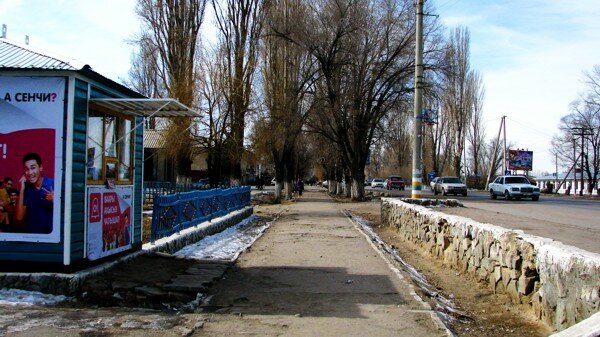




 Bishkek