A homework assignment
The kids have had an extended half term holiday. The school remained closed after the usual week’s break because there were problems with the heating system. It took the school authorities two weeks to resolve the issue – and they tell that, even now, the school is still quite cold.

I was quite impressed that they were addressing the issue in school.
When I first came here, there was a general impression that there was a “stork” like attitude towards AIDS – stick the head in the sand and pretend that it isn’t there – maybe the problem will go away. Here was a sign that the issue was being addressed.
In a way, it reminded me of the situation back in Britain in the 1980’s.
I sometimes say that remember a world without AIDS, but actually, that not true … genetic research seems to suggest that AIDS originated somewhere in Africa in the late 19th or early 20th centuries, and HIV, (the Human Immunodeficiency Virus), which ultimately causes AIDS by attacking white blood cells, seems to have been identified in humans sometime around the 1930’s, although it wasn’t actually “recognized” or “discovered” until the 1980’s. AIDS is not actually a single disease but a variety of diseases and is technically referred to as a “syndrome”, hence the name: AIDS – the Acquired ImmunoDeficiency Syndrome.
It became a worldwide pandemic and by 2009 there were an estimate 60 million people infected and the virus and AIDS was blamed for something like 27 million deaths and 14 million orphaned children – mostly in Africa. I was shocked to learn that, in 2007, something like a third of cases were accounted for by just three countries – 17% were in South Africa, 8% in Nigeria and 7% in India.
There are treatments which help to alleviate the diseases, but as yet no cure or vaccination against the virus.
I also remember the public reaction when the epidemic became newsworthy and started to hit the headlines … indeed, there was a lot of hype and hysteria about AIDS and HIV in the press … before the days of retro viruses and other “treatments”.
I was still teaching in school at the time and we were tasked with raising the issue of AIDS awareness with children the same way that it was, apparently, with Maxim and his class. For example, back in the UK, I took my fair share of School Assemblies and one year my turn to take Assembly fell on December 1st – so I had a ready made theme: World AIDS Day. I told them about three of my friends from my student days. There were lots of statistics about the number of people infected and much, much comment about how the “disease” was “incurable.” After having “introduced” my friends, with a few interesting facts, I dropped in the fact that each of them were infected with the virus. I pointed out that every one of those statistics were more than just a “number”, they were a person with family and friends. It was easy to dismiss them as numbers until you “knew” someone who was affected. Then you could put the story into context, give it a scale and see the real human aspect. Next time they saw the a news story about AIDS which quoted statistics about the number of people infected with HIV they could “borrow” one of my friends … to help them think about what the story actually meant to those living with it.
In fact, there is a fair amount of attention being paid to the issue in Kyrgyzstan. Although there are different statistics, officially there are supposed to be just over 3000 people infected with HIV in the republic, that’s a little under 0.1% of the population – which seems pretty insignificant when compared to the number of infected people globally, or even in some individual countries where it runs into the millions. Of course, it’s not insignificant to those who are infected, the families and friends. It seems that 70% of those infected in Kyrgyzstan are drug users – and mainly in the south of the country – although it has also been identified as a particularly important issue amongst migrant workers.
Several international donor organizations fund projects – spreading anti-AIDS information though seminars and campaigns in the media, as well as assisting in the delivery of treatment and reforming the blood transfusion service. That latter is quite important because there was a scandal in 2008 when something like seventy babies were infected with HIV – several health workers were imprisoned for infecting the children, as a result of negligence. The case caused considerable concern throughout the country about conditions, particularly the state of hygiene, in hospitals, and the quality of medical personnel.
The local Medical Academy, which trains future doctors, usually holds a conference/seminar on the topic to commemorate the day, and this year is no exception.

There are a number of NGO’s, (Non-government organizations), trying to spread information about the disease and working with those who are affected. For example, one charity called “Stay Alive”, was established by people infected with HIV-AIDS and some of their relatives, who have felt the strength of discrimination in society. It has organized a variety of activities and is establishing a Drop-in Centre. There are also a number of activities organized amongst the gay community and in the few gay clubs by local groups – often sponsored by international donors.
They do have AIDS testing here and I had to undergo a test in order to obtain my residence permit. It was quick and efficient, but I wasn’t too impressed with the counseling service. Although it is a requirement, they just looked at me and so “Oh, you need it for a visa … sign here”. I understand, however, that when locals are tested, it is not treated as just a formality.
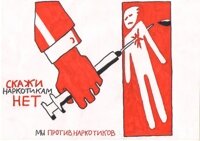
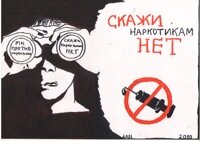
As it happens, on Tuesday Maxim came and told me that he had made a mistake – the poster that he had to draw was supposed to be “protiv Narkotomi” – “Against Drugs”. It struck me as a pity that the opportunity provided by World AIDS Day wasn’t being exploited in order to address the issue in the school, but the issue of drug abuse is also important, and as the majority of those infected in the country are intravenous drug users, maybe this is just the “hook” for raising the subject and “killing two birds with one stone.”
Anyway, for the record, there was another internet search and he eventually found three pictures, (including a fairly dramatic graphic depicting a syringe piecing a body through the heart), which he used as the basis for his particular contributions.








 Bishkek