A Touch of Frost
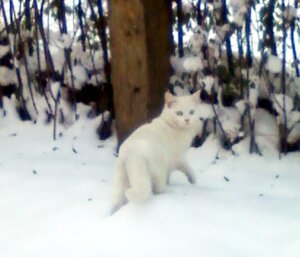
“Lucky”, the kitten, melting into the background
Winter certainly seems to arrived! Actually started early – before the “official” start of Winter – on December 1st.
We had snow and frosts – heavy snowfall (well, for this time of year) and temperatures falling to -15º … and that was here in Bishkek, so it can be imagined what conditions were like in the mountains, where shepherds – especially in distant regions – reported problems with grazing and keeping livestock, for the operation of vehicles, for communications, as well as energy facilities and utilities here in the city.
The press ran a number of reports – one headline read that the “snowfall paralyzed Bishkek“, and it is true that was harder to get around town. Oddly enough, it led to a reduction in the amount of vehicles on the road, (which was welcome), and what traffic there was tended to go much slower as drivers were being more cautious. It seems that many of them were caught unawares and hadn’t yet changed their tyres to winter treads … which meant that the one place where there seemed to be more vehicles was outside the vulcanizatsia - tyre shops – but these weren’t exactly going anywhere … they were in a queue waiting for new tyres to be fitted.
Out of Bishkek there were warnings of possible avalanches and drivers were actually urged not to travel on certain roads … I think that is the first time I have known that to happen.
Then, last week, (the first “proper” week of Winter), we saw snow which cut off a number of villages and closed at least one mountain pass and the Ministry of Emergency Situations – responsible for the Weather Forecasts in the country – issued an Extreme Weather Warning saying that we could expect severe winter conditions between the 7th and the 9th.
That was followed by an SMS message to all mobile phone users that road conditions in the mountain regions could be dangerous and asking everyone to be “careful”.Ministry predicted that, at least in some parts of the country, the temperature could fall as low as -38º to -43º.
To be fair, that was a predicted nighttime temperature in Suusamyr, which is on a high mountain plateau, but during the daytime it didn’t look that much better: -25º to -30º.
Down here in the Chui valley, (where Bishkek is located), the predictions were: daytime, – 12º to -17º and nighttime, -15º to -20º. and, for the record, the temperature on Sunday night fell to almost -20º, and during the day yesterday it was about -12º.
We are expecting it to get warmer over the next few days – that is, nearer to zero.
During that first week of Winter – December 1st to December 7th – Bishkek saw some considerable snowfall here in here in Bishkek … actually, it wasn’t all that deep, (25 cm According to the Ministry of Emergency Situations), but still quite surprising for this time of year … the average depth of snowfall is just 3cm.
Indeed, it was reported that we experienced 70% of the normal precipitation for the whole of the month of December … and, apparently, this year we’ve received over 1000% more snow than last year and over 400% more than the average.

Tractor acting as a snowplow to clear a path. Photo credit: kloop
Here in Bishkek, Tazylyk - the city authority’s agency that is responsible for clearing the roads – went into overdrive and sent out the snowplows … and dug into their reserves of sand and salt for spreading on the road surfaces.
Yesterday I saw a plaintive cry on one of the social media sites: “eight hours without electricity!” … and the first thought to come into my mind was about the possibility of rolling blackouts being implemented. According to the electricity companies, however, there were a number of power outages were “associated with damage to overhead power lines” brought about as a “result of squally winds with gusts up to 18-20 meters per second” – apparently “overhead power lines are designed for wind gusts up to 15 meters per second”. Although the outages started as early as seven o’clock in the morning, and some problems persisted up until almost midnight, the spokesman said that most of the individual outages were “short lived”.
.
As it happens, at least two of the main trunk roads in the country, (the main Bishkek-Osh highway – which is the main North-South arterial road in the country – and the road between Naryn and Kazarman), have been hit by avalanches closing them for at least a part of their route … and work is underway to clear them.
Apparently, already some six people have been killed in avalanches this year… all of them young, ranging from 21 to 39 years of age. Five died in one incident in January and the sixth in September, which is unusual because the “avalanche season” is usually reckoned to last from October to April.
It was a sign of how seriously the situation is being taken that Bishkek’s biggest circulation newspaper published a map indicating the areas in the country most likely to be prone to possible avalanches.

Avalanche Risk zones : Infographic published by Vecherniye Bishkek
(Some of the points are not particularly accurately placed on the map … but it still gives a good indication of “at risk” zones and is probably better than a simple list or table.)

MChS website – Advice on Avalanches
Another sign was that one of the news agency websites chose to republish the advice of the Ministry of Emergency Situations on what is considered necessary for people to know about avalanches.
What I found particularly interesting about this was that they published it in Russian. Nothing surprising there … but … on the Ministry’s website, although this advice appears on the English pages – and the Kyrgyz pages – it is noticeably absent from the Russian pages. They have advice about what to do in the case of Floods, Water Safety, Heavy Rains, Landslides, Mudflows, Earthquakes and Fire … but Avalanches are conspicuously absent.
Please don’t misunderstand me … this is not in anyway a “complaint” … it looks like a simple oversight as the link to the page on Floods is repeated on the scrolling menu at the bottom of the home page in Russian. It’s an easy mistake … and easy to correct.
Anyway …
For the record: Here’s what they say:
AVALANCHE
An avalanche is a snow mass that has slipped from a mountain slope and is moving under the force of gravity. It drags along more and more masses of snow on its way.
During an avalanche-hazardous period, it is necessary to know the following:
- Before traveling, obtain information about the weather, road conditions, the risk of an avalanche through mass media or an MES duty officer.
- When driving in a mountainous area and avalanche-hazardous road areas strictly follow the spacing interval of 500 meters between the cars set by the road services.
- Pay close attention to warning signs, placed in areas of possible avalanching and landfalls and, if necessary, drive through them early in the morning.
- Strictly follow the instructions of road services and warning signs: “Driving restrictions”, “Roads”, warnings of the Ministry of Emergency Situations of the KR and the Road patrol services of the MIA KR in the mass media.
Remember! An avalanche-hazardous period lasts from October to April, while the maximal risk of avalanching falls on the months of February-March.
Rules of conduct in avalanches:
- If an avalanche is falling from a high altitude, drive through quickly and warn incoming cars; if you are walking, walk quickly or run away to a safe place from the avalanche’s path or hide behind a rock ledge, in a small cave (you cannot hind behind young trees).
- If escaping the avalanche is not possible, free yourself of things, take a horizontal position, pull your knees up to your stomach and orient your body in the direction of an avalanche’s movement.
- Cover your nose and mouth with a glove, scarf or a collar, move in an avalanche using swimming motions, try to stay on the surface of the avalanche, moving to the edge, where speed is lower.
- When the avalanche stops, try to create some space around your face and chest, this will help to breathe.
- If it is possible, move upwards (you can determine where the top is by letting the drool spill out of your mouth).
- If you are caught in an avalanche, do not scream, the snow absorbs sounds and screams and pointless movements strip you of strength, oxygen and warmth.
- Do not lose self-control, do not let yourself fall asleep and remember that people are searching for you.
What to do after an avalanche?
- You lose consciousness from the heavy snow avalanche that collapsed on you. After you have gradually regained consciousness, you should try to free one of your hands and place your hand near your nose, so that you can have a small space for breathing.
- Try to move your second hand close to your face in order to be able to shove the snow away from respiratory organs.
- To determine where the top the bottom are, it is necessary to spit. If the drool falls in front of you, this means you are lying upside down (to the surface of the earth). If the drool stays on the lips, it means that you are lying with your head up. Similarly, you can check the condition by spitting to the sides.
- After you determine your position, it is necessary to try to stretch your hand up. If your hand does not come out through the surface, it is necessary to try to dig a passage for the air to come through it.
- If you find yourself in an avalanche in an upside down position, you should try to dig a space around you to be able to flip over.
- It is necessary to take small breaths, not to panic, not to make fast and sudden movements, since when you do it the heart starts to beat faster and the lungs require more air.
- If you managed to dig a through passage, but could not crawl out of it completely, it is necessary to scream to attract attention of rescuers during their search. You will definitely be found.
- If you find yourself outside of an avalanche hit zone, report by any means about location of the dwelling and start looking for and rescuing the injured.
FIRST AID IN CASE OF HYPOTHERMIA
In a heated room, warm up the chilblained body part by rubbing it with a dry soft cloth and then place it in warm water and gradually increase water temperature to 40-450. If the pain is receding and sensitivity is coming back, wipe your hand (foot) dry, put on socks (gloves) and if possible go to the district hospital.
.
Although I have written about certain aspects of the Ministry before, (for example, about Mountain Rescue Services, the Fire Service and Weather forecasting), I think that there is a lot more that could be said about their valuable work. Perhaps that’s a theme for another postcard or two.




 Bishkek