UNESCO’s List of Intangible Cultural Heritage of Humanity

The logo for UNESCO’s Intangible Cultural Heritage project
On Saturday, there was some breaking news that seemed to take everyone by surprise – well, that is, except for those “in the know” … those involved on the story as it unfolded.
I wasn’t one of them … so it took me by surprise … in more ways than one.
Now, every story should answer six questions … Who?. Where?, When?, What?, How? and Why? So let’s look at them, each in turn.
Who: The ninth session of the Intergovernmental Committee for the Safeguarding of the Intangible Cultural Heritage
UNESCO, (The United Nations Educational, Scientific and Cultural Organization), as the name suggests, is a specialized agency of the United Nations.
It was established as the “heir” to the International Committee on Intellectual Cooperation of the League of Nations, with the purpose of “contributing to peace and security by promoting international collaboration through education, science, and culture” among its 195 member states and 9 Associate Members.
In order to pursues its objectives it has established five major programs:
- education,
- natural sciences,
- social/human sciences,
- culture, and
- communication/information.
Each of these which supports a number of projects designed to further the overall aims which include: encouraging universal respect for the rule of law and human rights; the promotion of cultural diversity; establishing international cooperation to protect cultural and natural heritage; contributing to peace building by working for the eradication of poverty; promoting sustainable development; facilitating intercultural dialogue – fostering education, the sciences, culture, communication and information.
One of the projects they administer, through their World Heritage Committee, is the List of World Heritage Sites – established in 1972 but basically consists of tangible monumental elements of past cultures or natural environments … and, incidentally, includes the mount of Suleiman Too in the city of Osh in Southern Kyrgyzstan and the sites of the three Silk Road cities of Suyab, Balasagin and Nevkat in Northern Kyrgyzstan.
In 2001, UNESCO turned its attention to the world’s intangible cultural heritage – covering, for example, language, literature, music and dance, games and sports, culinary traditions, rituals and mythologies, knowledge and practices concerning the universe, know-how linked to handicrafts, and cultural spaces. It established a register for the recognition of Masterpieces of the Oral and Intangible Heritage of Humanity.

The UNESCO Headquarters building in Paris under construction in 1958 – Photo credit: The UNESCO offical website
Where: UNESCO headquarters in Paris
Actually, UNESCO has more than 50 field offices around the world, but its headquarters are located at No. 7, Place de Fontenoy in the 7e arrondissement of Paris – a Modernist complex of buildings. The main one is a Y-shaped building nicknamed the “three pointed star”, which was designed by three architects of different nationalities.
When: Friday, November 26th, 2014
The official announcement was made – at 18:58 local; time, (it was already 23:58 here in Bishkek), during the Ninth Meeting of the Committee which began on November 24th and ended on the 28th.
What: approved the application for inclusion of Kyrgyzstan yurt on the UNESCO Representative List of the Intangible Cultural Heritage of Humanity
In 2001, UNESCO turned its attention to the world’s intangible cultural heritage – covering, for example, language, literature, music and dance, games and sports, culinary traditions, rituals and mythologies, knowledge and practices concerning the universe, know-how linked to handicrafts, and cultural spaces. It established a register for the recognition of Masterpieces of the Oral and Intangible Heritage of Humanity.
The programme currently maintains two lists: the Representative List of the Intangible Cultural Heritage of Humanity, (representing cultural “practices and expressions that help demonstrate the diversity of heritage and raise awareness about its importance”), and the List of Intangible Cultural Heritage in Need of Urgent Safeguarding, (which contains those cultural elements that concerned communities and countries consider require urgent measures for their preservation).
Until Friday, the UNESCO Representative List consisted of 282 items including, for example: the Tango and Flamenco dances; the art of Azerbaijani Mugham, a performance art similar to that of the Kyrgyz Akyn – storyteller – comprising poetry and musical improvisation; the celebration of the Nooruz festival – a combined application from several of the Central Asian states; and the Kyrgyz epic trilogy Manas, Semetei, and Seitek.
The epic trilogy, incidentally, was nominated to the list by China in 2009 and, actually, caused quite a stir here … along the lines of “How dare they steal our heritage?”. On the other hand, it has to be recognized that there is a sizable Kyrgyz community in the People’s Republic of China, and, I suppose, that they deserve credit for recognizing the multi-cultural nature of their society and the recognition given to this aspect of the culture of one of their ethnic minorities.
The List of Intangible Cultural Heritage in Need of Urgent Safeguarding was much shorter with just 34 entries – but that includes Ala Kiyiz and Shyrdaks, the art of traditional Kyrgyz felt carpets.
For the record, there were also 11 programmes, projects and activities inscribed in the Register of Best Safeguarding Practices.
How:The process is quite a long one – taking a minimum of two years.
Member states can nominate any aspect of Intangible Culture for inclusion in the list and submits an application and supporting materials for consideration by the committee. This material is passed to a consultative body which examines it and considers each case on its merits, making observations and recommendations for the committees final consideration at it’s meeting in the November of the second year.
Acceptance and approval of an application is not automatic and the application may be referred back to the nominating member with, for example, a request for further justification.
Kyrgyzstan initiated the application process back in 2012, and in September 2012, it was decided to make a joint Kyrgyz-Kazakh submission of the Traditional knowledge and skills of manufacturing Kyrgyz and Kazakh yurt.
The necessary paperwork was drawn up and submitted. It might have helped that Kyrgyzstan is actually one of the 24 members of the committee, having been elected to serve for the period 2012 to 2016.
It must have been a busy meeting because there were some 58 different nominations on the table, (46 for inclusion in the Representative List of the Intangible Cultural Heritage of Humanity, 8 for inclusion in the List of Intangible Cultural Heritage in Need of Urgent Safeguarding and 4 for inclusion in the Register of Best Practices). Not all of them were approved … only 34 for the Representative list, 3 for the list needing urgent safeguarding and 1 for the list of Best Practices.
Why: The application has to satisfy a list of criteria
- The subject of the application has to satisfy the definition of intangible cultural heritage as defined in the 2003 Convention;
- Inclusion in the List should contribute to ensuring visibility and awareness of the significance of the intangible cultural heritage and to encouraging dialogue, thus reflecting cultural diversity worldwide and testifying to human creativity.
- Safeguarding measures are elaborated that may protect and promote the element.
- It has been nominated following the widest possible participation of the community, group or, if applicable, individuals concerned and with their free, prior and informed consent.
- Is included in an inventory of the intangible cultural heritage present in the territory(ies) of the submitting State(s) Party(ies), as defined in the 2003 Convention.
There are other (similar) criteria which are applied in the case of the Urgent Safeguarding list or the Best Practices Register.
One thing about this application which surprised me was that it specifically refers to the Kyrgyz and Kazakh yurts, as they are found throughout Central Asia, from Mongolia to Anatolia. Indeed, in the West, they may well be known as Gers, the name by which they are known in Mongolia.
There is no doubt however, that the yurt and the skills involved in its manufacture are ages old – dating far back into antiquity, that it is a simple and elegant solution to the “housing problem” faced by nomadic shepherds whether their flocks are pastured in high mountain meadows or on the steppes … and, I think, deserves the recognition that inclusion in the list grants.
Postscript:
Apparently the Kyrgyz and Kazakhs have also submitted another application, which is likely to be considered in 2016 - Aytysh – the art of improvisation.
Kyrgyzstan is also planning to submit applications for the traditional game of Kok Buro, and the Kara Zhorgo traditional dance.


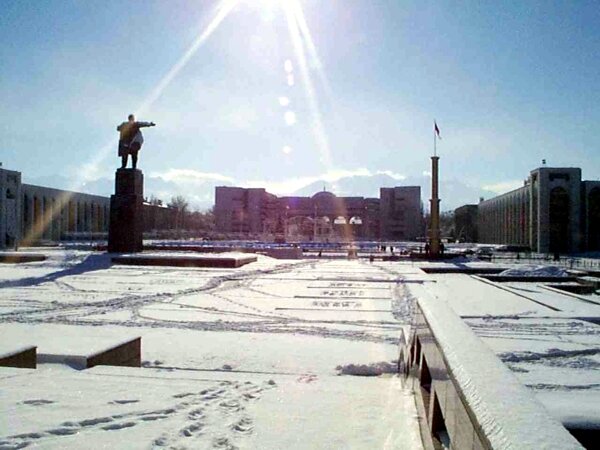


 Bishkek