Festivals Calendar for 2011
For several years now, some of the CBT, (Community Based Tourism), groups around the country have organized during the height of the Summer season, (July and August), small festivals in their own neighbourhoods. They have proved to be popular with tourists and locals alike, but are rarely crowded events so there is a good chance for people to get involved and experience something of the traditional nomadic culture.
Many of the festivals have a specific theme, but they all feature similar events.
Here is a list of the festivals planned by the Kyrgyz Community Based Tourism Association, (KCBTA), for 2011.
Cleaning up at Son-Kul Lake Saturday/Sunday July 23-24
Son-Kul Lake (on the northern shore of the lake, 100 km from the village of Kochkor)
The lake lies on a remote plateau ringed by mountains and is a favourite spot for both locals and visitors alike. During winter months it is basically inaccessible and shepherds bring their flocks to the summer pastures around the end of June. A number of shepherds offer accommodation to visitors in traditional Kyrgyz yurts situated at various locations around the lake.
Unfortunately, not everyone remembers the principle: “Take only photographs and leave only footprints” and so, several years ago it was decided to organize a “clean up” of the area.
For the record: Such “community actions” are fairly common in former Soviet countries and called “Subbotnikiy”, and usually take place on Saturday, (in Russian “Subbotnik” means Saturday).
The first such subbotnik was organized by the local Bolsheviks at a railway depot in Moscow in April, 1919, as part of a response to Lenin’s call to improve the Russian railway. The idea took off and the first all-Russian subbotnik was held on May 1, 1920 when even Lenin took part, (removing building rubble in the Kremlin). This was the subject of a famous painting by Vladimir Krikhatsky, (“Lenin at the First Subbotnik”), which portrays him carrying a log – which was to become a common subject painted by several Soviet artists. Over the course of time subbotniks became “compulsory” with “Lenin’s Subbotnik” being held sometime near to his birthday (22nd April).
Despite this, the practice of Subbotniks is still common throughout the countries of the former Soviet Union. As Spring begins, many large factories, offices, schools, colleges, etc., organize their workers to perform a “spring clean” of the territory around their buildings.
Because of the distance involved and to encourage participation it was decided to the event into a weekend festival with a number of cultural events and as result the weekend ”Clean up” isn’t all hard work, however! In addition to playing a role in helping to preserve the pristine beauty of one of Kyrgyzstan’s beauty spots … visitors can watch, (or join in), the diverse activities:
-
- traditional games (Arkan, Tartmai, Joluk, Tastamai …);
- enjoy a folklore show and song contest;
- see a variety of national crafts (e.g. felt-making).
The “clean up” has now become as a regular annual event.
National Horse Games Festival Sunday July 31
Jolgolot village, in the foothills of Kashka-Suu gorge
There is a Kyrgyz proverb that “A horse is man’s wings.”
To the Kyrgyz, a horse is a prized possession, and horsemanship a much-prized skill.
Perhaps, therefore, it is not surprising that among the most popular national pastimes, or sports are contests on horseback.
Kyrgyz horses possess such qualities as lightness and good coordination (essential in the mountains). They are exceptionally hearty, will eat almost anything, and are not susceptible to sudden changes of weather. They can endure long-distance marches with the rider. For these reasons Kyrgyz ponies were prized possessions even further afield in Russia and Europe in the past.
Most Kyrgyz – especially in the rural regions – can ride a horse and they are proud of their abilities … and their steeds.
To prove the value of their animals they enjoy arranging races – especially at some for of celebration, (festival or toi), so that the riders and show off their skills and the horses their speed or their stamina.
-
-
Horse races: There are several different types of races:
- Long-Distance Races – “At Chabysh” – an ancient and widespread sport. Fast and hearty horses capable of enduring long-distance are chosen for the race. Previously “At-chabysh” races were held on different occasions, usually in connection with some holiday or commemorative festival. The winner (or its owner) was given some jewelry and cattle as a reward. Horses of various breeds and ages took part in the races. The distance raced was 53 versts, later on 100 kilometers. Moreover the riders were quite often boys of 10-13 years of age, sometimes riding without a saddle. According to current rules, however, only horses three years old and older of any breed are admitted to the races. And no-one under 13 is allowed to participate. The distance raced ranges from 4 to 50 kilometers.
- Pacer’s Races – “Dzorgosalysh” – These races are run over shorter distances where speed is and not stamina is the crucial element. Experts consider “dzorgo” to be a great merit of a horse. These horses demonstrate not only speed but also gracefulness. The Kyrgyz people have many proverbs and sayings related to the pacer, such as: “Don’t let your horse run beside a pacer.”
- Girls and Young women’s Races – “Kyz dzharysh” - It is not only Kyrgyz boys and men who ride horses. Kyrgyz women also learn to ride horses in their childhood in the highlands, where there are severe winters and deep snows; where sheep are driven up and down steep mountain slopes, or across turbulent rushing rivers; and where one cannot do without a horse. The riders can be distinguished by their headdresses. Girls tend to wear hats with a wide marten and young women wear pretty kerchiefs. The races can be as competitive as any of the men’s races.
- Wrestling on Horseback for a Goat’s Carcass – “Ulak tartysh” or “kok-boru” (which means “grey wolf” in Kyrgyz). Apparently, the game originally historically developed in antiquity when herds of cattle grazed in the steppes and mountains all year round – exposed to possible attacks by wolves. Having no firearms, the shepherds could not deal with wolves. Brave djigits (horse riders) chased after the wolves until the beasts of prey fell, and then they began beating them with sticks and lashes, trying to snatch them away from each other. It is also said that the game was devised to train skilled horsemen – helping warriors to learn the secrets of horsemanship and combat on horseback.Over the course of time, the place of the wolf was taken by the carcass of of a goat. The skin endures the heat of battle well, and their long hair is easy to grab hold of. Later on when the people led a more settled life the more informal version of “kok-boru” was replaced by an organized sport. It transformed from being a game for the participants into more of a spectator sport. In the original version of the game, the field of play was not fixed and it was possible for the players to gallop away for over a kilometre – out of sight of those watching. Also the “gates”, or goals, were not well defined leading to numerous disputes.There are two teams, consisting of an equal number of riders – in formal competitions it is four. The playing ground is 300 by 150 meters. The opposite sides of this area, marked with flags, present symbolically “the gates” – or “goals”. In the center of the playing ground a carcass of a goat, weighing on an average of 30-40 kilograms, is placed. Typically, a game lasts 15 minutes – although competition games are divided into three parts of 20 minutes each . The objective of the game is to seize the goat’s carcass and deliver it into the gates of the contesting team.
The players are allowed to pick up the carcass from any place within the limits of the field, take it from their rivals, pass or fling it over to the partners, carry it pressed to the horse’s side or suspended between the horse’s legs. The rules forbid rearing the horse, making your horse collide with a rival’s at a high speed, seizing the rivals horse by the bridle, taking the reins off of it, including blows with a whip, or shouting or entering into conversation with one’s opponent.
- Chasing After the Bride – “Kyz – Kuumai” – In older days this game was a part of the wedding ritual. According to the rules the bride was given the best racer and she was entitled to a head start on her horse that began the race. The bridegroom set out in pursuit to catch up with her, in this way proving his love and right to marry her. Being at a disadvantage with the slower horse the bridegroom sometimes failed to catch up with his fiancée. Yet, although she might beat him with her Kamchi (or horse-whip) she did not reject him and the wedding would be held all the same. At present this traditional folk game is usually held during holidays for example in the green meadows of high mountain pastures, (jailoo) or on racecourses.
- Wrestling on horseback – Oodarysh - Two riders each try to pull their opponent off his horse. They are allowed to throw the rival, together with his horse, to the ground.
- Tyiyn enmai is a competition in which young djigits can show off their horsemanship and agility. It used to involve picking up coins from the ground while galloping – but these days the coins have been replaced by flags made from coloured rags. These are placed at measured intervals along a course flags and the riders gallop towards them, beding down over the side of their horse to reach down and grab them as they pass. As the rider grabs one, he throws it high into the air and the audience counts to keep tally. After three passes, the rider with the highest tally is adjudged the winner.
- Jumby Atmai – archery from horseback – Shooting at a target while galloping. In Kyrgyz, “jumby” means an ingot of silver or other jewelry on a thread tied to an inclined pole. The contestant has to break the thread with a shot and bring the jumby down. Originally, the contestant used a bow and arrow that was replaced by firearms over the course of time.
-
Horse races: There are several different types of races:
The festival will feature national horse games such as ulak-tartysh, kyz-kuumai, tyiyn-enmei and er-enish, as well as a folklore show and the opportunity to taste traditional Kyrgyz cuisine.
Taigan and Burkut Festival Saturday August 06
Tamchy village (on the northern shore of Lake Issyk-Kul)
Animals play a particularly important role in the traditional nomadic Kyrgyz lifestyle.
Hunting with golden eagles is an ancient tradition that dates back to the Mongol conquest of Central Asia around the 12th and 13th centuries, when a fine eagle and good horse cost the same price and both lent prestige to their owner. Although the practice is gradually disappearing in this area, hunting with birds (especially with eagles) is still practiced in certain regions of Kyrgyzstan and Kazakhstan. Westerners tend to think of this as falconry – and although hunting with hawks and falcons does take place, it is looked down upon by those who hunt with eagles as a pastime for children and dilettantes.
Sent out to hunt fawns, foxes, or other small animals, the eagle dives down on them and kills them. But often it is also capable of killing young wolves when they cannot negotiate the deep snow. Sometimes the eagles hunt in pairs, just as they would in the wild. A skilled pair, berkutchi (hunter) and bird, can typically catch 50 or 60 foxes a dozen badgers, a couple of lynx and 4 or 5 wolves in a normal 4 month season, which starts in the late autumn. Eagles rarely fail to catch their prey, which it quickly kills, usually by breaking the neck in its powerful claws.
The Taigan – or Kyrgyz Borzoi – is a rare breed of dog. This breed is embedded in the history of the Kyrgyz people, accompanying the nomadic herdsman and hunters.
The taigan moves swiftly, (in Kyrgyz the word means “catch up”) is agile, and typically is energetic and ”free-spirited”. It was well suited to hunting in the steppes and mountains which extend throughout Kyrgyzstan, and the Taigan was always highly valued as a hunting dog and companion. However as the need for hunting for food diminished, so too did the need for the Taigan and the breed went into decline. Some estimates put the breed numbers at barely 300 and, unfortunately, decreasing.
Horses occupy a major role in many traditional cultures. They have a special place in the traditional lifestyle and culture of the Kyrgyz people as a symbol of wealth and for their practical use to a nomadic people. They are valued for their physical strength, their endurance and their stamina. Whilst the number of sheep herds exceeded that of other domesticated animals, it was the number of horses which it owned that determined the status of a household.
It is said that a Kyrgyz learns to ride before they learn to walk – and although children can often be seen riding horses, in rural regions you may also see them riding donkeys..
The festival will feature a demonstration demonstrations of hunting with a Golden Eagle and also featuring Taigan dogs. There will also be a show of Kyrgyz national games including “Ulak-Tartysh” and “Tyiyn-Enmei” by children riding on donkeys. An exhibition and sale of handicrafts and souvenirs. In addition, there will be a Master-Class on the manufacture of silk and wool scarves – something found only in Kyrgyzstan.
Kyrgyz National Cuisine Festival Sunday August 7th … it was earlier scheduled for July 10
To be held in Karool-Dobo village, in the Chong-Kemin valley
Food is a question of taste – as the saying goes: “One man’s meat is another man’s poison”.
Kyrgyzstan stood on the crossroads of the Silk Road, and the caravan routes which crossed the territory carried not only goods for trade, but also brought examples of various cultures: Turkish, Persian, Arabian, Indian, Chinese, Russian, and European and these mingled with the culture and traditions of Central Asia. As a result Kyrgyz cuisine has absorbed elements from all of the cultures with which it came into contact, and although many dishes that you will find are common throughout Central Asia, it is still possible to find examples that have preserved their original, national identity. In many areas, such as Bishkek, Russian cuisine is common, but it is now possible to find examples from all over the world, including the all embracing “European”, Indian, Korean, Turkish and Chinese. Outside the cities local dishes, (such as Kyrgyz, Uzbek and Dungan) are more common.
It is said that the food in Central Asia falls into three different types:
-
- the subsistence diet of the once nomadic peoples such as the Kyrgyz (mainly meat, milk products and bread);
- the diet of settled Turkish peoples (the Uzbeks and Uighurs) including pilaffs, kebabs, noodles and pasta, stews and elaborate pastries and breads; and
- dishes which come from the South (Iran, India, Pakistan and China) with more seasoning and herbs.
In Kyrgyz culture many dishes used to have special, ritual importance, and be connected with particular calendar holidays. Although these dishes are of great interest, unfortunately, many of them are being forgotten, and have fallen into disuse whilst some, which formerly had ritual contents, have lost their initial meaning and are progressively turning into every-day dishes.
Meat is central to Kyrgyz cooking – the nomadic way of life did not allow for the growing of fruit and vegetables – which means that vegetarian visitors may find it difficult to find dishes that, meet their needs.
Although most Kyrgyz are Muslim, there are some traditional dishes which are not strictly halil – such as Olovo or Kuiruk Boor.
One of the most essential features of Kyrgyz cuisine is that dishes should preserve their taste and appearance. For example, there are almost no dishes comprising puree, minced, or chopped meat, (although there are a few exceptions.) Also, Kyrgyz dishes tend to have a plain taste; sauces and spices are used in only small batches, although spices are used more often in the South. Sauces are intended only to bring out the taste of the dish – not to change it.
Men are often considered to be the best cooks – many think that women spoil food cooked for others – although in the yurt the kitchen implements etc. are all stored on the women’s side of the yurt and hunting and implements to do with shepherding and livestock on the men’s side. In many ashkana’s (tea houses or cafes) and restaurants the chefs are men. Women cooks are more commonly encountered in those establishments serving Russian or European cuisines. Russian dishes such as Shchi or Borsh can be found in many places but staple items are Central Asian dishes such as manti, samsa, ploff, shashlik and laghman.
Traditionally the Kyrgyz are a very hospitable people. If a Kyrgyz family invites you for a meal then you should take a small gift – nothing lavish – for example fruit or flowers. Take your shoes off when entering the house. Picnics, especially, are served on a dostorkon, (a large cloth laid out on the ground around which the gathering sits – with your feet either to your side or away from the dostorkon), but don’t be surprised if this happens indoors as well. Handle the food only with your right hand. At the end of the meal bring your two hands up to the face and drag them down as if washing the face and recite the word “omin” – the Muslim equivalent of “amen”.
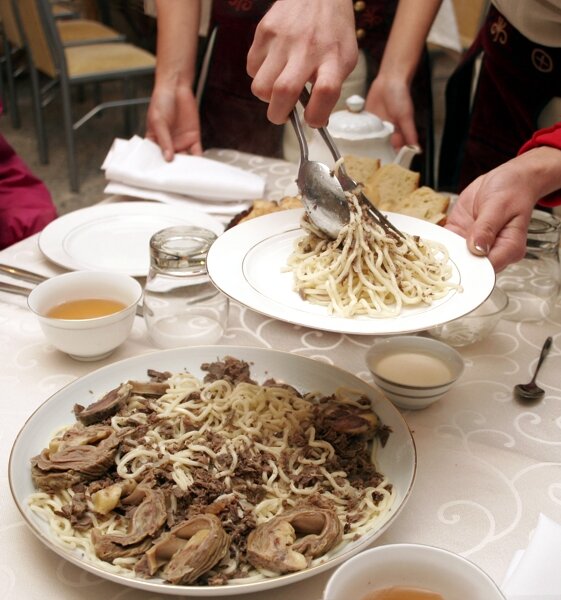
The festival of Kyrgyz National Cuisine features demonstrations of cooking, and tastings of traditional Kyrgyz dishes with explanation of recipes and cooking methods, as well as shows of traditional music and national games.
Kyrgyz Kochu Festival Saturday August 13
On the Southern shore of Lake Son-Kul.
The nomadic Kyrgyz have been livestock breeders for many centuries. At different times of the year, they would travel from one pasture to another taking their flocks and herds with them. In the summer they would leave for the mountain pastures, (jailoo), high in the Tien Shan mountains and in winter descend to the low lying winter ones, (kyshtoo).
Although they didn’t own the land, each family had traditional pastures where they would spend each season.
Departure to the summer pastures after the severities of winter was a joyous occasion. Everyone would be dressed in their best clothes and the horses decked with patterned saddlecloths, and the harnesses decorated with silver and different coloured enamels. The family’s belongings and household items would be packed onto camels and the horses were loaded with carpets and other lighter object. A woman in grand clothes and rich jewelry would ride a horse at the front of the procession.
The first clan that moved to the jailoo would prepare meals for subsequent groups and if the travelers passed another community, (ail), then they would be offered traditional drinks and snacks: kumys, airan and djarma.
Leaving the summer pastures for those on the lower prairies in Autumn, the people would perform a number of rites and rituals to ensure a safe journey – and a safe return the following year. They would pour kumys, airan and melted butter into the holes left by the yurts and thedjele, (a coral for the young foals), and fat would be thrown on the hearth.
This festival demonstrates the traditional annual moving of households from a high-altitude mountain pasture to valleys. It will feature National games, (such as: Kyz-Kuumai, Tyiyn-Enmei and Er-Enish), performances of traditional music, the chance to taste Kyrgyz cuisine and to join in a demonstration of dismantling a yurt.
Birds of Prey Festival Saturday August 20
Bel-Tam yurt camp, (on the southern shore of Lake Issyk-Kul)
Hunting with golden eagles is an ancient tradition that dates back to the Mongol conquest of Central Asia around the 12th and 13th centuries, when a fine eagle and good horse cost the same price and both lent prestige to their owner. Although the practice is gradually disappearing in this area, hunting with birds (especially with eagles) is still practiced in certain regions of Kyrgyzstan and Kazakhstan. Westerners tend to think of this as falconry – and although hunting with hawks and falcons does take place, it is looked down upon by those who hunt with eagles as a pastime for children and dilettantes.
Sent out to hunt fawns, foxes, or other small animals, the eagle dives down on them and kills them. But often it is also capable of killing young wolves when they cannot negotiate the deep snow. Sometimes the eagles hunt in pairs, just as they would in the wild. A skilled pair, berkutchi (hunter) and bird, can typically catch 50 or 60 foxes a dozen badgers, a couple of lynx and 4 or 5 wolves in a normal 4 month season, which starts in the late autumn. Eagles rarely fail to catch their prey, which it quickly kills, usually by breaking the neck in its powerful claws.
The festival will include a demonstrations of hunting with Golden Eagles; a folklore show; an exhibition and sale of handicrafts and souvenirs and the chance to taste traditional Kyrgyz cuisine.
For most of the festivals there is a small admission charge, but this includes a lunch, (and in some cases transport from the nearby villages).





 Bishkek