It’s all in the name: Pyotor Kozlov
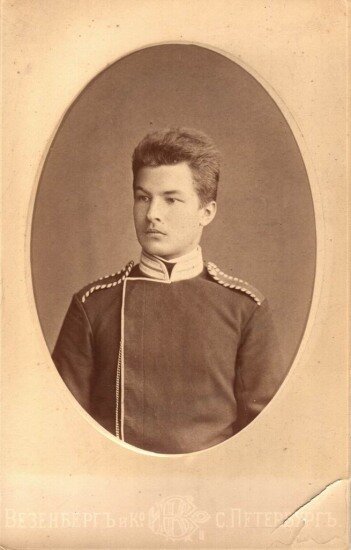
The young Pyotor Kozlov
In hospital I had to have a lot of tests and each time I was asked for my name and year of birth for the records.
Now, most people here have trouble, at first, with Ian, (I usually have to help them out by saying that it’s similar to the name of the Japanese currency – Yen – and then they seem to get the idea). They don’t seem, however, to have much problem with Claytor, (although the last letter is often missed off – Clayto … perhaps that’s because they are familiar with names ending in an ‘o’ … because Ukrainian surnames often do so).
Now, I am used to being called all sorts of names. Even back in the UK I used to get letters addressed to Mr. Claybor, Claypole, Clayter … and so on … but more often than not I was addressed as Clayton. Clayton is, of course, a much more common name than Claytor.
My mother once told me that our surname was sufficiently unusual that if I ever met someone else called Claytor then we were almost certainly related.
At the time I just took her word for it, but I was somewhat taken aback when, a few years later, I came across a reference to some American Claytor’s … who happened to be Black. When I asked her about it, she said that there were some rich landowners in the Southern states called Claytor … and it was customary at that time for their slaves to take their master’s surname. I had absolutely no idea, and still don’t, if this was correct … but it did seem plausible.
There are several suggestions about where the name originated. One is that it was derived from the word “cleat” – which apparently means “stream” and referred to where the person lived … “by the stream”. Once again, I have no idea if that is correct, but it does seem plausible.
In the family, however, there is a story that tells how the original Claytor was the son in a Northampton family called Clayton, who happened to members of the landed gentry. The youth met and fell in love with a Gypsy girl, (sorry Traveler girl), and they eloped to get married. Father was far from amused and disowned and disinherited his son. In reaction the boy decided to change his name by changing the last letter from an ‘n’ to an ‘r’. I have absolutely no idea if there is any truth in this … but it seems plausible and has the advantage of being much more romantic.
In reality, however, I suspect that the true story is much more mundane. In the past the rules of spelling were far from rigidly enforced. Many people wrote phonetically – exactly as they spoke. The early American records, for example, can seem very strange when reading them, but if they are read out load then it is becomes familiar and easier to understand. The change in spelling may not have had anything to do with a prodigal son but simply reflected the accents with which people spoke. Looking at the census returns at the turn of the eighteenth and nineteen centuries, we can find our Grandfather and his family – but the names are spelt differently each time … presumably the result of the census enumerator asking the question on the form and transcribing the answer that he was given.
Anyway, when I make a new acquaintance and learn their surname, I sometimes ask the question, “Really, and relation to …”. On one occasion in answer to the question, “Really, any relation to the film director?”, I got the answer, “Yes, he’s my father.”
There’s quite rare, however, most people answer, “No, we just have the same surname.” In Russian they have a wonderful portmanteau word to describe this situation – “odnofamilaretz” – odno derived from the word for one and familaretz from the word for surname.
One of the first people I met here was an interpreter called Kozlov. At the time I didn’t know the story of his odnofamilaretz, Pyotor Kozlov, but when I did come across the story of the explorer, I couldn’t help wondering if they were related in some way.
Although Pyotor Kozlov is well known for his role in the Russian exploration of Central Asia, that was mainly through Mongolia, Eastern China and Tibet, and he doesn’t actually play a large role in the story of Kyrgyzstan – he’s a sort of bit player in the story of Nikolai Prezhervalsk.
He was born into a poor family, (his father was a cattle drover), in Dukhovshchina, in the Russian province of Smolensk, on 3rd October, 1863. It is said that, as a child, he often accompanied his father on trips to Ukraine as part of his job and that this is where he developed a “wanderlust”.
He attended a local school in Smolensk and was a good student, keen on studying and an avid reader, but had to leave early, (after the sixth class – out of eleven), after his teacher failed to secure a scholarship for him and he went to work in a distillery over 60 kilometers away from the family home. Je found the work monotonous and boring and resolved to enter a teachers’ training college. His reading had already awakened an interest in Asia in the young man, reading of the exploits of Semyenov (Tien Shansky), and of his fellow countryman, Nikolai Prezhervalsk.
As it happened, the great explorer paid a visit to a local estate in 1862 and the two met by accident one summer evening. Apparently he made a good impression on the great man. Despite the age difference between them, they were a like minded couple and Prezhervalsk took an interest in the development of the young man and became his patron, arranging for him to finish his education, and to join the army so that he could gain the necessary skills and experience that he would need if he were to become an explorer: organization and observation, the ability to cope with the harsh physical conditions … and not to mention the possibility of hostilities.
He accompanied Prezhervalsk on a trip between 1883 and 1885, and having graduated from the Military Academy in St. Petersburg, was included in the team to undertake a journey through Eastern Turkestan to Lhasa in Tibet, starting in 1888.
Unfortunately, Prezhervalsk was taken ill shortly after the expedition arrived in Central Asia, dying and being buried overlooking Lake Issyk Kul.
By all accounts, Kozlov was distraught at the loss of friend and patron, but he was included in the team when the expedition eventually departed under Colonel Petsov after a year’s delay – and although the planned itinerary was curtailed, it was still a great success and served as a springboard for the young officer’s career.
A few years later he took command of an expedition when the leader, Ronorovsky, was taken ill. He wrote accounts of his hourneys which included descriptions of the upper reaches of the Huang He, Yangtze and Mekong rivers. He made a considerable name for himself, rivaling Heden and Stein for prominence as the leading explorer in Chinese Xinjiang, and causing concern for George MaCartney, the British Consul in Kashgar, who closely monitored his progress through the region and for the British Foreign Office after his 1905 meeting with the, then, Dalai Lama.
He went on to travel through the Gobi Desert, discovering an ancient city and finding a library of previously unknown ancient texts.
He died on 26th September, 1935.



 Bishkek