QWERTY – an exception to the rule
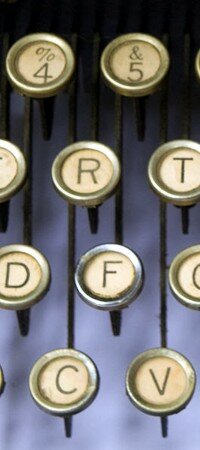
Typewriter keys
SPOILER ALERT: This postcard has (virtually) nothing to do with Kyrgyzstan.
One of my fabourite sayings is that “I don’t believe in absolutes …” which is ironic because that, in itself, is an absolute.
Even though I taught Mathematics, the Queen of the Sciences, which is often considered to be about rigour, logic and absolutes … but although rigour and logic are important, it isn’t about absolutes - the rules of mathematics change according to the circumstances, the context.
In a way that shouldn’t be surprising … it’s what the scientific method is all about … observe and if, and when, we encounter new or strange facts which seem to be contrary to the way we perceive the world, analyze and theorize, postulate a theory – either something new, or an amendment which revises an existing theory, so as to account for those apparent inconsistencies.
This is also how the legal system works … a law defines what is not acceptable behaviour and attempts to deter people from doing it by prescribing penalties (or – perhaps more rarely – what is acceptable and trying to encourage it by prescribing appropriate rewards). Over the course of time, however, these provisions are discovered to be inadequate as people find ways of “working around the rules” and so the laws are amended to take into account the new practices.
It is also similar to the Hegelian philosophical method of Thesis, antithesis and synthesis which guided Karl Marx in developing his socio-economic philosophy of history … that gave the world communism … and, I suppose, Kyrgyzstan more than seventy years of the Soviet Union.
In English we have a proverb about the exception that proves the rule … on the contrary, the exceptions do not prove the rule but they are important in helping to define and refine the rules.
To give some examples from language … English language, because that’s what I know best, but I am sure that the same sort of examples can be transferred across the language barriers and applied to French, German, Russian … and so on – although the Académie Française might want to take issue with me on that.
When I was a schoolboy, I learned a number of rules of grammar – things like:
- i before e … except after c … except for the exceptions
The reference to exceptions always appealed to me … there were others …
- you should never end a sentence with a preposition … (although, the rebel in me preferred the version “a preposition is something you should never end a sentence with“)
- don’t split infinitives … (a verb expressed in it’s simplest form - to something)
- q is always followed by u
People often ask me questions like: “in English, what’s the difference between …”, say, for example, “shall and will”. My answer, usually, goes something like, “Hmmmm, that’s a good question … it all depends …” – for one thing, there is always the difference between “theory” and “practice” … if there is a rule of grammar that says you shouldn’t split an infinitive then the mission of the Starship Enterprise would not have been “to boldly go” … but rather ”to go boldly” – but, somehow, that doesn’t seem so powerful a formulation.
I also had problems with the the last example … I couldn’t and still can’t understand why the u is necessary – if it is always there … it seems superfluous and doesn’t seem to add anything … for example, by changing the way the letter is pronounced – changing it from a kw sound (as in Queen – kween) to a k (as in queue – cue or kew). So, why is it there?, why is it necessary,
In fact, the Oxford English Dictionary lists some 18 words in which the letter q is not followed by a u … most of them are borrowed words and are related in some way to Islam and Muslims … such as the burqa – the long garment worn by Muslim women and qibla - the direction towards Mecca. We might be tempted, therefore, to generalize a theory that all such words are therefore also connected with words borrowed from the Muslim world. However, there are also three Chinese words on the list: qi – the life force in Chinese philosophy, qigong – a system of physical exercises and qin – a musical instrument. There’s also a European word … qintar – an Albanian unit of measure , and the name given to the subdivision of the Lek … as the currency unit is called.
But not all such words are borrowed … there is one that is native to English, albeit to the variety known as American English: qwerty.
Yes, qwerty is a word. It is an adjective used to describe the standard layout on an English language typewriter keyboard … and computer keyboards. It is derived from the fact that the first six keys on the top tow of keys are q, w, e, r, t and y.
This “standard layout” often seems strange and arbitrary. Some mobile phones and tablets using touch screens have chosen to display the letters in alphabetical order rather than trying to reproduce the qwerty layout. Indeed it is said that the very first typewriters also had the keys arranged in two rows, like those on a piano keyboard, with the letters arranged in a, sort of, alphabetical pattern:
3 5 7 9 N O P Q R S T U V W X Y Z
2 4 6 8 . A B C D E F G H I J K L M
Notice, there was no 1 (one) nor a 0 (zero) because the lower case letter l and the upper case letter O could be used instead.
The apparently arbitrary qwerty layout is probably down to one man – Charles Latham Sholes. He is known as the Father of the Typewriter, although as is often the case with new technological developments, there were several people working on similar ideas at the time … Sholes, however, had the good fortune to be the first to have his design registered and a patent issued – on 23rd June, 1868.
So, today could be considered the “birthday” of the typewriter. So, true to local tradition, (Birthdays are very important here … always an excuse for a celebration), let me say Happy Birthday Typewriter! …
However, to be accurate, the qwerty keyboard layout wasn’t really adopted until 1873.
There are several stories as to why he chose this particular layout … the standard story is that it was adopted as a way of slowing down the typist.
That sounds crazy to our modern way of thinking, where efficiency has been elevated as a essential goal. This exception to the general rule, however, did have some logic behind it … the story is that often the skilled and experienced typist could hit the keys at such a speed that the mechanical parts, (the levers that carried the slugs with the letters on them up in order to impress their mark on the paper), would get jammed. In other words, he needed to introduce an element of inefficiency in order to get the most out of his invention.
That may well be the case, but doesn’t necessarily explain the chosen sequence of letters … and the more cynical version of the story is that he arranged it so that the letters of the word typewriter were all on the top row and it was relatively easy for salesmen to impress potential clients by demonstrating how it worked by keying in the name of the device he was trying to sell them.
Incidentally, When I was teaching Computing and IT, one of the first things we had to do was to try and make sure everyone was family with the keyboard … It seems so silly to say that now … but times have changed, back in the 1980s keyboards were not as ubiquitous as they are now … and it was a real issue. So the first lesson involved word exercises based on the layout … such as find as many three letter words as you can where the keys are next to each other – SAW, WAS, RED, WERE, REED … and so on.
The last question was to find the longest word you could from using just the ten keys on the top row … QWERTYUIOP … it is proved to be quite a challenge but sometimes someone would come up with the answer typewriter.
It is often said that this ten letter word is the longest word that can be typed on just the top row of letters … but that’s not quite true … and even if it were, then it wouldn’t be unique … there are some other 10 letter words possible as well, (such as perpetuity, proprietor and repertoire).
In addition, there are also a few longer words running to twelve letters … but they are pretty obscure.
Since then, other attempts have been made to try and introduce different layouts that are somewhat more efficient and easier to use, once they has been learned … but, they haven’t taken off.
The reason is simple … Qwerty remains supreme for the simple reason that … it works.
It’s like Euclid’s Elements - which are fine when considering geometry on a flat plane, (such as a farmer measuring his fields), but can fail dramatically when different forms of geometry – such as on a sphere … like the earth. (such as when calculating the shortest route for an airplane to fly between two cities on different sides of the planet. Which is why aircraft leaving New York headed for Rome don’t fly due East even though the two cities lie, more or less, on the same line of latitude, but heads off in a North Easterly direction, following the seaboard of the US before crossing the Atlantic).
When there is a reason for adopting a new keyboard layout – for example using a 12-key keypad on a phone … then a new layout is adopted … with, on my Samsung mobile, A, B and C being associated with the 2 key, D, E and F with the 3 key … and so on. Sending an SMS is relatively easy once you get used to it … but it wouldn’t do for me when I typing these postcards.`
As it happens, qwerty is not only the standard layout for the basic keyboard in the English speaking world … with other, special purpose keys, added from time to time … it also serves as the basis for other languages using the Latin alphabet.
For languages that use a different alphabet – such as Russian which uses the Cyrillic alphabet, a totally different layout is used. We have special keyboards which show the two letters assigned to each key … one, the Latin letter and the other , the Cyrillic. With practice, it is possible to obtain a reasonable speed in typing the the other layout – although, to be honest, I try not to type in Russian if I can avoid it … I make too many mistakes.
The Kyrgyz alphabet, however, has an additional; three letters … I’m not sure how they will appear if you din’t have Kyrgyz language support installed on your computer so her is a picture showing one particular Kyrgyz keyboard layout:
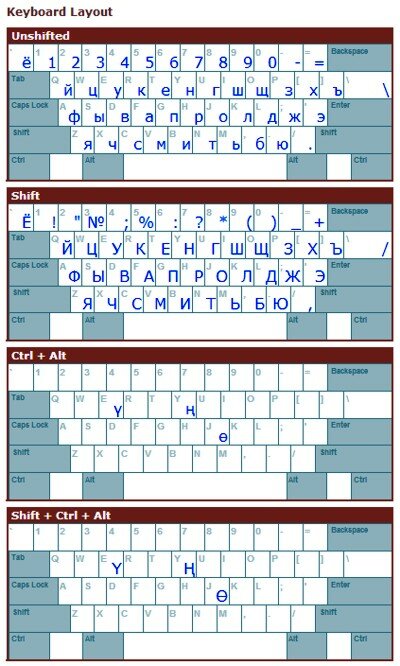
Key combinations to obtain the Kyrgyz alphabet



 Bishkek