Basic English
I am often amazed at how well some people here in Kyrgyzstan speak English. Not everyone, by any means, but there are some people who are extremely proficient. When I first came here, for example, I met a number who were not only fluent but spoke with an appropriate accent and could even use idioms appropriately.
Others are not so fluent. Their expression is often stilted, the word order is wrong … perhaps they add words that aren’t necessary or miss out words that are … they may use the wrong words or overly “flowery” words where more simple ones would suffice … and, as with all Russian speakers, there is always a problem with articles, (a, an and the).
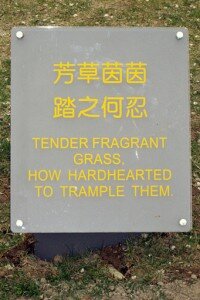
A sign in Chinglish
Talking of “flowery language”, the other day I came across a series of photographs of signs seen in China … which included helpful advice like “Don’t Fall Down“, exhortations like “Please behave well and be a nice tourist“, but my favourite was the Keep off the Grass notice which read: “Tender fragrant grass. How hardhearted to trample them“.
.
The kids, Andy and Maxim, often ask for help with their English homework, and although they have some difficulties in expressing themselves in speaking and writing, they do understand a lot when people speak to them. I can speak to them in English, for example, and they seem to understand almost everything … some of it is, I am sure, down to familiarity and guesswork will play a part, but I am often amazed at how much they can cope with.
This presents a problem in that they are always asking about new words … taken out of context, (for example, from a song or film), and then try to use them in a different context … sometimes leading to some amusing situations.
.
To give an example of the importance of context, the other day I was having a conversation with our computer Engineer who has Magic Fingers, (I’m not sure what the proper phrase would be, but if he had been a gardener we’have said he has “Green Fingers“). He has a vast experience and seems to be able to solve almost any problem our IT throws at him … not every problem to be sure, as some are beyond any form of human resolution … but most.
He was bemoaning the fact that he doesn’t really know English. When he is called in to help a guest at the hotel who has a problem, although he begins with his standard “I am sorry but my English is poor”, they tend to look at him as if to say “Great! … How is this going to help?” … but after a few minutes when they have described the problem and he posed some questions and got some answers, they often say something “But your English is OK”.
As he himself points out, he knows enough to deal with technical issues – the vocabulary and uses of words … in the given context - but when if comes to general conversation he always experiences problems searching for the right words and the grammar for putting them into a sentence. As a result, he said, he feels embarrassed and afraid of making mistakes and appearing to be “stupid”. On the other hand, he feels comfortable with the technology, being familiar with both the vocabulary and the context.
I tried to reassure him and put his mind at ease by saying (in English) that what he really needed was practice … so that he could gain in confidence and avoid the embarrassing pauses as he searched his memory for the right word.
.
It is said that English has more words than any other language and, although it is possible to prove this, it probably reflects the fact that English represents an eclectic mix of Nordic (Germanic) languages, French (a Romance language), and Classical (Greek and Latin) as well as incorporating lots of new words from different languages – especially from the domains of the former British Empire. Many words have more than one meaning, or can be used in different ways – as a noun, and adjective or a verb – and often the only way to determine the intended meaning is by the context. Even though there are thousands of words in English, (the Oxford English Dictionary suggests estimates about three quarters of a million and some linguists say it is more than a million – it all depends on how you count them … ), it is possible to get by with a relatively small number of words.
- Back in 1930, Charles Ogden published a scheme for Basic English which comprised of a core vocabulary of some 850 words commonly used in everyday life, accompanied by some simplified grammar rules, which would allow learners of the language to express themselves – even quite complex ideas. (Some additional supplementary lists brought the total of words up to about 2000.) The system he created was criticized on several grounds, but it still forms the basis of several training schemes, especially in Asia.
- In 1959 the American broadcaster, Voice of America, adopted a version of Special English, comprising about 1500 individual words – which is still in use.
- Simplified Technical English is another, similar scheme developed for use in the aerospace industry, where English is used as an international standard for communication.
It’s claimed that these systems not only make it easier (and quicker) to learn the language, but also bring other advantages – reducing ambiguity by providing a common base for communication thus increasing comprehension, as well as making translation easier and faster.
There are disadvantages, however, as the limited vocabulary lacks the diversity and richness that the complete language offers. It is more difficult to express complex ideas in the limited vocabulary and simple sentences become longer as it takes more to express the same meaning.
As a result, some things can be really confusing … especially where one word in Russian can have several meanings in English – and, yes, I know that it works the other way round as well.
Take predlogat, for example, which can mean to offer - or to suggest. However, it is nearly always translated as “offer” … even when, in context, ”suggest” would be a better word. which can lead to some amusing situations.
.
____________________
For the record: these are Ogden’s 850 Basic words … it’s in alphabetical order which is probably not the most useful way to present them. They are usually categorized as Operations (basically the equivalent of verbs); Things (similar to nouns) and Qualities, (like adjectives, including 100 pairs of opposites).
A
a, able, about, account, acid, across, act, addition, adjustment, advertisement, after, again, against, agreement, air, all, almost, among, amount, amusement, and, angle, angry, animal, answer, ant, any, apparatus, apple, approval, arch, argument, arm, army, art, as, at, attack, attempt, attention, attraction, authority, automatic, awake .
B
baby, back, bad, bag, balance, ball, band, base, basin, basket, bath, be, beautiful, because, bed, bee, before, behavior, belief, bell, bent, berry, between, bird, birth, bit, bite, bitter, black, blade, blood, blow, blue, board, boat, body, boiling, bone, book, boot, bottle, box, boy, brain, brake, branch, brass, bread, breath, brick, bridge, bright, broken, brother, brown, brush, bucket, building, bulb, burn, burst, business, but, butter, button, by .
C
cake, camera, canvas, card, care, carriage, cart, cat, cause, certain, chain, chalk, chance, change, cheap, cheese, chemical, chest, chief, chin, church, circle, clean, clear, clock, cloth, cloud, coal, coat, cold, collar, color, comb, come, comfort, committee, common, company, comparison, complete, competition, complex, condition, connection, conscious, control, cook, copper, copy, cord, cork, cotton, cough, country, cover, cow, crack, credit, crime, cruel, crush, cry, cup, current, curtain, curve, cushion, cut .
D
damage, danger, dark, daughter, day, dead, dear, death, debt, decision, deep, degree, delicate, dependent, design, desire, destruction, detail, development, different, digestion, direction, dirty, discovery, discussion, disease, disgust, distance, distribution, division, do, dog, door, doubt, down, drain, drawer, dress, drink, driving, drop, dry, dust .
E
ear, early, earth, east, edge, education, effect, egg, elastic, electric, end, engine, enough, equal, error, even, event, ever, every, example, exchange, existence, expansion, experience, expert, eye .
F
face, fact, fall, false, family, far, farm, fat, father, fear, feather, feeble, feeling, female, fertile, fiction, field, fight, finger, fire, first, fish, fixed, flag, flame, flat, flight, floor, flower, fly, fold, food, foolish, foot, for, force, fork, form, forward, fowl, frame, free, frequent, friend, from, front, fruit, full, future .
G
garden, general, get, girl, give, glass, glove, go, goat, gold, good, government, grain, grass, great, green, grey/gray, grip, group, growth, guide, gun .
H
hair, hammer, hand, hanging, happy, harbor, hard, harmony, hat, hate, have, he, head, healthy, hearing, heart, heat, help, here, high, history, hole, hollow, hook, hope, horn, horse, hospital, hour, house, how, humor .
I
I, ice, idea, if, ill, important, impulse, in, increase, industry, ink, insect, instrument, insurance, interest, invention, iron, island .
J
jelly, jewel, join, journey, judge, jump .
K
keep, kettle, key, kick, kind, kiss, knee, knife, knot, knowledge .
L
land, language, last, late, laugh, law, lead, leaf, learning, leather, left, leg, let, letter, level, library, lift, light, like, limit, line, linen, lip, liquid, list, little (less,least), living, lock, long, loose, loss, loud, love, low .
M
machine, make, male, man, manager, map, mark, market, married, match, material, mass, may, meal, measure, meat, medical, meeting, memory, metal, middle, military, milk, mind, mine, minute, mist, mixed, money, monkey, month, moon, morning, mother, motion, mountain, mouth, move, much (more, most), muscle, music .
N
nail, name, narrow, nation, natural, near, necessary, neck, need, needle, nerve, net, new, news, night, no, noise, normal, north, nose, not, note, now, number, nut .
O
observation, of, off, offer, office, oil, old, on, only, open, operation, opinion, opposite, or, orange, order, organization, ornament, other, out, oven, over, owner.
P
page, pain, paint, paper, parallel, parcel, part, past, paste, payment, peace, pen, pencil, person, physical, picture, pig, pin, pipe, place, plane, plant, plate, play, please, pleasure, plough/plow, pocket, point, poison, polish, political, poor, porter, position, possible, pot, potato, powder, power, present, price, print, prison, private, probable, process, produce, profit, property, prose, protest, public, pull, pump, punishment, purpose, push, put .
Q
quality, question, quick, quiet, quite .
R
rail, rain, range, rat, rate, ray, reaction, red, reading, ready, reason, receipt, record, regret, regular, relation, religion, representative, request, respect, responsible, rest, reward, rhythm, rice, right, ring, river, road, rod, roll, roof, room, root, rough, round, rub, rule, run .
S
sad, safe, sail, salt, same, sand, say, scale, school, science, scissors, screw, sea, seat, second, secret, secretary, see, seed, selection, self, send, seem, sense, separate, serious, servant, sex, shade, shake, shame, sharp, sheep, shelf, ship, shirt, shock, shoe, short, shut, side, sign, silk, silver, simple, sister, size, skin, skirt, sky, sleep, slip, slope, slow, small, smash, smell, smile, smoke, smooth, snake, sneeze, snow, so, soap, society, sock, soft, solid, some, son, song, sort, sound, south, soup, space, spade, special, sponge, spoon, spring, square, stamp, stage, star, start, statement, station, steam, stem, steel, step, stick, sticky, still, stitch, stocking, stomach, stone, stop, store, story, strange, street, stretch, stiff, straight, strong, structure, substance, sugar, suggestion, summer, support, surprise, such, sudden, sun, sweet, swim, system .
T
table, tail, take, talk, tall, taste, tax, teaching, tendency, test, than, that, the, then, theory, there, thick, thin, thing, this, though, thought, thread, throat, through, thumb, thunder, ticket, tight, till, time, tin, tired, to, toe, together, tomorrow, tongue, tooth, top, touch, town, trade, train, transport, tray, tree, trick, trouble, trousers, true, turn, twist .
U
umbrella, under, unit, up, use .
V
value, verse, very, vessel, view, violent, voice .
W
waiting, walk, wall, war, warm, wash, waste, watch, water, wave, wax, way, weather, week, weight, well, west, wet, wheel, when, where, while, whip, whistle, white, who, why, wide, will, wind, window, wine, wing, winter, wire, wise, with, woman, wood, wool, word, work, worm, wound, writing, wrong .
X, Y, Z
year, yellow, yes, yesterday, you, young .




 Bishkek