In hot water
One of my acquaintances has his birthday on June 12th … and he says that the city always gives him a birthday present.
“Is he somebody important, that the city gives him a present on his birthday?” – no, he’s just an ordinary citizen, with a wife, three children, a car which he can call his own and an apartment that he rents. “So, why then does the city give him a birthday present?” – that’s a good question … and the answer says more about his sense of humour than it does about the city.
You see, June 12th is when they usually turn on the hot water.
OK – that probably takes a bit of explaining.
In most places around the world water is piped to properties, (homes and office, shops and cafes, and so on), as cold water. If you want hot water, then you heat it yourselves. Growing up as a child in Malvern, for example, we had a boiler behind the fireplace and in the winter the fire heated the water which we stored in a tank in the airing cupboard, in the bathroom. That was fine in winter, when we had an open fire to heat the living room where we would spend most of our time. The fire heated both the room and the water. At other times of the year, when we didn’t need a fire in the living room, an electric immersion heater in the tank would heat the water so that we could wash and take a bath. Later, fed up with the additional work and the mess created by a coal fire – and the fact fire only warmed one room, my father decided to install central heating and we so we got a gas boiler and radiators. Thermostats allowed us to determine the temperature we wanted for each room in the house, and what temperature we wanted the hot water. We could turn the system on and off as required.
When I first came to Kyrgyzstan, I was surprised to discover that there was no fireplace and no boiler, but there were radiators and plenty of hot water. I was surprised, that during the autumn cold spells that we couldn’t turn on the radiators on … they stayed as cold as they had during the blazing hot days of summer. Then, suddenly, one day in October, they started to work and gave off a warmth that was very welcome. The radiators of the central heating system were never very hot, but take the chill off the rooms.
It was explained to me that the hot water supply and central heating system were exactly that, “centrally” provided. There are two “heating stations” in Bishkek, one to the East of the city and another to the West. They heat water which is then piped to properties throughout the city. The Central Heating system is turned on in October and off again in April, no matter what the temperatures, or whether you wanted it or not.
I was told how sensible and economic this system was compared to our wasteful Western system.
During one of my early Russian lessons, I had to translate a piece of text about how a class had been given the task about the sort of house they would like to live in. They all wrote about how they would have lots of bedrooms – so that each member of the house could have their own … and how the kitchen and bathroom would have running water … both, hot and cold running water.
Out in the rural areas, and even on the outskirts of the city, where there is no Heating Plant, things are different and it is was back in Malvern as a child … cold fires – although probably stoves or boilers rather than open fires – in each household. Most urban areas of any size, however, have their Heating Plants and centralized systems.
There might well be some economies of scale to be gained, but there also some drawbacks … not only is the system expensive to install and maintain, if there is a problem then the whole city suffers while it is fixed and there are problems at the moment … the system is old and outdated, and according to some sources, outworn and in need of complete overhaul if not replacement. There are plans to try and raise the funds for this by raising prices and privatization of the Heating Plants … but they have been put on hold by the events of the Easter Revolution, which was sparked of by concerns about the huge increase in prices being imposed for basic utilities.
Also, you, the consumer, lose control of the temperature you want to receive, when and where you want to receive it.
There is also the question of pollution produced by the huge chimney stacks at the heating stations.
Still that is the system they have here, and that we have to live with. Well, almost. We can, of course, install our own hot water boilers and central heating systems if we want to do so … and, in recent years, many people have chosen to do so.
During the summer months, the Heating stations are able to undertake maintenance and repair work on the Central Heating system which provides the city with heat during the cold winter months. The hot water supply, however, proves to be a more difficult proposition. Hot water is needed and switched on all year round. Well, almost. In order to carry out essential maintenance work, the system is turned off for one month – usually from May 11th to June 11th. As a result people have to find alternative ways to get the hot water needed for washing and bathing.
One solution is to install water boilers … and, as I said, many people have done so. Others go to one of the local Bath Houses which abound everywhere, or to one of the local swimming pools, where water is heated for the showers.
Whatever the solution that is chosen, everyone looks forward the whole month to June 12th – when they are given hot water once again.
That’s what’s my friend meant about being given a birthday present by the city every year … they restore the hot water supply to his home.


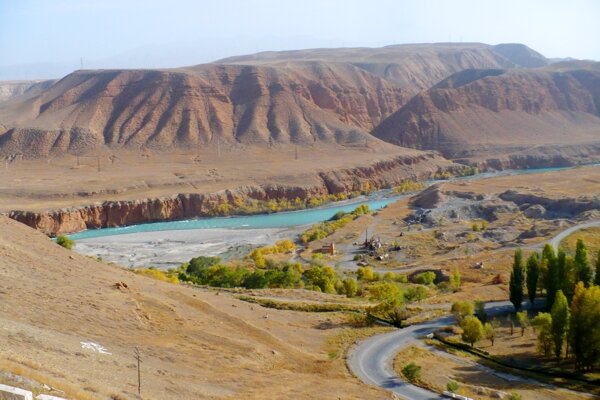


 Bishkek