Cooksie
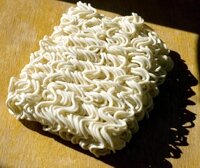
Instant Noodles – as invented by Momofuki Ando
We get some very strange questions from time to time … and one in particular sticks in my mind: “Can we get Pot Noodles in Bishkek?”
For the record: Pot Noodle is a propriety brand of instant noodle – a snack food – available introduced into Britain by Golden Wonder in 1977. They are available in a selection of flavours and varieties. The dehydrated mixture packaged in a sturdy plastic pot, from which the prepared noodles can be eaten, ( which also contains a sachet of sauce, such as soy sauce), consists of noodles, assorted dried vegetables and flavouring – artificial flavouring … there’s no chicken in Chicken Pot Noodles. The product is prepared by adding boiling water, which softens the noodles and dissolves the powdered sauce.
Actually, it wasn’t really that strange a question when you knew the context. It was from a group of tourists that were going on a trek into the mountains, camping, and they thought that would be a useful “stand by” if they had to cook for themselves. They wanted to know if they would be able to obtain this particular item here in Kyrgyzstan … or if they should sacrifice some of their precious baggage allowance on bringing some with them from home.
We were able to tell them that, although they may not be able to get Pot Noodles as such, that’s just a brand name and there is plenty of choice between different types of instant noodles available here in Bishkek – where they are known colloquially as Cooksie.
Noodles are fairly basic, staple, food here in Kyrgyzstan – as in Asia generally – made from a flour dough which is usually cut into strips and then boiled, (and/or fried), and often served with some sort of sauce. Here they are generally handmade at home, which is well worth seeing as it is quite a skill … but it is also labour intensive and special kitchen implements now exist to help the busy housewife produce large quantities to a uniform consistency.
For the record: Although the word itself is derived from the German word Nudel, they actually originated in Asia … some have been found by archaeologists, preserved in a pot, that date back to something like 4000BC (!). The earliest references to them come from Chinese records shortly after the time of Christ and sometime at the beginning of the third century they had already become a a staple food part of the Chinese diet.
By the Ninth century they had been introduced into Japan, and the thirteenth century saw them appear in Persia.
Apparently, Marco Polo was served them on his travels … and although he is often credited with the introduction of them into Europe, there are record that show that similar foods were already being prepared in Europe and the Middle East long before this.
There are many different varieties of noodles depending on the flour that is used to make them, the way that they are prepare and the shapes into which they are cut. The can be cooked straight away, or stored either dried or refrigerated. Instant Noodles on the other hand are a fairly modern innovation being introduced only in 1958. Having said that, apparently in a survey in 2000, they were rated as the greatest Japanese invention of the last millennium in a survey which placed Karaoke second (Arrrgh!!!!) and the Compact Disc came in fifth.
They were invented by Momofuki Ando, was born in Taiwan – which was occupied by Japan at the time. Orphaned early on, he was brought up by his grandparents, who owned a small textiles store and at the age of 22 his entrepreneurial spirit took over and he opened a textiles business.
In 1933 he traveled to Osaka in Japan and enterred University, and also started a trading firm. With the Japanese defeat at the end of the Second World War he took out Japanese citizenship. In 1948. however, he was convicted of tax evasion – apparently for providing student scholarships … which at that time constituted a form of tax evasion (??? – no, I don’t understand how that works) - and spent two years in prison.
Later he started another small firm producing salt … but it too ran into financial difficulties.
Life in postwar Japan was hard and there were food shortages. Part of the response to this desperate situation was the import of wheat from the United States as an element in a Humanitarian Aid programme. The Japanese government tried to persuade people to eat bread made from this flour, but it wasn’t popular … they were used to noodles and rice. The government, however, felt that noodle manufacturers were too small and inefficient to make use of the flour effectively, so Ando set about trying to find a way which could help improve the situation and he hit upon the idea of “instant noodles”.
In 1958, after months of experimenting, he eventually found a way of flash frying the finished product before drying so that they could be easily re-hydrated with boiling water. He started marketing his Chikin Ramen - Chikin, (sic), because they had a Chicken flavour and Ramen as this is the Japanese name for noodle – and because they were much more expensive than fresh noodles, they took off as a luxury item. As prices dropped they became more and more popular.
Thirty years later, in 1971, he introduced Cup Noodles – having seen how Americans in particular used to take a brick of his instant noodles in half, place one half in a cup and pour on the boiling water … he got the simple idea of putting the noodles, (together with dried vegetables and meat – into a special styrofoam cup so that all that was needed was to remove the lid, add hot/boiling water, wait a few minutes … and then eat.
They can be stored for anything between 4 and 12 months – depending upon environmental conditions.
Today, apparently, instant noodles are found all over the world – including here in Kyrgyzstan – and almost 100 billion servings are consumed every year – almost half of that in China.
There has been some controversy about them, especially over their nutritional value – being high in carbohydrates, fat and salt but low in fiber, vitamins and minerals and some nutritional experts recommend adding fresh chopped vegetables and.or health lean meat or fish to the mix to supplement the nutritional content of the dish.
To a certain extent they are still looked upon here as a lesser quality food option – something to turn to in lean economic times … or for occasional use due to the speed and ease in which they can be prepared.
There is now a museum dedicated to the instant noodle in the suburbs Osaka, named after Momofuki Ando … who was also granted various prestigious awards by both the government and the Emperor. He died on 5th January, 2007, aged 96 … of heart failure.





 Bishkek