Sabantui
In recent times the question of ethnic rivalries and disputes has reappeared in Kyrgyzstan.
It’s not a new phenomena … over the years there have been several occasions when ethnic differences has sparked conflicts and driven communities apart. This is hardly surprising given the vast range of ethnicities that live in the Republic, some of them small, others quite sizeable.
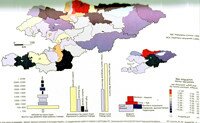
It used to be said that there were over 80 nationalities represented in the population of the Kyrgyz Republic. In fact, in 1999, there were some members of 132 nationalities registered just in Bishkek – including 33 “Brits”.
The Kyrgyz, themselves, make up just over 50% of the population – up until the 1970s the numbers of Kyrgyz was in decline – but this tendency has been reversed. Of the other nationalities the major ones are: Russians (17%), Uzbeks (13%), Ukrainians, Germans and Tartars. According to the 1999 census there were 12 nationalities with a population of over 20000 people.
Some of these ethnic groups have been here for a long time … centuries even, dating back to the time of the the Great Silk Road. Some are much more recent.
The Uighurs, for example, lived in the part of China known as Xingjian, just over the border, for about a thousand years and some families claim to be able to trace their lineage back to the 10th century. A major Uighur migration into the rest of Central Asia occurred in the 1850s and 1860s – when they fled Manchurian expansion – and there was a second wave in the 1920s.
Similarly, the Dungans, ethnic Chinese Muslims – in China they are known as Hui, arrived in Kyrgyzstan as refugees from persecution in 1882 after a series of failed Muslim rebellions.
The Soviet period was one of considerable internal migration and this helped to reinforce the multi-ethnic nature of the population – as well as feed the periods of population growth.
Indeed, the last major influx of nationalities occurred when Stalin moved sizable populations of other minorities here: these include Koreans, Germans and some Chinese (though there was already a Chinese population called Dungans or Dongans, in residence. Many Germans have now emigrated to Germany leaving some smaller towns practically empty. A large proportion of the Russian population have also emigrated since Independence in 1991, and there are often reports of even more seeking to emigrate.
The 1970′s saw a consolidation (or stagnation) in population growth. The natural population increase was maintained – but migration between Kyrgyzstan and other republics of the Soviet Union matched this growth. This trend continued throughout the 1980′s. In the 1990′s, declining birth rates, a slight increase in death rates and continued migration (such as the exodus of Germans and Russian) led to a much lower level of population growth (1.2% as opposed to 2%). This affected the urban populations more than the rural ones: Bishkek, Talas and Karakol were the only towns to exhibit a increase in population.
Following Independence, migration was still an important factor – and, one year (1993/4) actually helped towards a decrease in the country’s population. The effect, however, was not universal in geographical terms … different regions were effected differently. In the South, for example, there was a general tendency for an increase in population. The losses were experienced in the North (except in the capital, Bishkek, and a small number of other towns) and mountainous regions. Again, the impact was more marked in urban communities than rural ones.
From 1996 until the millennium, the fall off in the numbers of migrants meant that population growth grew stronger – however, there was internal migration, away from remote regions towards the regional centres – and in particular, to Bishkek. It looks as if this trend is continuing.
There were a number of other consequences of important social and demographic importance. For example, the migration led to differences in the ethnic mix of communities. Although it is common for “ghettos” (areas where communities tend to congregate) to emerge, there was a tendency for some nationalities (e.g. Kyrgyz, Germans and Uighurs) to settle in rural communities and for others (such as Russians, Koreans and Uzbeks) to prefer urban ones.
In English, the name “Tartar” implies a vicious and warrior like nation – which is not surprising in that they are descended from the Mongol “Golden Horde” of Genghis Khan, most resemble Russians rather than the other Turkic peoples.One of the ethnic sizeable ethnic groups to be found in Kyrgyzstan are the Tartars, a Turkish people from the Volga region in Russia – where they have their own Autonomous Republic Tartarstan, (“Land of the Tartars”), which is centred around the capital: Kazan.
They have settled throughout Russia, but especially in Tatarstan, in South Western Siberia and in the Crimea. The Tsar began encouraging the Tartars to begin settling in Central Asia in the middle of the 19th century as farmers, traders and clerical workers. There were mass deportations from the Crimea in 1944 and many were transported to Central Asia, particularly to Uzbekistan.
A large number have now emigrated to either the Crimea or Russia since Independence and there are now just over 50000 in Kyrgyzstan.
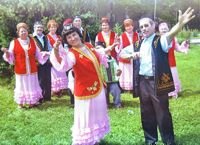
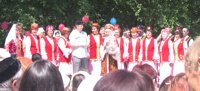
Which brings me, (at last), to Sabantui – a tradition Tartar holiday.
In Russia, (especially in Tartarstan, of course), it is quite a big holiday
The name is derived from two Turkish words: saban (“plough”) and tui (“holiday”) – and it marks the end of the period of work in the fields. It is an old festival – the first written reference to it was on 15 June 1292, and it is sometimes presented as a “marriage with nature”.
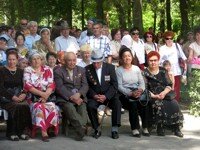
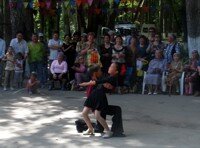
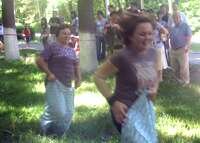
Every year the Tartars of Kyrgyzstan gather in June to celebrate the festival. This year, the festival was held on June 6th. The venue changes from year to year, but in recent years the festival has been held in Karagachovaya Rosha – Elm Grove, in Southern Bishkek. There is a concert of national music, and many games, especially for the children. These include “Egg and Spoon” races, (but there is a catch in that the spoon has to be held between the teeth, not in the hands), sack races, tug-of-war and racing with a yoke with two pails full of water, wrestling and a version of “climbing the greasy pole”, (where contestants climb up a tall tree in order to retrieve prizes that have been placed there beforehand).
This year, I went with the kids and some people from the office and John, a consultant who has been working here for the last year or so.
We arrived early which meant that the place filled up around us … which is something that I’ve always preferred, personally, although I know that many people get tired waiting for things to get started. As is often the case here, we did have to wait as the opening ceremony was delayed whilst we waited for official visitors to arrive …
Another advantage of arriving early was that we had the pick of picnic spots … unfortunately however, we chose somewhere which the insects liked as much as we did. They didn’t worry us too much, however, as we spent most of the time wandering around soaking up the atmosphere. It was a really pleasant atmosphere with people of all ages from young kids to wartime veterans. Some of the children performed dance routines and were later joined by many of their elders.
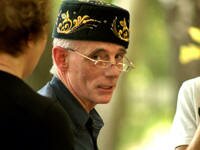
There were lots of things to see and do ,,, as well as the performances and games, there was the tree top obstacle course which proved to be a popular new addition and went down a bomb with the kids
As well as performances of traditional Tartar music, they are often joined by folklore groups of different nationalities – Kyrgyz, Cossacks, and others … and, as such, the festival represents an interesting example of inter ethnic cultural cooperation that acts as a counterpoint to the ethnic disputes that have been hitting the news.




 Bishkek