St Yuri’s Day
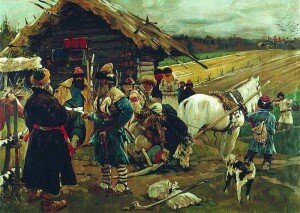
A Peasant Leaving His Landlord on Yuri’s Day – by Sergei Ivanov
Today is the second of the St, George’s Day of 2013. It’s actually St. Yuri’s Day, but Yuri is one of the Russian equivalents of George.
In the Orthodox calendar, Russians commemorate two St. George’s Day: the first in the Spring falls on April 23rd – as in the West – but there is a second in the Autumn which falls on 26th November. There is a catch in that the Russian Orthodox Church still operates on the Julian Calendar … whereas the rest of the world – well, most of the rest of the world – operates on the Gregorian Calendar. November 26th on the Julian calendar corresponds to 9th December on the Gregorian one.
This second St. George’s Day commemorates the consecration of the Church of St. George in Kiev by Yaroslav I, Yaroslav the Wise, in 1051.
Yuri’s Day happens to be held at a time when the agricultural year is over and it had a significant importance in the life of the Russian peasant.
Traditionally, this was the day by which all debts had to be settled and the two week period around the day, (the week before and the week after), was the only time when peasants were free to move from one landowner to another, but this practice was brought to an end by Boris Gudunov – thus establishing the system of serfdom that helped to shape the Russian Empire.
Although I see the logic in this day being chosen … the harvest having been safely gathered in … it seems a little late in the year for commemorating the Harvest.
Coming from Britain, I am used to Harvest Festival falling in the early Autumn. In Britain, as in most of Europe, the Harvest Festival is normally held around the time of the Harvest Moon, the Full Moon that falls closest to the Autumn Equinox. In most years, this occurs in September, but it can also fall in early October. The Jewish equivalent, Sukkot – The Feast of the Tabernacles – also falls in September/October. The American festival of Thanksgiving, however, which commemorates the first harvest gathered in by the pioneers after landing in the “New World” falls in November.
In Russia, there are several occasions which amount to Harvest Festivals … Drozhinki, which falls as early as 15th August in some places, (28th August on the Gregorian Calendar), but elsewhere it falls in September.
.
There has been a fair amount of news in recent weeks about the annual harvest having been gathered in … and it seems to have been a successful year with the harvest bringing bumper crops , (especially in wheat and sugar beet), not necessarily as a result of more land being brought under cultivation but because yields have been higher.
When it comes to the tradition of repaying debts by St. Yuri’s day … there is no chance that this will happen … Kyrgyzstan’s external debt is estimated at 3.6 billion dollars. OK, that’s peanuts compared to that of the United States, (which stands at 14,710 billion dollars – and incidentally, for the record, although that’s a record sum it is nothing extraordinary … the last time the US didn’t owe anyone any money was in 1835), and I think that, for once, we can pleased that Kyrgyzstan finds itself pretty far down in the rankings on an international league table, ranking 127th out of some 204 countries and territories in terms of external debt.
In fact the country’s external debt has shown a remarkable growth since the turn of the century … although in the last full year for which figures are available, they actually fell … not by much … but a reduction all the same.
For the record: This table shows the total public and private debt owed to nonresidents repayable in foreign currency, goods, or services – in billions of US Dollars – the final figures for 2013 are, of course, not yet in:
2000 1.1
2001 1.4
2002 1.6
2003 1.5
2004 1.5
2005 1.97
2006 2.43
2007 2.48
2008 2.97
2009 3.47
2010 3.47
2011 3.74
2012 3.6
2013 ???
The level of debt and reliance on the international community for grants and/or loans in order to fulfill certain projects – or even to maintain the everyday operations of government has been the subject of much comment … especially as the percentage of debt to GDP has also inexorably risen to raise the question of its sustainability – last year, according to the Minister of Finance, the country’s “foreign debt” amounted to 47% … although estimates put it this year at somewhere between 43 and 45%.
..
As to the traditional right of the peasant to change allegiances to a new landlord, even if Boris Gudunov did away with it, I am not sure what the more nationalist elements might make of the parallel with the current trend back towards the Russian sphere of influence.
.




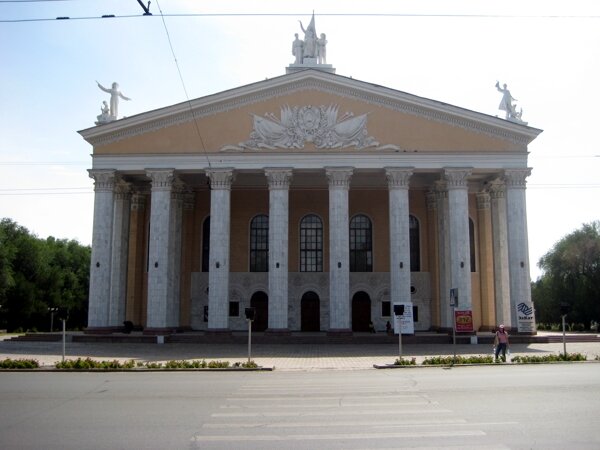

 Bishkek