The Mosaics of Bishkek
Turdieva’s post on kloop
I am sometimes asked about where I get the inspiration for different postcards … and there are different, many different, answers. Sometimes postcards are prompted by an anniversary or event, others are because I have seen an interesting news article, on occasion people write and make suggestions and, in fact, I have quite a long list of topics about which I intend to write … but never seem to get round to.
Some time ago, one of my correspondents wrote and suggested that I might want to consider one of the features of Bishkek architecture … the mosaics and bas reliefs … and, to be honest it’s a topic I had long wanted to address. I kept putting it off, however, because I felt that I didn’t have enough photographs to illustrate it.
A couple days ago, however, there was an interesting post by Raihana Turdieva on the kloop portal … “BAS-RELIEFS AND MOSAIC ON HOUSES OF BISHKEK”
The decorative murals of Bishkek may not rival those of Pompeii in terms of classical beauty and historical importance – but they do have a striking attractiveness, exhibit a wide variety of styles and form and have a story to tell.
During the Soviet period, many of the new apartment blocks erected as part of Khrushchev drive to provide homes for the masses resulted in many near identical buildings on the outskirts of towns and cities. Functionality was the key – simplicity and the absence of anything that could be interpreted as “excess”.
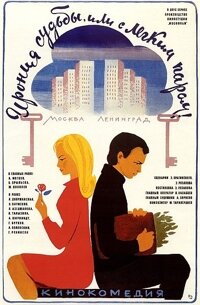
S’lorgkim parom!
This even led to one of the classics of Soviet Cinema – S’Lergkim Parom … shown on one TV channel; or another every New Year.
The film tells a story of mistaken identity … but not of a person … of a town, a building and an apartment … Having started to celebrate the holiday early with friends in a Moscow Banya (Sauna), the hero of the story falls into a drunken sleep and his friends decide to take him to the airport and put him on his flight home … the trouble is … they put on the wrong flight and he ends up in totally the wrong city. Unaware of this mistake, when the plane lands he is woken up and as he emerges from the airport he gives an address to a taxi driver … who duly deposits him outside the desired building … oblivious to the fact that he’s not where he thinks he is … after all – all the buildings are of a standard design and look alike – he makes his way to the apartment and let’s himself in.
That bit always seems to be the weak spot in the story … I can accept the basic premise up to this point but it seems to be stretching belief a little too far to assume that even if every town had streets named after the same Soviet heroes, every building looked alike because they were based on a single design … I find it hard to had to accept that they keys would also match.
Be that as it may – suspend the disbelief and it’s a charming love story with humour and poignancy – well worth watching if you get the chance!
Anyway, architects would take advantage of the possibility to inject some creative individualism by decorating the exteriors – to brighten up the dull and monotonous plain walls. Most of the apartment blocks had windows and balconies down the longer sides, but the ends were usually windowless and provided a plain canvass which could be “played with”. Some architects even managed to get their murals, mosaics and bas relief designs into prominent places near or over an entrance.
Unlike the mosaics of Pompeii, they weren’t commissioned by some aristocratic landowner but they still had to exhibit symbolic, ideological themes … and were often controlled and vetted by the Communist Party as part of the nation building programme – demonstrating an admiration for the achievements of communism in general and the Soviet Union in particular.
They were not simple decorations … as well as having to satisfy the Party hierarchy, with allegorical significance attached to each and every detail, they also had to be appealing and survive the various weather conditions experienced in the country – without suffering damage or fading. Special materials were used in their construction – often imported from Russia.
I am told that the salary of the artists were considerable … much higher than that of, for example, a doctor … although in many cases nobody really knows who the artists were … the individual items are not signed and the names don’t always seem to have been recorded. We do know, however, that Theodore Hertzen was responsible for several of the Mosaics …
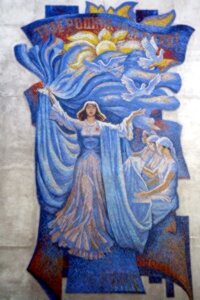
Mosaic adorning a textiles factory
Nobody is really sure how many examples there are, although I think about twenty individual examples can be identified – including, for example:
- on walls, such as outside the Ministry of Justice on Moldoaya Gvardia, apartment blocks;
- the laboratory complex of the Kyrgyz State National University;
- the circus;
- the facade of the Frunze Museum;
- The bas relief on the building of the Supreme Court on Prospect Erkindik – later used a the headquarters for the Prourator’s Office after the 2010 revolution;
- the Ala Too Cinema at the intersection of Prospects Erkindik and Chui – complete with it’s 1960′s depiction of cosmonauts;
- On the Academy of Sciences building on Prospect Chui;
- and even on factories -such as the sewing factory at the intersection of Jibek Jolu and Togolok Moldo;
- not mention numerous apartment blocks – especially on Sovietskaya and in the microdistrics – some of which Turdieva illustrates in her post.
One of the most important was outside the old airport – high on Prospect Mira past Akhunbaeva – near the present Ak Keme hotel … it would have been one of the first sights seen by visitors to the country after they had landed.
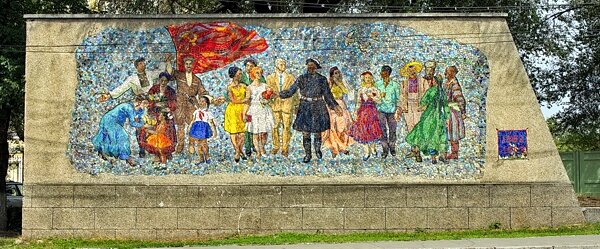
Mural opposite the Old Aiport
Others were inside buildings … such as the Ai Peri building at the intersection of Isanova and Prospect Chui … and as some of these buildings have been privatized their is a question of their preservation … and, unfortunately, it looks as if some have already been lost to prosperity.



 Bishkek