Zelenka – Green Fingers
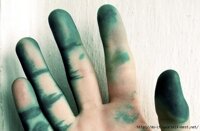
A literal interpretation of “green fingers”
If I say that I have “green fingers” then, back home in the UK, people will think that I am goof with plants … house plants or garden plants … but here it can have different connotations.
As it happens, as I type this I do indeed have “green fingers” … but it’s because I cut myself opening a can of cat food as the cats mewed and meandered around my feet in eager anticipation. That’s not to say that I blame them, (or, for that matter, anyone else), for my misfortune … it was just one of those things … as I lifted the lid off the can my index finger brushed against a sharp edge which cut into the flesh.
At first, the blood flow from the wound was slow and seemed insignificant … but as I put it under the tap to wash it it started to flow quite copiously … a bright red viscous liquid.
I opened the medical kit and looked for the antiseptic … and found a bottle of zelenka – which roughly means “bright green” in Russian – and poured it over the wound … before I could mop it up with varta (cotton wool) and bind it with bint (gauze) it had ran freely down the finger and onto the middle finger and the palm turning everything it touched green – hence the name.
I had never come across zelenka until I came here … although, apparently, it is known and accepted as an antiseptic agent – it is not widely used; here in the former Soviet Union, however, it is quite common … it is not unusual, for example, to see young children with green patches of skin where it has been applied to a wound and there’s even a phrase used to describe a child with cuts that have been painted with zelenka following, for example, a fall: ”green leopard”.
It’s used for the cleaning of post operative and post traumatic scars, cuts and abrasions … for the treatment of inflammatory conditions and also staphhylococcal infections, and is applied externally and to the surrounding area of the wound.
It is usually rubbed, for example, into the navel after the freshly cut umbilical cord is knotted on a newborn infant, as a protective measure against infection.
I an told that it is based on a dye used in textiles and it’s antiseptic qualities may well have been discovered accidentally.
It seems that at one point William Perkins, (1838-1907, a child prodigy who entered the Royal College of Chemistry at the tender age of 15), was researching a treatment for malaria – working with coal tar and acid. One of his experiments produced a purple substance moveinom which was bright purple in colour. Following this he moved from medical research into the field of dyes, producing syntetic dyes which could replace the expensive natural dyes such as cochineal and indigo … and was so successful that he was even knighted in recognition of his achievements.
The first use made of these new dyes by doctors was to colour preparations of different microorganisms … so that they could be easily examined under a microscope … and it was then that it was noticed that these substances were killing germs on the spot. .
It’s cheap and effective which might help to explain why it is used so widely here – but according to at least one source, there has been little or no research into it – for example into possible side effects – which may help to explain why it has not been widely adopted in the West with our culture of “test, test, test”.
Apparently it is also used in veterinary medicine.
As well as in it’s liquid form, it is also available as a “pencil”.
One of the advantages of zelenka over iodine, (the other major antiseptic often used here), is that it doesn’t dry the skin out … but …
Useful though it is as an antiseptic, it has one big problem … if just a drop of the solution gets onto your clothing or skin, it’s going to be there for a long time. Imagine the mess if you knock a bottle over and it spills its contents onto a table or something … or worse still, you drop the bottle and it breaks …
Fortunately, once exposed to sunlight, the stain starts to fade … but it will still linger and it is best to “attack” it as soon as possible with bleach or “saturated soapy water” … on the skin then alcohol or lemon juice … to dilute the liquid.







 Bishkek