So, what exactly is an oblast?
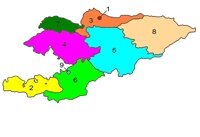
Oblasts in Kyrgyzstan
A few weeks ago I was sitting in one of Bishkek’s newest “venues” – a coffee shop, they seem to be sprouting up all over the city like dandelions on a lawn – having chat over a hot drink with a visitor to Kyrgyzstan, (I was actually drinking Hot Chocolate – but at least he was drinking Coffee).
He told me that he had come across the postcards and had been “dipping in” to them. He commented on the fact that there seems to be a postcard for everyday and wondered how I kept finding things to write about … He asked me, (like a lot of other people have, over the years), if I was planning to turn them into a book … to which I replied, “not really”.
The idea of the of the postcards was originally to provide a short update on what I was doing here, so far from home, and every now and again I had to add some background material to explain to people who had no idea where Kyrgyzstan is or what has happened here or why I seem to think something has some specific significance.
Take for example a couple of words that keep cropping up: oblast and rayon. What on earth are they?
It’s not that I have no interest in writing a book. It’s just that the nature of the postcards and a book are quite different.
I aim to keep most postcards to about 1000 words (2000 on Saturdays when I write a review of the week’s news), and although I sometimes find myself struggling to get near that limit, often I exceed it – by far!
Each is written at a particular time, prompted by something, (such as an event, anniversary or something in the news), and, more or less, self contained … and so there’s a fair amount of repetition involved. A book, on the other hand requires a more cohesive approach and needs to be written in quite a different manner. Individual postcards might provide material for a book, but it would require a lot of time and effort to rework them into a suitable format.
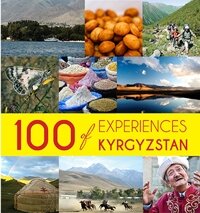
The title speaks for itself – I hope!
I have actually used them to write several short books over the years, (the latest of which has just been published: 100 Experiences of Kyrgyzstan).
Each one has a original concept and based on that I have written short sections for which the postcards have been a useful source.
Some years ago, for example, I was asked to write a text for a short booklet about Kyrgyzstan. It was before the Tulip Revolution in 2005, so few people in the West had heard of the country and even fewer really knew much about it and what it had to offer tourists.
I was given a brief – some general information about the history and geography and then something about the various “attractions” that could be found in different parts of the country, followed by a description of the activities that visitors could undertake.
I did as I was told, and it was only later, (some time after it had been published), when a Marketing specialist took a look at it and made a number of suggestions as to how it could have been improved upon, that one particular point stuck home. One of his comments was phrased in the form of a question: “Why have you organized the content by oblast?”
He went on to point out that to most people in the west, this is not just a foreign word … it is meaningless … and even if they knew the word they probably wouldn’t have any image of how they fit together as a “jigsaw” puzzle to give a complete whole.
Both of the words oblast and rayon are taken from the original Russian for administrative divisions – like County, Shire, Parish or Province.
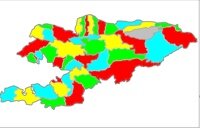
The Rayons of Kyrgyzstan
The Russian word oblast was the name given to an administrative region in several Slavic countries and in some of the countries of the former Soviet Union.
It is often translated as “area”, “zone”, “province”, or “region”. The last, however, can lead to confusion, because the subdivision of “oblast” is called “rayon” which is also translated as “region”, (or sometimes “district”, depending on the context).
The word “region”, (as in the Central Asian region), can also refer to a wider, more informally defined area.
These aren’t the only words that have been used over the course of time.
For example, when the Kyrgyz Autonomous Soviet Socialist Republic (Kyrgyz ASSR) was established in 1928, it was divided into 7 cantons, 52 volosts, 6 gorods , (city or town… the Russian word can mean either), 2 sluts, (urban type developments), and 416 rural councils.
Later, During the Soviet period the administration was altered and the land was divided in regional oblasts (administrative regions – although most of the territory belonged to an oblast, some areas were placed under direct Republican control), rayon (district) and selsoviets, rural communities known as suts or gorod.
Following independence the selsoviet was replaced by the ayil-kenesh, or ayıl okmotu, which may encompass a number of small villages, up to about twenty, each having their own elected mayors and councils.
Today, Kyrgyzstan is divided into seven oblasts, (usually translated as provinces) that administered by governors appointed by the President. The capital, Bishkek, and the second large city Osh are administratively independent cities (called shaar) with a status equal to that of an oblast.
The provinces, and independent cities, are as follows:
- Bishkek (city)
- Batken - located in the southwest of the Kyrgyz Republic, and consists of four mountainous regions, with altitudes ranging from 400 to 5621m asl. It borders the Ferghana oblast of Uzbekistan to the north, the Sogd oblast of Tajikistan to the southwest and Osh oblast of Kyrgyzstan to the east. Until 1999 it was part of the Osh oblast. There are seven enclaves – parts of other republics contained in the territory.The oblast was created in 1999 after incursions by armed militants of the Islamic Movement for Uzbekistan seeking to cross Kyrgyz territory between Tajikistan and Uzbekistan.
-
Chui - lies in the northern part of the country and borders Kazakhstan, and the Issyk Kul, Naryn and Talas oblasts.
- Djalal Abad - lies in the South West of the Kyrgyz Republic, bordering Uzbekistan, and the Kyrgyz oblasts of Talas, Osh, Naryn and Chui.
- Naryn - lies in Central Kyrgyzstan and borders with China and the Kyrgyz oblasts of Chui, Issyk Kul, Djalal Abad and Osh.
- Osh (oblast) - lies in the South of the country, bordering China, Uzbekistan and Tajikistan as well as the Kyrgyz oblasts of Batken, Djalal Abad and Naryn,
- Talas - occupies the north-western part of the Kyrgyz Republic on the border with Kazakhstan and Uzbekistan. It also shares borders with the Kyrgyz oblasts of Chui and Djalal Abad. It is an area of Kyrgyzstan not often frequented by Western tourists – but has much to offer. Known as the motherland of the legendary Kyrgyz hero, Manas, there are many places associated with him. In the east of the oblast is the “road” said to have been traveled by Genghis Khan and where one of his wives is said to be buried.
- Issyk Kul - lies in the North of the country and shares borders with Kazakhstan and China, as well as the Kyrgyz oblasts of Chui and Naryn.
- Osh (city) -
Each province comprises a number of districts (raions – or rayons), administered by government-appointed officials (akim).




 Bishkek