Jerboa
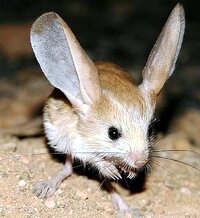
A Jerboa
The other day I was looking through a book of wildlife in Kyrgyzstan and came across an entry which surprised me … about Jerboas. I had never heard of them before I came here … and I have certainly never seen one before … except, perhaps as a cartoon character.
Initially, my attention was grabbed by the striking photograph which showed a rodent with extremely large ears … but what surprised me was the opening sentence of the description which referred to the natural habitat of the creature and referred to “semi-desert and desert zones”. When I went looking for more information I came across the sentence: “They tend to be found in hot deserts”.
Although it said that Kyrgyzstan has almost every types of climatic zone … desert doesn’t really spring to mind as one of them. That’s probably because our general impression of “deserts” conjures up images of sand dunes … rolling into the distance. In fact, they are simply areas where there is little precipitation and, consequently, living conditions are hostile for plant and animal life.
Now, we certainly do have arid zones and areas that are designated “semi-desert”.
For the record: About one third of the land surface of the world is arid or semi-arid. This includes much of the polar regions where little precipitation occurs and which are sometimes called “cold deserts”.
Jerboas are to be found throughout Northern Africa and Asia east to northern China and Manchuria … and that includes Kyrgyzstan.
The first thing that was obvious in the photograph were the long ears, but other striking features of their anatomy, (which were actually hidden in the picture), are long hind legs, very short forelegs, and long tails, large heads with a flat snout and big round eyes, and long whiskers. As a result of the similarities, they, they are sometimes referred to as Kangaroo rats … although the is the name of a related species which is native to North America … and neither are not related.
Fore the record: they are also sometimes referred to as Earth Hares.
Jerboas are very mobile and quick. They move around their environment in the same way as a kangaroo – by hopping. The long hind legs provide the power for long jumps while the shorter paws are used only for digging.
There are two types of jerboa, characterized by the number of toes on the hind feet: three-toed and fiver toed jerboas.
The tail can be longer than its head and body and it is common to see a white cluster of hair at the end of the tail. It is used to balance the creature when it is hopping and as a “prop” when the animal is sitting upright.
The fur of is fine and, usually, the color of sand, this color in most cases matches the environment in which the jerboa lives – a form of natural camouflage.
Although the striking long ears in the photograph caught my attention … only some species of the jerboa family have long ears like a rabbit whilst others have ears that are short like those of a mouse.
Jerboas are nocturnal. During the heat of the day they usually shelter in their burrows but at night they leave the burrows due to the cooler temperature of their environment.
They are solitary creatures. Once they reach adulthood, they usually have their own burrow and search for food on their own, not in groups … although “loose colonies” may be formed, whereby “some species of jerboa dig communal burrows which offer extra warmth when it is cold outside”.
The entrances of the burrows are usually found near plant life, especially along the borders of fields.
In the summer, they plug the entrance to their burrow, possibly in order to keep out hot air and, it is thought, predators. In fact, most burrows have an “emergency exit” that ends just below the surface but is not strongly obstructed, which allows the enables the animal to escape quickly.
According to some sources, jerboas often create four different types of burrows:
- Two “temporary” burrows for use during the summer months:
- a “day” burrow, which is used for cover while scavenging during the daylight and
- another used for scavenging at night.
- They will also have two permanent burrows with longer tunnels
- one for summer, which is where the young are raised, and
- one for winter, used for hibernation.
Jerboas are herbivores – although some species are known to eat beetles or other insects. They cannot eat hard seeds. They do not store food.
Most of the texts seem to agree that there are four species of Jerboa to found in Kyrgyzstan, but the names seem to vary from source to source.
- Allactaga elater – the Little Jerboa or Small Five-toed Jerboa - found in the Western parts of the Talas and Chui valleys;
- Allactaga major – the Great Jerboa – found in the Western parts of the Talas and Chui valleys;
- Allactaga sibirica – the Siberian or Mongolian Jerboa – There are two subspecies which are found to the West of Issyk Kul, (in Boom Gorge and the Kochkor valley), and in the Ak Sai valley in the South of the Naryn oblast … and
- Dipus sagitta – the Hairy-footed Jerboa – however … only one specimen of this animal has ever been collected – in 1959 in the Alai valley of Southern Kyrgyzstan … it is known to be a native of the Taklamakan Desert and the Tarim Hollow across the border in China.
The first three are five-toed Jerboas whilst the last is a three-toed Jerboa.
There are also four types of Jerboa listed in the Red Book as endangered species, however, two of them are probably subspecies of one of the other:
- The Small Five-Toed Jerboa: This small, nocturnal rodent, (just 10cm long), has very long hind legs with a hind foot that measures about 6cm, and a long tail ending in a black “flag” with a white spot. It prefers land at an altitude of about 700-800m with little vegetation.
- Vinogradov’s Jerboa: The species known as Vinograd’s Jerboa is found in the South of Kazakhstan – but there is some dispute if it is found in Kyrgyzstan. There is, however, a sub-species of the Small Five-Toed Jerboa called Vinogradovi which prefers hilly land and is found in the Talas and Chui valleys.
- Severtov’s Jerboa: This is a species of Vinogradov Jerboa.
- Mongolian Five-Toed Jerboa: This rodent has a brown-grey coat, variegated with yellow and dark spots, and a white belly. The tail goes from brown to white to black – with a white stripe through the black tip. It prefers a mountain habitat and stony desert landscapes. There are two subspecies which are found to the West of Issyk Kul, (in Boom Gorge and the Kochkor valley), and in the Ak Sai valley in the South of the Naryn oblast.




 Bishkek