The other White House
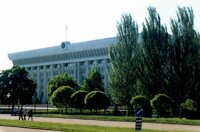
The White House
They say that moving house is one of the three most stressful experiences that a person can go through. On 1st November, 1800 John Adams moved into a new home but he probably had plenty of other stressful things to worry about apart from that … he was, after all, President of the United States of America when he moved into 1600 Pennsylvania Avenue which had been specially constructed to serve as the official residence (and principal place of work) for the incumbent of that august office … and is known down to this day as The White House.
Now, it’s easy to get confused when talking about the White House. Most people, when they hear the phrase, think of John Adam’s “town house” – but there are other buildings around the world that go by the name. Several other residences used by the American President, (especially holiday homes), are also called by that name: the “Summer White House”, the “Winter White House”, there have been several which have been called the “Western White House” … even the residence of President Jefferson Davis, who led the Confederate States of America during the American Civil War, is known as the White House of the Confederacy.
There’s a White House in Moscow – a government building that serves as the home of the Duma, the Russian Parliament … which burst into the world’s headlines when Boris Yeltsin and the people of Moscow set out to defend it during the Constitutional Crisis of 1993. It took sixteen years to build, (from 1965 until 1981), and was originally known as the House of the Soviets, and it served as home for the Supreme Soviet and, after the collapse of the Soviet Union, for the State Duma of the Russian Federation … until, that is 1994, when the moved to a new homw and the building became the House of the Government of the Russian Federation.
Here in Bishkek, we also have a White House … 209 Prospect Chui … once officially called the Dom Pravitelstvo – Government House. It was originally built to serve as headquarters for the Communist Party Central Committee and the Council of Ministers … and, once the office of President was created, it housed the Presidential Office – but not the official residence, which is in the Ala Archa Presidential Residence on the Southern edge of the city.
The seven storey marble clad building was completed in 1985 as part of the city’s development under Turdakun Usubaliev, which saw the erection of a whole range of similar buildings which now dominate the city: The nearby Historical Museum and indeed the whole of the Ala Too Square complex including the Ilbirs Factory and the Ministry of Agriculture, the Phiharmonia, National Library, the Municipal Banya (Sauna) … and the headquarters of the security services, (the KGB).
The design was was based on that of a government building in Moscow and although it looks like a solid block, this is deceptive. Like Buckingham Palace in London, the edifice hides an inner, “secret” … in the form of courtyards. In plan the building forms a “figure eight” – each arm, or arc, forming a corridor – surround two small inner courtyards or wells.
In the center of the front of the building, beneath a flag pole, there is a representation of the Gerp, (the state seal). This replaced a representation of the Republican crest, (similar to that on the former Council of Ministers building in the Old Square – which now serves as the current Dom Pravitelstvo), when the USSR collapsed and Kyrgyzstan declared its independence.
Although there are doors on the front edifice, this is rarely ever used. There are entrances on all four side, imaginatively referred to as the North, South, East and West Doors. The main entrance is actually “round the back” – as is the case with most apartment blocks here in Bishkek, along the impressive long side of the building, up an imposing flight of marble steps. Most people, however, use the Western Door which is nearest the driveway from Prospect Chui.
In front of the building, facing Prosepct Chui, (inside the fence), are flower beds and fountains. The flower beds used to be filled with red flowers which were supposed to symbolize the country’s Soviet ties.
When I first came to Kyrgyzstan, the whole area was “open plan” and you could walk right up to the doors, in the same way that you can at the Historical Museum just down the road. During the Summer, the fountains, children would play in the fountains and in Winter time the embankment served as a popular spot for sledding. Security concerns, however, prevailed and the fence around the building was erected.
Personally, although I understand the security issues, which later events were to prove I can’t help feeling that this was a bad sign. The fact that you could walk right up to the building was a sign of the openness of the country, whilst the erection of the fence seemed to symbolize the government cutting itself off the people.
As the main government building in the capital, the White House has witnessed several historic events.
For example, it was apparently from here that the newly elected Askar Akaev “studied the situation” unfolding in Moscow in August 1991, whilst his counterparts in other Central Asian Republics backed the coup plotters who had arrested Mikhail Gorbachev in his holiday dacha.
He was also in March 2005 when a series of protests against his regime led to a mass protest involving tens of thousands gathering in Ala Too Square and advancing up the street to the White House. Fighting broke out and Akaev seized the opportunity provided by a break in the action to make his escape.
At several points within the perimeter fence, and also in the nearby Ala Too Square, there are a number of access stairs to various underground facilities. Some years ago there was a report in the local Vecherniye Bishkek newspaper about some reporters who managed to gain access to one underneath Ala Too square. The said that it was apparently a “secret” complex of rooms connected to the White House by a long underground corridor, but hadn’t been used since before independence – there were still portraits of members of the politburo of the Soviet Union, (including Andropov and Brezhnev), on the walls and “a lot of dust everywhere”.
There are also stories about underground tunnels linking the building with the outside world. I am told that there was one between the building and that of the GSNB -the security services, the successor to the KGB – on Jibek Jolu, According to some reports I have seen it was used as an escape route by Askar Akaev in 2005, (but I have also seen other reports that whilst the crowds were massing on the southern side of the building, along Prospect Chui, that he was being driven out of the gate at the “back” of the building – that is on the Northern side of the building.
After he had left the building was stormed by protesters who ran amok and ransacked the offices.
April, five years later, his successor as President, Kurmanbek Bakiev, was also in the building when a mass protest gathered outside. The police tried to suppress the civil disorder, tear gas was used, and then two trucks rammed the gates and shots were fired … live ammunition was used and there were casualties. Bakiev fled and the crowd gained access to the building, running amok and ransacking the offices. Fire broke out, sweeping through the building causing considerable damage.
Afterwards, the building was renovated and the Jogorku Kenesh, the Parliament, (which had been housed in the former building of the Council of Ministers in the nearby Old Square), moved into the White House, swapping places with the government offices which relocated to that place.
Then in October 2012, the crowds that had been gathered for yet another mass protest in the main square, moved towards the gates of the White House. One of the leading politicians led a group of the protesters in climbing over the gates and running into the building, chasing security guards. They were evicted and the leaders of the rally brought to trial charged with attempting to usurp power – losing the case in the first court, winning an appeal against the convictions but eventually losing once more in the Supreme Court – effectively decapitating one of the parliamentary parties of some of their charismatic leadership.
For the record: There have been other attempts to storm the building but these have been either short lived or unsuccessful.



 Bishkek