ATC
When I was teacher, I once had a pupil who was a keen trainspotter. One day appeared in the computer room and said that he had bought a computer program and wanted to try it on the school computers … he didn’t have one at home.
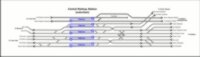
Not Kings Cross – but a similar track layout
It was, of course, a computer game. But … it wasn’t like most of the computer games that were common … either then or now. It wasn’t of the “shoot-em-up” type. In a way it was a combination of a role playing game, and a game of strategy. The player assumed the role of a signalman controlling the all the “points” to Kings Cross Station, one of London’s biggest and busiest railway station. The display was a schematic of the platforms and railway tracks leading into the station and the program was provided with a the timetable of arrivals and departures – their points of origin and destination which would dictate which track they would . The player then had to make decisions as to which points to activate in order to allow the trains to pass and keep their designated slots on the timetable. Just to complicate things – there were also occasional hazards built in, special trains, weather conditions, power cuts, a fire … and so on. Points were allocated on avoiding crashes and delays.
It was played in “real time”, so it could take a whole day. As a result, it could take all day to complete a game – most of the time spent waiting but some periods of frantic activity requiring instant reactions. It was by no means an easy game requiring specialist knowledge, patience, analysis, quick thinking … and the ability to make decisions.
Although several people took and initial interest in the game … it was too slow for most of them and the lack of blood and gore didn’t encourage them to have a go. I know that I only had a couple of goes but found it somewhat frustrating and didn’t have the patience to sit and gain the experience necessary to learn from my my early mistakes in order to avoid repeating them.
It did, however, give me a totally new insight into that particular pupil and his character, patience and the range of skills that he had mastered to become an expert at it … as well a certain amount about the job of a signalman and a renewed respect for them, an understanding of what they faced on a daily basis and the responsibilities they carried on their shoulders.
I think he was surprised when I took the program and used it in lessons as an example of computer simulations and how they can be used for training purposes – discussing the sort of things that the programmers had to take into account in order to create the game. I don’t think it made any more appealing … but it did help to teach a few important aspects of life.
Some of my colleagues, (teachers of Computing and Information Technology), were a little surprised by my choice of example – most of them were using Air Traffic Control (ATC) rather than “Rail Traffic Control” … probably because there was more material available including BBC videos.
The purpose of ATC is to prevent collisions, organize and expedite the flow of traffic, and provide information and other support for pilots and the role of an Air Traffic Controller is complex – they need to be well organized individuals, quick with numeric computations and mathematics, have assertive and firm decision making skills, able to maintain ‘their cool’ and composure under pressure, and possess an excellent long-term memory.
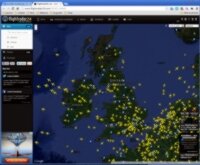
Flightradar.com
ATC was first introduced at Croydon Airport in London as early as 1921. In those days it was a lot simpler – sightings were done manually, planes were slower, there was more time. The introduction of radar, faster planes and the introduction of computerized systems has meant that instant life-and-death decisions (literally) have to be made. Sites like flightradar24 show quite how complicated the situation in the crowded skies can be.
Here in Bishkek, the situation has been complicated by the presence of the Manas Transit Center servicing military flights to Afghanistan. In addition to the military flights, the airport services some 350 scheduled flights a week, (landings and take offs), plus charter flights, occasional flights by private planes. It’s not as busy as the world’s major airports … such as Heathrow, (the successor to Croydon), but the responsibilities are the same.
For the record: the timetable frequently changes but at the moment there are scheduled flights between Bishkek and:
- Almaty
- Astana
- Batken
- Chelabinsk
- Delhi
- Djalal Abad
- Dubai
- Dushanbe
- Ekaterinburg
- Irkutsk
- Isfana
- Istanbul
- Kazan
- Khujand
- Kiev
- Kranadar
- Krasnoyarsk
- Moscow
- Naryn
- Novosibirsk
- Omsk
- Osh
- Seoul
- Saint Petersburg
- Surgut
- Tashkent
- Urumqi
- Ulan Bator
On 20th October, 1961,the International Federation of Air Traffic Controllers (International Federation of Air Traffic Controllers Associations, IFATCA) was established in Amsterdam. This was to be a significant milestone in the history and development of air transport and the association now has 133 members representing some 50 thousand air traffic controllers worldwide.
The event also served as the basis for a new “professional holiday” dedicated to air traffic controllers, (the International Day of the Air Traffic Controller), giving the opportunity to stress the importance of the profession, to draw public attention to their work, to declare their achievements and to formulate plans and goals for the future.






 Bishkek