Passports
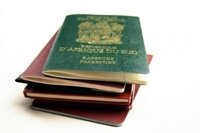
Passports
Back in 1932, on 27th December, the Central Executive Committee and the Council of People’s Commissars of the USSR adopted a resolution “On the establishment of a single passport system to the USSR” and mandatory residency passports (Propiska).
That’s the reason why today is considered the professional holiday for the employees of the Passport and Visa service.
The Tsarist system of passports, established in the reign of Peter the Great, had been abolished shortly after the October Revolution as it was a symbol of the regime’s despotism. In 1922, a law allowing free travel across the whole of the Russian territory, (the RSFSR). By 1932, however, there was a growing desire to control people’s movements and so the passport system was reintroduced – but it applied only to people over 16 living in “cities, industrial communities, working on transport, in state farms and new construction facilities”.
A person also had to obtain an obligatory “visa” in their passport at the local police agencies “not later than after 24 hours upon his arrival to a new settlement”. The cancellation of such registration also became obligatory for those who left “beyond the limits of the center of population for good or for a term longer than 2 months”; for all those who were leaving a previous residence and those exchanging their passports; prisoners; for those being under arrest for more than 2 months. Any violations of this new passport order could result in administrative or even criminal proceedings.
As a foreigner, under Kyrgyz law I am required to carry my passport, (or “a document confirming my identity”), at all times outside my home.
I am never quite sure what other documents might count as proof of my identity, but some people do seem to have a choice available to them … although in most cases for all practical purposes, it’s the passport that is required in order to access to legal employment, public services and social/economic rights … and I once met an Englishman who managed to gaion access to the White House on the basis of an International Drivers’ Lisence issued by the AA.
Kyrgyzstan has basically continued to use the registration systems that it inherited from the Soviet Union in order to register births, marriages and deaths, (which are registered by local register offices – ZAKS – or by municipal authorities), whilst passports are issued by separate “passport offices”, (OVIR).
Perhaps we need to be clear when I refer to a “passport” … to most people, a passport is a a document, issued by a national government, which certifies the identity and nationality of its holder, (with their name, date of birth, gender and place of birth with an attached photograph), for the purpose of international travel.
This is indeed the main purpose for which Westerner’s use passports … and there is a long history of such documents – back, even, into biblical times … (as in Nehemiah 2:7-9). In some cases, the issuing authority wasn’t necessarily a state, but as late as in the seventeenth century, the issuing of passports had not yet been established as the exclusive right of the state. “Passports” could be obtained from a local lord, or a magistrate or a commander in the army, in fact, from anybody, provided that that person wielded sufficient influence for the document to be accepted and may have taken the form of a letter, or a certificate.
I that’s the main purpose of a passport, then perhaps it’s understandable that I didn’t get my first passport until I was in my mid 20′s … I didn’t need one because I didn’t travel abroad. Most Americans don’t travel abroad either … apparently only about 35% of them have a passport. (I suppose there’s plenty enough for them to see and do without crossing the border.)
Here in Kyrgyzstan, there are two documents that are called a “passport”. There is the “internal passport” – a standardized credit card sized plastic card with the necessary data and a photograph and serves as an identity card. Before these cards were introduced, (in 2004), it was a booklet similar to what we in the West would recognize as a passport … but with the vital difference that it did not grant permission for the holder to travel abroad – for that they had to apply for and obtain a Zagranpasport.
Most Kyrgyz don’t have a zagranpasport – they don’t need one unless they are travelling abroad – and, as there are agreements allowing them to travel to, (and even live and work in), places like Russia and Kazakhstan.
If I was a citizen of Kazakhstan, or Russia, then I would be able to use my “internal passport” – but, being a Brit, the only real option is my British passport. Although Britain has now introduced an ID card, it’s not compulsory, nor – given the British antipathy to such documents being introduced, is it ever likely to be so.
These passports are issued to children once they reach the age of 16 – and are renewed after ten years, when they get married or move, (both marital status and address are recorded on the document).
Kyrgyzstan introduced these “ID cards” and machine-readable passports/travel documents that meet international standards for security, (the zagranpasport), in the period 2004-2006. They wasn’t without controversy, however, as
- when the new documents were introduced there was a shortage of blanks documents which led to long waits, (and opened the door to corruption),
- the colour of the first batch seemed to be variable,
- there were complaints about the quality of the translation (into Kyrgyz), and
- a few other hiccups … it was said, for example, that they were easy to forge or counterfeit and were therefore in high demand by various criminal organizations.
As a result, a series of changes have been made in the passport system since then in order to increase document security.
However, corruption continues to be very widespread and, it is said, fake passports still are a problem. Recently, for example, it was reported that a criminal was released from prison in “suspicious” circumstances was wrongfully issued with a passport and was on a flight out of the country within hours of his release.
It may well be true that, in the past, it did sometimes take a long time to obtain a passport … but I get the impression that the system is a lot more streamlined these days and it doesn’t seem to take too long. The kids got their passports within a couple of weeks and there were no “hidden” fees or “additional payments”.
Kyrgyzstan has been described as a “document community” … everything is documented and a document is needed to gain access to and certify particular rights – and the inherent obligations. One document is a pre-requisite for obtaining another.
The first Kyrgyz passports were issued in 1994 – some three years after declaring Independence from the Soviet Union. Until then the former Soviet documentation, (introduced in 1974), was used – and in certain circumstances can still be in use. An expired Soviet passport can still be used by “stateless people” – for example, soviet citizens who have never applied for or been granted Kyrgyz citizenship for one reason or another – in applying for an ID cards, although they can’t be used for identification.
The 1994 passports used to be dual purpose, serving as internal identification and as travel documents if the zagrastanizta was completed, but these days they are no longer valid for foreign travel. One of the reasons this function was withdrawn was the apparent ease with which they were falsified.
There is estimated to be around 25,000 people, primarily former citizens of the Soviet Union, who have unresolved citizenship and missing passport/ID documents. Many of them apparently live in the “new settlements” springing up on the outskirts of Bishkek and there’s been quite a bit about them in the press recently and they have been called “invisible citizens”.
Recently, a deputy in the Jogorku Kenesh stated that there were about 8000 children in the country without even a birth certificate … which means they are deprived of all forms of state support – cannot go to school, cannot get medical help, cannot get proper work, cannot be registered as living anywhere, cannot get any of the other official documents they need to pass a normal life – such as a passport … I wonder, however – I don’t know, if they can be called up for military service.
As for me … few years ago I solved my problem by applying for and obtaining a Sviditelstvo vide na zhitelstvo – a Residence Permit … which acts in much the same way as a local passport as a proof of identity. It’s a passport sized booklet which records the details of my British passport, my address and my local Social Security number. It serves as my local “passport” and I can use it in the same way as a passport to open a bank account and to make transactions on it, to board a internal flight, to enter the country without requiring a visa, to work in the country, to buy property and gain access to medical and social amenities.
For the record: As in many countries, a driving licences cards can be used as a proof of identity, (although some countries do not accept driving licences for identification, often because in those countries they don’t expire as documents and can be old and easily forged), as can an oodostivleniya, (an identity card), issued by the persons employers, (or college in the case of a student), their Voeinie Bilet – their Military record book.


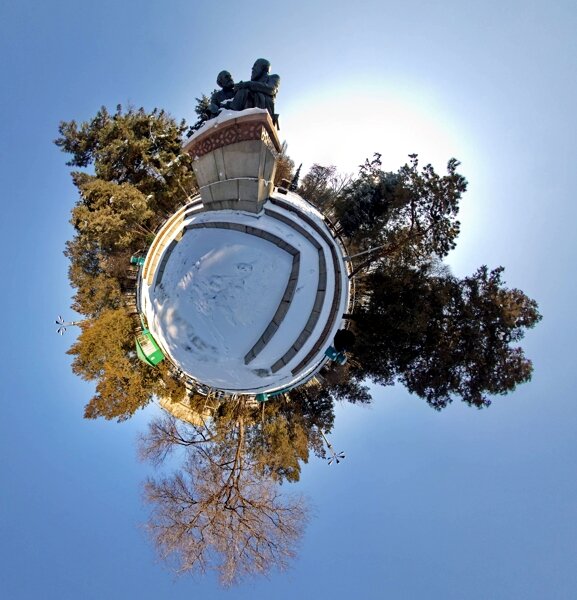


 Bishkek