Baitik Baatyr and the fall of Pishpek
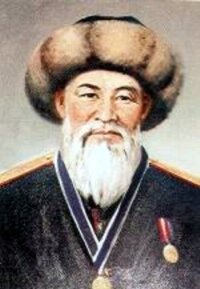
Baitik Baatyr
Baitik Baatyr was a manap (tribal leader) of the Solto tribe in the latter half of the nineteenth century, and played a decisive role in the liberation of his people from the Kokand Khanate in 1862 – and in doing so helped to shape the future of his people.
Baitik was born in 1820 to the “junior” wife of Kanai, who was then the head of the Solto tribe. As the son of the “junior” wife, Baitik had a low status and had to all the chores. In his youth he never had “good clothing”. However, he grew up to be tall, strong and intelligent, all of which endeared him to his father, and he soon became Kanai’s favourite. When Kanai died, Baitik became his successor. By all account he was popular with his people as he was clever, kind and just.
According to a contemporary description he was a tall, broad-shouldered man with expressive eyes, a long black beard, clear voice and a grand bearing.
Baitik Baatyr was the leader of the northern Solto tribe when the Russians took the fort of Pishkek in 1862.
The Setting:
Kokand was a major power in the Central Asia of the period. In the 1820′s they had begun a major campaign to exploit the Ferghana valley, Talas and Chui valleys – building some 35 forts to protect the trade routes and project their power and influence. Pishpek (the forerunner of modern Bishkek was one of them).
Pishpek fort was built in 1825. About 250m square, it had two walls, (an inner and an outer wall), with crenulations and towers at the corners, and a moat. The size of the garrison varied and from time to time numbered between 150 and 700 troops. Also living within the fort were the local “hostages”, given as peace pledges by the local nobles. Over the years a small settlement grew up around the fort – and it became the most important of the trading posts in the Chui valley.
The internal politics of Kokand, however, were unstable and weakened their power in the Seven Rivers region, (Semireche), – which included the valley of the Chui river. The Russian empire had already extended as far as Vernoe -or Verney, present day Almaty – and the Tsarist authorities were always keeping a watchful eye on their southern neighbours.
In 1860 a garrison arrived in Pishkek from Verney and besieged the fortress. It took them seven days – and four tons of gunpowder – before they could take and destroy the fortress. Mission accomplished – they packed up and returned to Verney. The following year Kokand sent another garrison and set about reclaiming their possessions Pishpek and Tokmok, and rebuild the fortress, bigger and stronger.
The 1862 uprising – and an invitation to the Russians:
For some time the Kyrgyz and the Kazakh subjects of Kokand had suffered under the exploitation of their Kokand masters and, faced with unbearable taxes and military drafts, (possibly made worse as reprisals for help extended to the Russian armies in 1860), and in 1862 they revolted.
Baitik Baatyr was the leader of the northern Solto tribe at the time. One story is that he invited the garrison command to a feat, then arranged for them to be attacked and slaughtered on their return journey. They then set about besieging the fortress once more – but without artillery they realised that they stood no hope of taking it. They appealed for help to the Russian garrison at Verney, and some 1400 troops (with canons) were dispatched. This time the siege took 10 days. Breaches in the wall made one day were rapidly filled overnight and raiding parties from the fortress harried the new arrivals – but in time the fortress fell.
Another version of the story is that in order to pre-empt further incursion of the Tsarist empire into its territory, the Kokand leaders decided to undertake a pre-emptive strike and attacked them Uzun Agach near Verney. Having lost the battle they retreated to Pishpek but the Russians in pursuit besieged them in the fort – for two months.
It was the end of October, so having sacked the fort and taking two senior officers as hostage, the troops returned to winter in Vernoe … returning the following Spring to complete the work of demolishing the fort to rob Kokand of its outpost once and for all. In 1864 the Kokand khanate were expelled from this part of Kyrgyzstan and Pishpek became a Cossack garrison guarding the important Veney-Tashkent road and in 1878 Pishpek became a town.
The conquest of the fort went down in Russian history as a defining moment - the voluntary assimilation of the Kyrgyz into the empire.
For his role in the conquest, Baitik Baatyr was rewarded with the rank of Captain in the Imperial Army, a medal – a “big gold medal” – and the endearing friendship of the Russian authorities.
When he died, in 1886, a memorial tower was erected to the South of the city, on the road to Ala Archa. Often referred to as his mausoleum, this is a mistake as he is not actually buried here … no-one seems to know where his grave really lies – but the tower is a memorial to the hero. It is often visited by members of the Solto tribe, who come to pray at the “tomb” of their beloved governor.



 Bishkek