Bazaar shopping
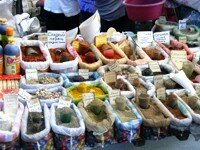
Colourful market display of spices
There are some people who love to go shopping … and there are others, like me, for whom it is a necessary evil. Still, even I have to admit that there is something fascinating about wandering through a bazaar.
Apart from the myriad of sensations, (sights, sounds, smells … ), it offers an insight into the daily life of the local population … and, who knows, you may just find that something special that you have been looking for – but didn’t know it.
Kyrgyzstan is in the heart of Asia, and the bazaars offer a special experience be it the colours of the fruit and vegetables, the faces of the prodvetsi, (the stall holders), the fabrics, the everyday household objects, the racks of clothes, the hustle and bustle of the crowd, the dodging of the trolleys as the porters yell, “Doroga, doroga!” (literally “Road, road” but meaning “Make way”) … or whatever …
Bishkek, the capital, has a number of markets, large and small, scattered throughout the city, each serving their local community. Some are specialized, (selling food, or clothes, or household items … ), whilst others are general purpose. Some are open air, whilst others are under cover in special buildings. From the Spring, through the Summer and into the Autumn, the food stalls are a blaze of colours with fruit and vegetables, herbs and spices, (but in the winter care may be needed to cope with the snow and ice).
Unfortunately, there’s another hazard, all year round, which is common wherever there are crowds – everywhere in the world … pickpockets.
The most famous of Bishkek’s Bazaars are Osh and Dordoi …
-
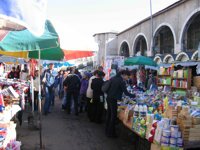
Osh Bazaar
Osh: The largest market in Bishkek, located at the Western end of Kievskaya. It has been described as a “must see” tourist attraction in Bishkek – but I think that depends on the tourist.The market is divided into different sections selling food and produce, with special halls for the sale of Dairy products and another a meat (although the squeamish might want to give that one a miss …) and market halls nearby selling clothes, household objects, hardware and all sorts of other products. In one there is a shop selling fabrics and, Kyyal, (which is Kyrgyz for Fatasy or Dream), a shop which specializes in Kyrgyz crafts such as shyrdaks and other felt objects. There is even a small pet market in the area to the south of the food market which is held on Sundays …
Despite the section on handicrafts, this is really a local market, meant for locals …
Traffic in the area around the bazaar can snarl to a halt, especially at busy times, and this has been a source of considerable controversy as the city authorities have attempted to renovate the area.
-
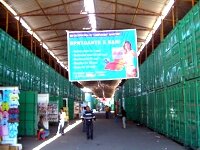
One of the Dordoi alleys … on a quiet day
Dordoi: (also known as Tolchok, which means “jostling crowd”). The bazaar, which is often referred to as the largest market in Central Asia, stretching for about 1 kilometer square, lies about seven kilometers from the city center, on the northern outskirts of town. To get there you need to take a taxi or marshrutka minibus, bus or trolleybus.Predominantly a clothes market, there are also sections selling household and electrical goods and other products – even furniture. It’s known as a wholesale market because, as well as ordinary residents from Bishkek coming to buy things for themselves and their homes, traders and shopkeepers from other markets and shops come here to buy goods to resell. This has helped to build its reputation for being the cheapest place to buy things but, sometimes, bargains can still be found elsewhere.
It was established in 1992 as wholesale markets around the region began to run into difficulties, Dordoi flourished, attracting Chinese goods – there is a large Chinese section in the bazaar – which were bought up by traders from Uzbekistan and Kazakhstan.
As well as the Chinese section, there is also a Turkish one selling Turkish goods.
Technically, it is an amalgam of several different markets, each with their own name, such as Ak Suu (White Water), Alkanov i Ko, Evropa (Europe), Kerben, Kitai (China), Muras – Sport, Sever, (North), Vostok (East) and Zhongali. The last one is technically a different market, the rest belonging to and administered by the Dordoi Association. The Association also owns and opperates other properties around the city – perhaps most notably the Alamedin Bazaar and the Dordoi Plaza Shopping Center.
It reputedly employs some 20,000 (as stallholders, security, administrators, service personnel, and so on).
It has attracted a fair amount of international attention as one of its features are that part of it is built out of some 7000 multi-coloured shipping containers, (from from rusty red to sea blue and deep green) … which serve as both stalls and storage space, arranged in alleyways. There is often two layers of containers with the on the ground serving as a stall and the one above it acting as a store.
In addition, there are some more traditional buildings surrounding the bazaar which serve as administration buildings, cafes and even hotels for the stall holders and toilets.
Also, small communities have grown up around the bazaar.
There has been some criticism that the Bazaar, despite being one of the biggest economic entities in the country, brings in precious little revenue to the budget in the form of taxes, partly because the stallholders operate on what is called the patent system rather than pay taxes on the level of business. They make a one-payment to the tax authority based on a presumption of the level of trade, and then are released from having to keep accounts and make reports. When there have been suggestions to revise the system
There are, however, others, such as:
-
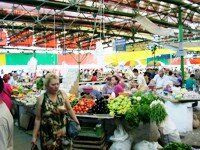
Alamedin market in Bishkek
Alamedin: A smaller version of Osh Bazaar, on the intersection of Jibek Jolu and Almatinskaya Streets, which tends to serve the communities on the Eastern half of the city. It is indoor market hall … which makes it easier to navigate in winter … and there are many shops and stalls in area immediately surrounding the bazaar;
- Comfort: which specializes in hardware, household appliances, and anything to do with DIY;
- Orto Sai: a general purpose open air market that serves the microregions in the south of the city, with a “flea market” at the eastern end;
- Kudai Bergen Avtorinke, (apparently it means: The God Given Car Bazaar); a few kilometers to the West of the city is an open space which operates as a market for trading second hand vehicles – and spare parts. Although it is open every day, it is busier at the weekends.
Also worth mentioning are:
- Most towns and villages operate a bazaar … such as Djalal Abad, Karakol, Kochkor, Naryn and Osh.
- Ak Suu – near the Uzbek border and similar to the Dordoi Bazaar in Bishkek, this acts as a wholesale market serving traders from Uzbekistan as much as the local population.
- Karakol Animal Market: said to be one of Central Asia’s best animal markets – even if the famous one in Kashgar is bigger and more colourful. Although it is called an Animal Market, it is primarily for livestock: sheep and goats, horses, cattle and the occasional came. It is held on Sunday mornings, with the animals being driven in from the surrounding country, sometimes even before the sun has risen. By mid morning, it is usually all over and done with … except for a few animals which may be sold at a lower price because the vendor has a long way to travel home and basically must sell before returning home.
- Osh: the bazaar, which runs for about a kilometer along the banks of the Ak Burra River, is referred to in most guidebooks as one of the most picturesque in all of Asia.
Some final points:
- In some of the larger bazaars, it is easy to get carried along with the general flow of the crowd … and the layout can be confusing – like being in a maze – it is easy to get lost.
- Many people think of bazaars as being different from shops where prices are “fixed”, and although it is possible to bargain, the stallholders may well have some leeway for discounts and price variations, it is probably not trying too hard as the mark-up is not always that great,(especially if the stall’s clientele are basically local).



 Bishkek