Glaciers
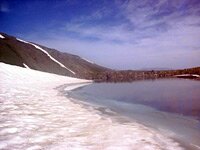
At the highest altitudes, snow falls and does not melt. As more snow falls, it compresses that which is already lying on the ground, and forms sheets of ice. Some of the ice is forced down mountain valleys forming valley glaciers gouging a course (typified in U-shaped valleys and hanging streams, which are left over once the ice retreats), and carrying debris (moraine) along its course to deposit it some great distance away.
The ice in valley glaciers, (known locally as “ice rivers”), can move at a rate between 3 and 40 cm a day, depending upon the size – width, thickness and slope of the valley. At the edges are often found crevasses – which may easily be covered by freshly fallen snow, and so present a particular hazard to mountaineers.
Glaciers, (8000 of them – one source says 8208), and permanent snow cover some 8100 square kilometres – about 30% of the total land area of the Kyrgyz Republic. The glaciers themselves cover about 4% of the surface area of the country.
Together, the glaciers contain some 580 billion cubic meters of water – enough to cover the whole of Kyrgyzstan to a depth of 3m.
Although a 1994 guide book says that many of the glaciers were advancing, more recent evidence indicates that they are, actually, in the process of retreating and a joint report from the United Nations Environmental Program (UNEP) and the World Glacier Monitoring Service (WGMS) says that during the twentieth century the area under glaciers in the Tien Shan range decreased by 25-35%. Another report, (from the Technical University of Dresden, issued in 2005), commenting on the Northern Tien Shan where the Kyrgyz and Kazakh borders meet, says that the glacier melt in the region corresponds with temperature changes with only a “little decrease” occurring in the period 1960-1975, but increasing significantly from 1975 onwards when the glaciated area decreased by 35-40 percent. The Kyrgyz submission to the UN Framework Convention on Climate Change in 2009 reported that in the event of global warming resulting in a temperature rise of 4 to 6 degrees then the number of glaciers could fall from around 8200 to a mere 142.
The situation is spread uniformly throughout the country. For example glaciers on the Southern slopes of mountain ranges are disappearing at a greater rate than those on other slopes.
The retreat of the glaciers will almost certainly have a number of serious effects on the environment, agriculture and economy as the glaciers of the Tien Shan provide the key source of water for rivers and mountain streams which in turn feed irrigation systems and reservoirs used for hydro-electricity production, (not just in Kyrgyzstan but across the whole region of Central Asia), and water supply for the urban centres such as Bishkek. The year 2008, in particular saw a dramatic fall in the water levels at the strategic Toktogul Reservoir leading to “electricity rationing” being introduced.
Other predictions of the implications of retreating glaciers include an increase in desertification, less water for irrigation and a consequent reduction in the land available for pastures and growing crops.
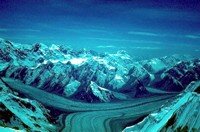
The most famous of the glaciers in the country is the Enilchek (Inylchek) Glacier – actually there are two branches – Northern and Southern in the Peak Pobeda/Khan Tengri massif in the Eastern Tien Shan.
Some glaciers are within easy reach of Bishkek, (for example the Ak-Sai and Adygene in Ala Archa National park).
Here is a list of some of the major glaciers to be found in the republic. Different sources sometimes give different figures for their length and area – possibly a sign of the effects of climate change.
| Glacier | Location | River | Length (km) | Area (sq. km) | Altitude at foot |
| Southern Enilchek | Pobeda/Khan Tengri | Enilchek | 60.5 | 632.3 | 2980 |
| Northern Enilchek | Pobeda/Khan Tengri | Mezebacher Lakes | 32.8 | 215.2 | 3400 |
| Kayingdi | Pobeda/Khan Tengri | Kayingdi | 29.0 | 97.2 | 3400 |
| Korjinevskovo | Zapaiski Ridge | Djanai Dartak | 21.5 | 99.4 | 3890 |
| Mushketova | Pobeda/Khan Tengri | Arir Ter | 20.5 | 71.3 | 3440 |
| Semyenova | Pobeda/Khan Tengri | Sary Jaz | 20.2 | 64.5 | 3340 |
| Lenin | Lenin | Achik Tash | 13.5 | 58.1 | 3760 |
| Mushketova | Kakshaal | Kotur | 13.3 | 23.0 | 3940 |
| Nalivkina | Kakshaal | Ai-Tala | 13.2 | 19.5 | 3960 |
| Keikal | Pobeda/Khan Tengri | Terekti | 12.9 | 26.8 | 3380 |
| Petrova | Ak Sheirak | 14.3 | 73.9 |





 Bishkek