An exercise in Public Relations
Shortly after the Easter Revolution the Interim government made a somewhat controversial decision to change the Mayor of Bishkek.
At this point in time, administrative posts in local government, such as the governors of oblasts, city mayors and akims (chairman) of local councils, were all appointed posts, not elected ones. Some politicians have said that they want to see these posts elected under the new consitution. The Mayor of the capital was appointed by the President, and it was a very important position, held in the past by many people who either been Prime Minister in the past, or would be future Prime Ministers. The last of the Mayors appointed by President Bakiev had been relatively popular and seemed to really care about getting things done in the city. A proramme of civic works, for example, was undertaken to clean up the city along with a number of landscaping projects. The cynic in me might be tempted to say that the programme, (which had been started under a previous Mayor but pursued by the new incumbent with gusto), was aimed at creating favourable conditions for last year’s Presidential elections as it not only made a difference to the way the city looked, but also served as a job creation scheme. These would in turn have a psychological effect and foster a sense of pride amongst the inhabitants for their city.
Removing him from office proved to be controversial because, many of the ordinary citizens of Bishkek felt that the sitting Mayor really cared about the city, worked for the city and was making a real difference to the city. Some of them actually felt so strong about it that they campaigned to lobby the interim government.
Despite that, it was decided to replace him. It was said that there were questions that he had to answer, and a criminal investigation was initiated. He denied any wrong doing, and claimed that his removal from office was, simply, “politically motivated”.
His replacement has been active, and continued the work which was already underway. It’s probably too early to make any judgment on his performance, as he has only been in post for a couple of weeks, but I have noticed one thing in particular, which I felt is worth a comment.
My email is now receiving a series of messages from “Bishkek Meria“, which emanate from the Municipality’s Public Relations Department. In the past, the only messages I can remember receiving from them were: an appeal from the elected councillors for calm on April 7th, following the events and civil disturbances in Talas the previous day, and later an appeal NOT tom replace the sitting Mayor.
In the last two weeks, since the appointment of the new Mayor following the revolution, I have received a small barrage of such messages, on a wide variety of topics, ranging from the survey of food prices in local markets, (which are monitored by the local authority), to meetings held between the Mayor and different groups, (such as with the Higher Education institutions located in the capital).
At the moment, it seems to me to be a bit disorganized …
For example, some days there are no messages at all, but on others there are five or six. To fair, I do understand that this is likely to happen everywhere, in any organization. There are, after all, “slow news days” whilst at other times there is a deluge of things happening … as the saying puts it: “It never rains, it pours”. Also, to be honest, I would be much more suspicious about “news management” if I received three messages every day.
Although I applaud the efforts at keeping people informed, and showing, the range of responsibilities and activities of the local authorities, (and indeed that the local authority is actually doing things), I am a bit surprised that a Public Relations Department hasn’t paid more attention to the question of “image”.
For example: there is no common format to the messages. Some are just text emails, others are formatted to be easier to read with logos and contact details; and others have attachments such as word documents.
The messages in plain text, in particular, are often just one long paragraph. It seems to me that it would be better to split it into short paragraphs which can make specific points, even if they are only one sentence each. Messages that consist of one long paragraph means that it appears like a stream of consciousness which has been typed in a hurry, without any thought, without any structure and without any review. That doesn’t strike me as the sort of image that a serious organization should want to convey about itself.
Now, it is always possible to criticize style, layout and structure. As a former teacher I am well aware of that. Not everyone, for example, will like my style, layout and structure, and I understand and accept that. I can say, however, that I do think about what I am writing, that I do try to structure my “postcards” to try and make them easy to read, and that I do review them before “publishing” them. “Mistakes” do sometimes slip through the process but, then, I do not claim to be perfect in this respect.
Another point which strikes me as a foreigner, non-native Russian speaker, is that the texts are difficult enough to read anyway. I find that it is not easy to “scan” a document in order to get the gist of what it says. It’s not just a case of knowing the language, or not, as the case may be. Letters of the Cyrillic alphabet, used for both Russian and Kyrgyz, are all the same size and occupy a rectangular, or square, space. As a result, words in Russian look to a foreigner like boxes of different lengths … whereas, in contrast, letters in the Latin alphabet have different shapes and sizes, some with extensions which reach above the main part of the letter, and some which extend below. This means that every word has a different shape which makes word recognition easier, and facilitates “scanning” the text to get the gist of the text, or “speed reading”. Now, I know that the recipients of these messages are mainly locals, so they are written in Russian, or Kyrgyz, and so the rectangular shape of words is inevitable, but text that consists of just one continuous paragraph in Russian, or Kyrgyz, can be difficult to read as it is just one large rectangle, (the paragraph), comprising of a series of smaller rectangles.
Most of all, however, I am left asking myself the question: why send these messages to me at all?
A press release might be interesting to read, but should really be sent to those working in the media, who then decide how to use, how to publish, the information. So, why am I receiving it?
Notices about specific topics which might be of interest to me, would be useful, but that would require a set of different mailing lists – it seems that, at the moment, they only have one … which, once again, seems to me the wrong image to send out. It strikes me as the “blunderbuss” approach – fire enough grapeshot in the general direction of the target and hope that some of the pellets will hit it. The others are wasted, not the expense expended on the wasted effort is not so great as to make the whole exercise a total waste of time.
Notices about topics that are of no interest to me arrive in my mailbox and take time to read, (or to simply “scan” so that I can confirm that it’s not relevant to me), which serves as an irritant … which is not the effect that a Public Relations exercise is supposed to create.
Some announcements seem to be designed to communicate decisions of the local authority, especially where the decision affects all organizations “regardless of their form of ownership, organization or establishment” … that is to all organizations, enterprises, and so forth in the city … municipal, commercial enterprise, non-commercial voluntary bodies, etc. One such message, for example, concerned the preparations for Dehn Goroda – City Day, but more about that in a separate postcard.
It seems to me that detailed “Announcements” on specific topics could be circulated to specific, identified, target groups. For example, Press Releases could be circulated to those working the media, information about Price Monitoring to Public Associations working with the population, and traders.
For a wider, more general audience, it might be better to compile a short, informative, newsletter to distribute regularly, say, once a week. This could include snippets about all and any topics, , with a note to say that further details are available on request for interested parties. Such a newsletter could be circulated to a distribution list which includes “all and sundry”. Of course, it should be well presented in a readable, comprehensible and attractive format. This will involve some time and effort in selecting, editing and presenting the information… but I think that the effort would reap rewards. It would help to disseminate the information to as wide a range of population as a whole, and enhance the image of the municipality as an institution … and, thus, should help contribute towards the awareness of, interest in and pride in the city amongst the population.
Which is presumably why the new Mayor has instigated the programme in the first place.





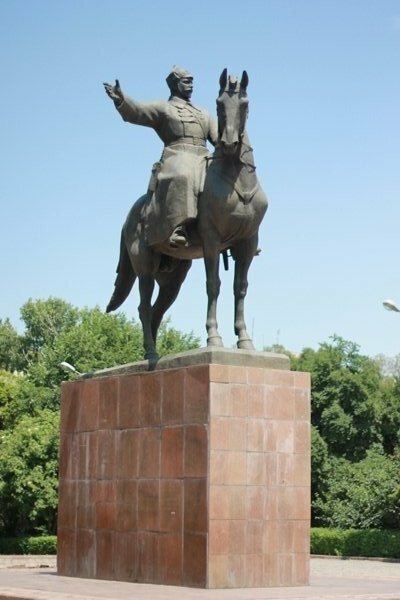
 Bishkek