Singing an ode to Kyrgyz apples
A few years ago, we had an enquiry from a tourist who wanted to come to Kyrgyzstan “to see the apples”.
This caught me by surprise.
Although I was aware that we grow a lot of apples here in Kyrgyzstan, I was intrigued as to why someone would want to travel all this way to see the orchards when we grow an awful lot of apples in the UK as well. Indeed, in our garden we had four apple trees of different varieties, (two “eaters” and two “cookers”) which almost every year bowed on the weight of the plentiful fruit. Many fell to the ground before we could get to pick them – and one of my regular jobs was to rake up the “windfalls” and sort them into ones that could be salvaged and others which were to be composted.
So I went off and did some research.
To my amazement I discovered some learned articles in a variety of journals that seemed to suggest that, although the apple was now found virtually throughout the world, it’s origins were thought to be deep in the Tien Shan mountains. As it turns out, deep in the Kazakh Tien Shan, not the Kyrgyz part of the range – a little bit to the East of the modern republic.
The research seems to show that the modern apple evolved from seeds which had blown over the mountains from China many millions of years ago and then seeds were transported westwards over a period of time – naturally at first, (for example carried by migrating birds or simply blown by the wind), but in more recent times, (over the last 10,000 years), with the assistance of human intervention. Everywhere, the fruit proved to be a popular food and the cultivation of trees began with grafting and new hybrids were developed wherever mankind settled.
For the record: As it happens, it’s not just the apple that it thought to have originated in this area. Central Asia turns out to have been a real melting pot in the world of flora. Rhubarb and the tulip, for example, are also thought to have their origins here. Surprisingly, the walnut, for which Kyrgyzstan is particularly well known as it hosts the world’s largest extant of wild walnut forests, probably didn’t originate here – but it probably the source of the European walnut. Alexander the Great is supposed to have found the tree when he conquered the region and sent some back to Macedonia where it thrived. Oddly enough, they are still known in Russian as Grecheskiy Orecky – Greek Nuts – which is the cause of a little annoyance locally.
Anyway, in Kyrgyzstan there are numerous varieties of apple – varying in shape, colour, size and sweetness. For several years there has even been an Apple Festival organized by the Association of Orchardists and the Gardens and Plastic project, (the first one being held in 2005, and it has been held annually, in October, ever since), to commemorate and market the fruit – giving people the opportunity to taste and purchase some of the wide variety of organically grown produce, products made from apples (and other food and beverages), as well as giving people the chance to have a good time. The Festival has normally been held in the Issyk Kul region, but this it was held in Kochkor, in the Naryn oblast.
In fact, I hadn’t heard anything about this year’s festival – we received no leaflets or posters, unlike in previous years. So the first I heard about this years’s event was when I received the latest issue of the IBC Monthly Newsletter, which included the following article:
Singing an ode to Kyrgyz apples
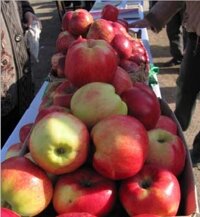
Communities of Issyk-Kul and Naryn oblasts and the “Nur-Omur”Association, with the support of Kompanion Financial Group,Mercy Corps and the Kochkor District Administration held the 5thAnnual Apple Festival on October 30, 2010 in the Kochkor villageof Naryn.
This year’s Apple Festival brought together about 400 people from 40 villagesof Naryn and Issyk-Kul regions to celebrate this year’s harvest. The day wasfilled with exciting contests and competitions for adults and children, humoroussketches and jokes, musical performances, as well as the traditional andthe most delicious part of the holiday – apple tasting and the display of originaldishes made with apples.
In addition, to further the development of organic horticultural practices andagricultural market linkages, event organizers facilitated round tables to providecommunity members an excellent opportunity to discuss and identify important ecological and economicissues at the local level for further joint development.”
The tradition of the Apple Festival was born in 2006. This year’s Apple Festival is held in the Naryn region forthe first time. Communities of Kochkor took the initiative to introduce gardening experience that serves as agood example for others, “- says Erkinbek Zhumabayev, Kompanion’s Chief Liaison Officer.
There was tough competition in the fight for the title of the “Biggest Apple.” A juicy fruit weighing 700 gramstook first place. Among the vegetables, the winners were: a 4 kg beet; a 12-pound pumpkin; and a huge potato,weighing 1.6 kg.
I am used to receiving announcements of different events just before, (say a day or two), before they are going to happen, but this time, the first I knew about it was three weeks after it had happened.
What a waste … I would have liked to have gone – and I can think of several others who might have enjoyed the day out as well.
These events are normally small scale – something approaching a village fete back in the UK, but they are fun all the same – they get me out of the office … and you never know quite what you might come across. Last year, for example, at a similar festival I found several jams that I had never tried before – including Pine Cone Jam – a speciality of the Issyk Kul region. It wasn’t bad … tasty and interesting. (Nothing, incidentally like the Greek wine Retsina which is fermented in Pinewood barrels and often credited with tasting like disinfectant – which is a little unfair. Although Retsina is not my favourite wine – and if there was a choice I would choose the alternative – it is not too bad.)
Unfortunately, this is not the first time that something like this has happened – that we have learned about an event only after it has happened.
Why does it happen? – because there is a tendency here to “do, nothing, do nothing, do nothing” – and then – “rush, rush, rush” as the appointed date becomes imminent. I keep saying to people that if they want their events to be well attended then they need to market it – and if they want us to try and encourage tourists to attend, then we need to know about them well in advance … preferably a year in advance, so that we can include them in our planning and marketing and offer them to clients as part as part of their itinerary.
For example, the clients with whom I opened this postcard would have been delighted to have gone along. When they came to Kyrgyzstan – it was the wrong week for the festival and although they saw lots of fruit orchards – especially apples -the trip wasn’t exactly what they had in mind. It didn’t stop them, however, recommending a similar to some of their friends who also wanted to undertake a pilgrimage to the “home of the apple” this year. However, for various reasons – something to do with a revolution back in the Spring – that particular trip was restricted to Kazakhstan … although they say that they may come back to visit Kyrgyzstan next year. Maybe, we’ll be able to arrange a trip to the festival for them if they do come.
Anyway, this year I missed the chance of weekend out. What is really annoying, is that I passed through Kochkor that weekend – twice … on my way to Naryn, and back. It would have been nice to have taken the opportunity to call in.
If only I had known!







 Bishkek