Vanahun and the opening shots of the Battle of Kursk
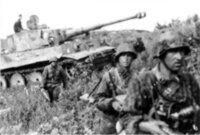
Opposing forces - German troops at the Battle of Kursk
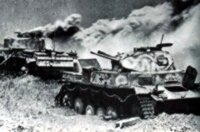
Opposing forces - Soviet tanks at the Battle of Kursk
For 50 days in 1943, (between July 5th and August 23rd), one of the biggest battles of the Second World War was contested between the German Wehrmacht and the Soviet Red Army.
Some say that it was the biggest armoured battle, not just of the war but of all time – involving something like 700 tanks … although some historians, whilst admitting it was a sizable engagement, think that the title should go to another battle between the French facing the German invaders at the start of the war. They also point out that in addition to the armour, there were lots of other forces thrown into the battle – the respective airfoces and considerable infantry divisions.
There is no doubt, however, that the battle was influential, if not a fundamental turning point. in helping to decide the final outcome of the war.
Kursk is on the Western border between Russia and the Ukraine - almost as far West as you can get in Russia, (yes, I know that’s a slight exaggeration – but I hope it makes the point about its relative position), although in 1943, of course, it was well inside the Soviet Union.
Operation Barbarosa, launched in June 1941, saw German forces being sent into the USSR, and for a while things were not going too well for the Red Army. Stirling and determined defence, however, had stopped the invaders short of Moscow and bogged them down at Leningrad and Stalingrad.
As the Soviet position strengthened around Stalingrad, and their own weakened, the Germans High Command sought to launch a campaign, (Operation Citadel), which would involve simultaneous attacks on the Northern and Southern flanks of the salient – encircling the Soviet forces, before striking Eastwards and once again threatening Moscow.
They began a massive build up of forces in preparation for launching the attack – amassing some 50 divisions (including 16 armored and motorized division), with more than 900 thousand people, 10 thousand guns and mortars, almost 3000 tanks and assault guns, and over two thousand aircraft. All this did not go exactly unnoticed by the Soviet High Command, who not only received intercepts of Enigma coded military signal traffic from the British – but were also apparently fortunate enough to receive firm intelligence from captured German soldiers about the plan for the attack.
As a result, they were not only able to prepare in order to meet an attack, (building up forces in depth – with over a million three hundred thousand people, more than 19 thousand guns and mortars, almost three and a half thousand tanks and self-propelled guns, (including more than 900 light tanks), amd almost three thousand aircraft. Some were allocated to large reserves held in the rear and able to be launched when and where reinforcement was required).
Convinced that a reconnaissance raid on the Southern flank of the 550 kilometer long front around the salient, which indeed it was, they decided to launch a preemptive bombardment just before the Germans were do to begin their own. Although this didn’t win the battle in itself – it did help to make Kursk the first that a German Blitzkrieg strategic offensive was halted before it had penetrated deep into the opponent’s territory and achieved considerable strategic aims. Within a week the Germans had lost about 60% of their armour and were forced onto the defensive … a long and exhausting withdrawal … harried by continuous counter attacks, guerrilla tactics operated by regular troops and partisans, constantly piling on the pressure.
The German High Command, however, were severely hampered by Hitler’s distrust of many of the officer’s in Wehrmacht and his insistence that the army hold their position and not withdraw – leading to many being trapped in untenable and insupportable positions.
By August 23rd, the Germans had been pushed hundreds of kilometers back, lost huge amounts of equipment and a considerable proportion of their manpower. Losses were considerable on the Soviet side as well, but the balance of power and the initative had shifted – in favour of the Soviets … and was to stay there for the rest of the war.
This year marks the seventieth anniversary of the battle – and today is the seventieth anniversary of what is considered to be the end of the engagement … although the Germans tend to refer to the initial stages around Kursk itself as the battle whilst the Soviets grouped together the subsequent engagements around Orel, Belgorod and Kharkov.
Incidentally, the liberation of Orel and Belgorod led to the first ever victory salute in honour of the Red Army, with fireworks set off in the sky over Moscow – on August 6th, 1943.
To the citizens of Kyrgyzstan – or the Khirgiz Soviet Socialist Republic as it was then called – the battle was an important engagement. In the early days of the war, following the launch of Operation Barbarosa, the population was mobilized and something like a quarter of the manpower of the republic enlisted in the Red Army.
The 385th Infantry Division, for example, was formed in Frunze and throughout the war received material assistance form those left back home – and the troops were known by the nickname Frunzenty. The Division saw action around Kirov but also played a role in the Battle of Kursk.
Some of the troops from Kyrgyzstan were stationed in the village of Alexandrivka, on the Northern flank of the salient, and were among the first to engage the enemy. In the defence of village, there was a mortar emplacement under the command of Sergeant Mansuz Vanahun. In the course of the battle it was surrounded and only Vanahun was left alive. Having run out out of ammunition he threw a grenade at the advancing enemy, but if failed to explode and over a dozen enemy soldiers stormed into his trench. Seeing that capture was inevitable, he took a shell and ripped off the mine cap, striking it down on the mortar base plate causing it to explode. He took his own life but also took some 50 of the enemy with him and prevented his weapon from falling into their hands. In recognition of his sacrifice, he was granted the title of Hero of the Soviet Union.
And that was just the start of the battle – of fifty days of fighting.
That’s probably the most often story told of the Kyrgyz at the battle of Kursk – but the roll of honours awarded to soldiers from soldiers from units such as the 14th Alay-Gulchinskiy, the 162nd Central Asian Infantry Division, the 224th Pamir Regiment and the 67th Guards Rifle Division, and which included the Medal of Courage, the Order of the Red Sta for Valour, the Order of Bogdan Khmelnitsky, the Order of Alexander Nevsky, the Order of the Red Banner, and the Order of Suvorov, indicate that it wasn’t exactly an isolated incident.
I have to admit that, although I was already aware of the Hero of the Soviet Union award, I hadn’t heard of all of the others beforehand … but they do sound impressive.
.
Incidentally – there’s a bust of Vanahun in Kant where the local unit of the Border Guards is also named in his honour.





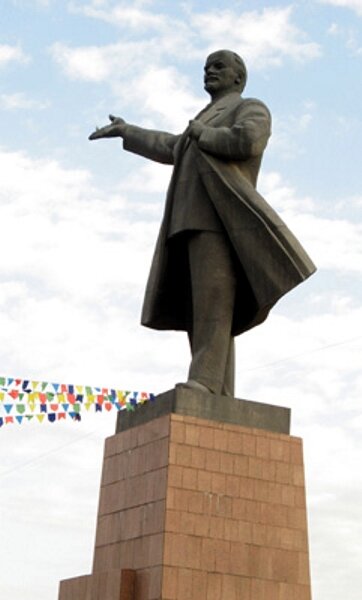

 Bishkek