Ecotourism – what’s that?

Picture: "What is ecotourism? Presenting the popular and not so crappy graph" by Planeta -
The other day I had a visitor, a student preparing a report on Ecotourism and Sustainable development.
Everything went well until she got to the question “Have you heard about ‘Ecotourism’? – and, if so, what does it mean?”
I’m afraid that I laughed and said, “Yes, I had … “, but when it came to the meaning there was a problem … “because nobody knows what it means.”
There was, for example, an excellent text book on the subject that was published here a few years ago that identified about a dozen different ways that the term could be understood.
It’s a term that seems to have changed its meaning over the course of time – or at least to have adopted new emphases and interpretations.
She took me aback by saying “I do!” … and I know that I should have followed that up with another question … but I let it pass. A missed opportunity
The trouble is that there is no generally agreement as to what the term means; no definitive definition – if that’s not a contradiction of terms.
Perhaps the closest to a “definitive definition” is the one that was adopted by The International Ecotourism Society, (TIES), in 1990: “responsible travel to natural areas that conserves the environment and improves the well-being of local people“, … but even this is not without problems.
For the record: it is not really clear who coined the phrase – so we can’t ask them what they had in mind. The term seems to have been around since the 1960′s but was “popularized” in Mexico in the 1980′s.
Since then Ecotourism has become an increasingly important and growing sector of the tourism industry as tourist perceptions and aspirations have changed – perhaps even acting as an agent in that very change.
In fact it has become such a powerful concept that tour operators, hotels and other service providers seem to bandy the label around almost as a totem.
Although everyone seems to have their own understanding, the differences are not necessarily one of definition, but may simply be examples of a difference in emphasis.
There does, for example, seem to be a general consensus about the some of things that ecotourism should entail – which basically boils down to having a “care for the environment”: the wildlife and plants; using energy saving devices; leaving a “low carbon footprint”, (which can be a bit of a problem for remote locations such as Kyrgyzstan); conserving water, (so a round of Golf is presumably out); … and so on.
Perhaps this is best summed up by the motto: “Take only photographs, Leave only footprints“.
My interviewer told me a story that illustrated this “ecological” emphasis on conservation; about how she had asked one tour operator, (but she didn’t tell me if it was a Kyrgyz tour operator or someone abroad – and I didn’t ask … I know, I know, another missed opportunity), if their tours could be described as “Ecotourism” … and they replied something like, “Yes, we take our groups out into the countryside, into nature – so they are Ecotours”.
Incidentally, it’s always struck me as odd that those first three letters of the word – “eco” – with their implied connection to that trendy term ecology” can be soooooo misleading! After all, “eco” is also the start of “economy” and “economical” … so why can’t the term refer “budget holidays”?
There are, however, other aspects to the “environment”, however, which can be more widely interpreted than simply referring to just the physical environment; there is also the social and cultural environment … and hence the inclusion in the TIES definition of improving “the well being of local people”.
Incidentally, it seems to me that there’s yet another aspect to it as well … our responsibility to future generations … ecotourism has been considered an important element in helping to ensure that future generations may experience destinations relatively untouched by human intervention … in the same way that the current tourists can.
On their website, for example, TIES extends their own definition of ecotourism beyond just conservation and improving the well being of local communities by referring to:
- Conservation - protecting the natural and cultural heritage found in the destination, “conserving and enhancing bio-cultural diversity” -
- Communities - increasing the local capacity building and employment opportunities, empowering local communities to fight against poverty and to achieve sustainable development
- Interpretation - enriching personal experiences and environmental awareness, promoting a greater understanding and appreciation for nature, local society, and culture.
The graphic, taken from a presentation, offers a different interpretation of the term – suggesting that Ecotourism represents the intersection of interests of the natural environment, (Conservation), the Local Community, (not just the “service providers” but also the wider host community) and the industry (represented by Profits).
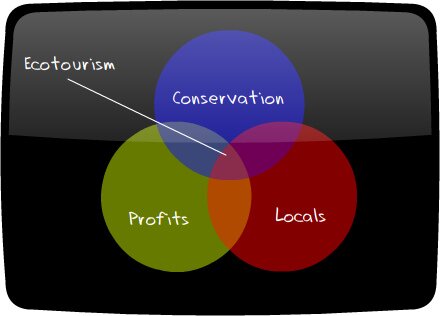
Picture: "What is ecotourism? Presenting the popular and not so crappy graph" by Planeta -
Whilst it brings together the location (in terms of Conservation) with the Local community, it also brings a new element into consideration: the idea of Profit – tourism is, after all, an economic activity.
Personally, however, I have a little problem with this analysis … as it misses out the other major player in the scenario … the tourist themselves and their interaction with the locale, its environment, the local community and their culture.
Ecotourism is often seen as involving tourists to visiting areas of natural beauty, (with fragile, pristine, and relatively undisturbed natural environments – so presumably city center locations, like downtown Bishkek, don’t qualify), and emphasizes ”low-impact” and often “small scale” alternatives to standard commercial tourism, (otherwise referred to as mass tourism – which also suggests problems associating areas such as Issyk Kul with the label “Ecotourism”).
Tour products, (such as itineraries, destinations, accommodation or other facilities), that can be described using an Ecotourism label, can serve many different purposes, such as:
- to “educate” the traveler, and/or
- to help raise awareness and funds for “ecological conservation”, and/or
- to directly benefit the economic development and political empowerment of local communities, and/or
- to foster respect for different cultures and for human rights.
So, Ecotourism represents a balancing act.
- Making accessible fragile and remote locations to visitors from far away, whilst
- minimizing their (negative) impact on the destination, whilst at the same time
- maximizing the positive contribution that they can make to the host community, possibly even providing for enhancements and improvements, and
- making a contribution to mutual understanding between peoples and communities.
Oh, yes, and for the record … Kyrgyzstan is definitely a good candidate as an Ecotourism destination. It:
- is remote – even when it comes to those who live nearby … after all, remoteness is not just a question of distance … and getting to the destination can be time consuming and difficult;
- with a fragile natural environment that includes a number of rare and endangered species, melting ice caps and serious pollution concerns;
- has a population which is generally poor and subject to social pressures,
- with a distinctive culture that is under threat from the pressures of globalization and the modern world,
Incidentally … it’s not just Ecotourism that has this problem with definition … the student was also asking about “Sustainable Tourism” and this also suffers from a rather opaque definition. Indeed, when I went looking for it on the website of The Global Sustainable Tourism Council, (GSTC), which claims to be “the international body for fostering increased knowledge and understanding of sustainable tourism practices, promoting the adoption of universal sustainable tourism principles and building demand for sustainable travel”.
When I went looking for what they meant by the term “sustainable Tourism”, however, it appeared that although they said a lot about who they were and their activities, a definition of the term seemed to be singularly lacking. To my mind it should have been there on Home Page, but I had to go looking … and I eventually found the following definition of Sustainability: “Use of resources, in an environmentally responsible, socially fair and economically viable manner, so that by meeting current usage needs, the possibility of its use by future generations is not compromised.”
Actually, that struck me as quite a good working definition … so why, I wonder, was it hidden away and broadcast loud and clear on the opening page?
Of course, it leaves an open question … what are the differences between this and Ecotourism, Responsible Tourism … and any of the other “trendy” terms that have been coined? … Why do we need a separate concept. In face, I think I can see some … but t would be nice if it had been made crystal clear to avoid any misunderstanding.


 Bishkek