To tip, or not to Tip … That is the question

A tip ... left by a satisfied customer ... or ... ?
One of the most difficult questions we get asked by clients is about tipping. Should they give a tip? and, if so, how much?
In some countries, leaving a tip is not only customary, it is expected.
I remember, for example, reading a story of a dissatisfied customer in America who, when presented with the bill in a restaurant, duly filled the billfolder with the required amount, got up and left. As they walked down the street, they were somewhat surprised to find that they were being pursued by the waitress who apparently said, “You forgot the tip”. Somewhat astounded by the “effrontery” of this approach he replied … “No, I didn’t … I didn’t think you deserved a tip.”
Although I have a lot of sympathy with the diner’s point of view but I am not sure whether I would have responded in the same way, especially knowing that in many parts of the world, the salaries of people in the catering industry, (and in hospitality generally), are basically very low and the employees’ main source of income is based on receiving tips.
That’s not the situation here in Kyrgyzstan … although the salaries are still low – a combination of low salaries in the country generally and the standard practice in the industry worldwide – but they are supplemented by the “service charge”. I tried to explain the difference between Tips and Service Charges in a postcard a couple of years ago. Basically, the price for the meal quoted on the menu is the cost of the meal itself, but a service charge, (which can be anything from 10% to 20%), is added and used to supplement the salaries of the employees. Order an expensive dish and the staff receive an additional boost to their salary, but choosing the cheapest item on the menu means that they too receive less.
Perhaps that’s a reason why some waiters, (and I can think of one in particular), who are very “forward” in proposing those little extras like bread, sauces … or dessert, and almost frowns if you decline … or tries to “up sell” and suggest a more expensive option when it turns out that the item you selected from the menu is not available for some reason or another.
For example, a friend of mine went into a restaurant and, amongst other things, ordered a local beer, (by name), to go with his meal. When the waiter arrived with a glass of different, more expensive, imported beer my friend naturally responded with, “No, no, that’s not mine, I ordered a ****”, only to be told that there was none left and the barman had poured this as an alternative. Now, my friend was an economist and understood only too well that – although it may raise questions about the stock management – “these things happen”, but he decided to pursue the point. Why wasn’t he told and offered the alternative – maybe he would have chosen something else instead. Apparently, the waiter forgot that he was working in a service industry and adopted a “that’s all there is, take it or leave attitude.” If it had been me, I think I might well have decided to leave it – the restaurant that is … but my friend decided to take it further and asked for the manager.
By his account it was a long and involved conversation … touching on a number of issues but concentrated on the “quality of service”. When the question of service charge came up, (which, of course was higher for a more expensive beer), he asked, “What do I get for my 20%”.
It seems that the manager decided to dodge that one and instead of admitting that it represented the source of the employees salaries, he mentioned things like the ambiance, the decor and … oh, yes … and the high quality of service.
“Why,” my friend asked, “was the waiter paid more for delivering a glass of imported beer than a glass of local beer?” Where was the additional service that warranted an additional payment? …
To be honest, I only heard one side of the story … and I hasten to add that this didn’t happen in Kyrgyzstan – but in another Central Asian capital city … but I tell it because I think it makes the point.
Incidentally: this is also a reason I never really ask for suggestions off the menu … I see a conflict of interests … although I will ask, “what have you got today?”, “what’s off today?” … but that’s another story.
Maybe it is because I am British and, generally, we don’t add a service charge to the cost of the meal … although I understand the situation is changing … that in our hotels we don’t add a service charge. The price on the menu is what you pay – Technically, the salaries of the staff are factored into the price, and any tips that they do receive is theirs.
We do say that if someone feels that they want to reward a member of staff for particularly good service, then they should hand it to the person directly. That also saves us the hassle of administration and accounting – both of which are complex enough without this additional headache. It’s a veritable minefield.
Although there are ways around this, basically, if we include the service charge then it becomes a part of our income and thereby subject to tax … and is taxed again as Income Tax when their staff member receives their salary.
In both Britain and the States, there have recently been a number of highly publicized legal decisions concerning employers – including some well known names – withholding all or part of the “tip”, (or “gratuity”), and also relating to employees who do not declare the full value of the tips they receive.
A recent article referred to the different attitudes towards tipping in various countries. Drawing on data gathered from TripAdvisor, it reported that the Germans are the most prolific tippers, followed by Americans and Russians. In all the other countries where the survey was conducted, less than half of the respondents said that they alwaysleft tips when on vacation. Britain and France came in fifth and six place, ( both with 39%), of the respondents saying that they left tips.
- Germans – 69%
- Americans – 57%
- Russians – 53%
- Brazilians – 40%
- French – 39%
- Brits – 39%
- Spanish – 36%
- Italians – 23%
There is a vague reference to The Americans were particularly interesting because, if the number of respondents who said that they sometimes left tips, then the percentage rose to a staggering 99% – in other words it was an almost universally accepted practice – a “cultural norm” or “social obligation” – with 21% reporting that they actually felt “guilty” if they didn’t leave a tip.
There are even guidelines issued by the Hoteliers and Restaurants Associations and even on websites like CNN, and TripAdvisor has a similar list especially for the States; There’s even a site dedicated to the whole topic of how much to tip in different situations.
If it is a cultural norm to tip in America, that’s not the same everywhere … the article mentions, for example, that there is no real culture of leaving tips in places places as varied as Belgium, Estonia or South Korea – and they missed out some other places like Italy, Japan and Spain … they did report, however, that it is not allowed in China, (it even says that the practice is actually illegal – but I haven’t been able to confirm that).
For the record: Wikipedia has an interesting list comparing the practice in different countries … but it doesn’t include Kyrgyzstan.
The fact that some people actually felt guilty if, for some reason, they left me wondering left me wondering about why they chose not to do so … but the article didn’t go into that. Instead, the author’s main purpose was to discuss the factors that affected the “tipping behaviour” of clients, especially its value as a motivator for improving the quality of “customer service”: the friendliness, helpfulness and politeness of the staff.
They quoted examples from other research a variety of other such factors which affected the tipping behaviour of clients, including:
- the desire to reward examples of “good service”
- as a “carrot and stick” means of “controlling” the quality of the service – for example, the authors cited research suggesting that waiters sometimes give “poor service” when they “expect” a poor tip and that few waiters didn’t reward diners who tip well with some form of preferential service.
- the quality of the food,
- the reputation of the establishment,
- a desire to impress others,
- or simply out of habit, a sense of social obligation or just plain and simple – generosity.
They even cited suggestions that the choice of muzak, (background music), being played and even the colour of lipstick a waitresses wears can affect the size of a tip. Indeed, there is other research, (that they don’t quote), that even the weather plays a role … people tend to tip more when the sun is shining.
Personally, to my mind the first of these is the main, (if not only), reason for tipping someone: as a reward for examples of good service – to show appreciation and gratitude to someone for exceeding expectations and doing more than simply “doing their job”.
I appreciate that might give me a problem in somewhere like China where there is no tradition of giving tips. Despite the fact that Russia came out quite high in the TripAdvisor data, this tends to include most of the former communist countries … such as Kyrgyzstan.
It was once explained to me that the official attitude had been to frown upon the practice of giving tips as capitalist and bourgeois … people were paid for doing their job and they didn’t need the additional money … it was an a form of insult to offer them a “bribe” like this. Despite this, it is always pleasant to be “appreciated”, to have one’s efforts “recognized”, and it is pleasant to receive “gifts” … and so forth, and so most would eventually and quietly accept tips if and when they were offered – even whilst still protesting that “it really isn’t necessary!”
I remember, for example, being in Albania – a former communist country shortly after the fall of the communist government, and having changed some money into Albanian Leks, being surprised that there was virtually nothing to spend it on. At the end of the trip I had virtually the entire sum left intact. Fortunately it wasn’t a huge amount, but I was left in a quandary – what to do. I appreciated that it was going to be difficult, if not virtually impossible, to convert back to Pounds, so – having saved a few banknotes as souvenirs – I resolved to give it to our guide as a tip. He had been informative and entertaining and given me lots of material for stories to regale my friends back home with. When I tried to give it to him, however, he was quite adamant … No, no, it wasn’t necessary … he was just doing his job. I finally persuaded him to take it by pointing out that it would be better for him to have it and put it to good use than for it simply to sit a drawer at home.
Things, however, are changing. In Britain, the service charge seems to be making inroads in some establishments and I see in a guide that bills itself as a “luxury Web publication providing objective analysis and information to affluent consumers”, that a “gratuity is usually included” in restaurants in the UK; if that is true, then it’s not a development that I welcome.
Here in Kyrgyzstan, tips are now accepted as normal practice. Indeed, in my opinion, we are adopting the less attractive aspects of Western culture: its becoming “expected” that there will be a tip.
So to answer the two questions I started with:
- Should I give a tip? – depending on your level of satisfaction … yes. It will be appreciated, reward good service and encourage future good service – even if you are unlikely to return to that establishment again … even if there is a service charge.
- How much? – that depends on how much you value the service you have received – almost any sum will be gratefully appreciated. I appreciate that this looks as if I am trying to “dodge the bullet” and simply pass the buck back – leaving all the responsibility to the individual concerned – but then, tipping is both a personal thing and also reflects national cultural attitudes. I think that one approach might be to simply adopt the practice that you have at home.
To try and be a bit more concrete, let me outline my personal approach when if comes to trying to decide on how much to give as a tip:
- If I am very dissatisfied with the service I have received, then I ask to see the administrator or manager, and explain to them why I am unhappy. Fortunately, it doesn’t happen very often – I can only think of a handful, or so, of cases in the eighteen years I have been here … but the teacher in me says, “treat it as a learning experience and explain so that they have the put it right for the future”.
- If I am not particularly satisfied then I pay the amount shown on the bill – if possible and I have the correct change, down to the exact som.
-
- Also, if it’s a type of “self service” venue or a bar/café with a jar for Tips, I still tend to pay the exact sum … occasionally I may put something in the jar if I think that there is a reason. (I try to remember that it may be self service … but someone still clear away and clean the table and they are likely to be among the poorest paid staff in the place … but the Tips jar is usually split anyway so I want to “thank” them in particular, for example, in helping me find a table in a busy establishment, I tend to leave something on the table rather than in the jar.)
- If the service has been satisfactory, but nothing out of the ordinary – if I feel that they are just “going through the motions” and ”doing their job”, then I tend to return the favour and “go through the motions” too. I round up the sum shown on the bill and forget the change.
- If I happy that the staff have been indeed been friendly, helpful and polite, treating me with the attention and courtesy that they would like to receive if the roles were reversed, then I will give more than just change – usually 10% of the bill, but sometimes more … and
- If I am really happy with a particular person for showing exceptional care for me as a client, then I may give a specific sum – depending on the circumstances – and I try to make sure that it goes to the particular individual who has shown commitment and dedication.





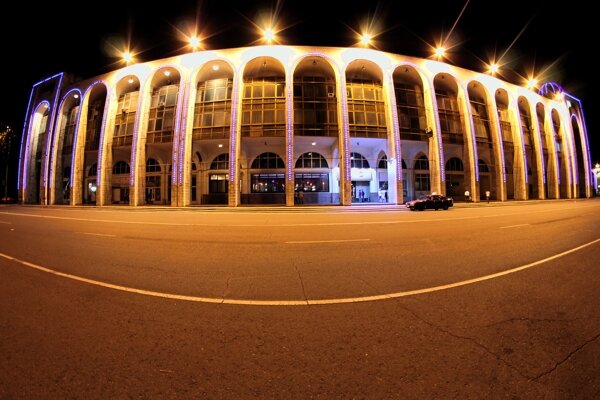
 Bishkek