What a hoot! – the owls of Kyrgyzstan.
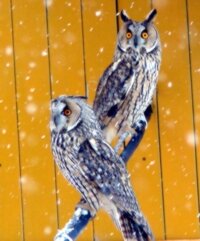
A pair of owls resting
Yesterday, 31st July, was Harry Potter’s Birthday … so I thought I would mark the occasion by paying attention to a character from the stories: Hedwig … his pet owl.
There are something like 400 different species of birds found in Kyrgyzstan … including ten of the order Stigiformes - that is … Owls.
For the record: there is another form of owl, the Tytonidae – often referred to as Barn Owls – but, as far as I can ascertain, there are no known species of this type of owl found in Kyrgyzstan.
Owls are birds of prey that are found throughout world, (except for Antarctica, most of Greenland, and some small isolated islands).
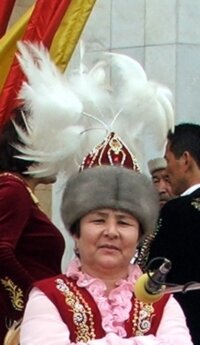
Kyrgyz traditional hat decorated with feathers
The association with magic and sorcery is fairly widespread, but it’s not just down to Rowling’s Harry Potter. (Apparently, the Harry Potter phenomena has led to a huge demand for owls to be kept as pets). Owls have featured in many different cultures and they have often been characterized as harbingers or symbols of death or bad luck, or alternatively as symbols of wisdom.
Here in Kyrgyzstan, they are associated with combating evil spirits – their feathers are particularly prized as a feature in the Shokulo, a tall conical hat made from a thin layer of felt, laced with bright materials and pieces of expensive furs and with a veil to cover her face. It was decorated with silver and golden ornaments, precious stones – and long pendants of coral, pearls and turquoise – which reflected the wealth of the brides family – and feathers of an eagle or an owl -the owl feather is to protect from “evil spirits” or “evil eyes”.. .
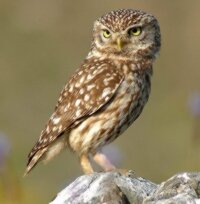
Little owl - a native of Kyrgyzstan
One of the possible reasons for the negative associations that are common in many different cultures may be due to the fact that it’s hunting style tends to rely on stealth and surprise. Most are nocturnal creatures although some may be active in the hours of sunrise and sunset. Their foliage often blends well into the background making it difficult for their prey to see them and their wings have special serrated edges which help to muffle the sound of their beating wings meaning that they are rarely heard as they descend on their prey in the dark night sky … until, that is, it is too late.
They can vary in size considerably, from a mere thirteen and a half centimeters to as much as 84cm.
Typically have a flat face with pointed ears, a small sharp, curved beak and forward facing eyes which gives them a form of bifocal, stereoscopic vision. This, in turn, gives them greater depth perception which is useful when hunting, allowing them to focus more easily on their prey. This has a drawback, however, as it means that although they can clearly see prey at a distance, they may have difficulty seeing things which are just a few centimeters in front of them.
Also, because the eyes are fixed in this position, owls have to swivel their heads in order to change their scene of view … they can usual turn their heads through as much as 270 degrees. This has led to the evolution of a number of special features to evolve; additional vertebrae to give both strength in support of the head.
In some species, within the constraints imposed by their physiology, the eyes can act independently of each other – as can the ears which may not be symmetrically positioned … and this means that they can be employed as a sort of radar – direction and range detecting system – in order to locate potential prey.
There is usually a circle of feathers around the eyes.
Of the over two hundred separate species of owl that have been identified, ten are known to be found in Kyrgyzstan. Two of them are listed in the Red Data Book of Kyrgyzstan as an endangered species.
- Pallid Scops Owl, (Otus brucei) - sometimes called the Striated Scops Owl. Although it is not commonly encountered, it breeds in the West of the country and is found in the Bishkek region, Chui and Talas valleys.
- Scops Owl, (Otus scops) – also known as the Eurasion Scops Owl. Found throughout the country, up to altitudes of about 2000m above sea level, in wide open areas with trees and precipitous valleys.
- Eurasian Eagle Owl, (Bubo bubo) One of the largest owls in the world with a wing span that can reach as much as 188cm. They are resident throughout the country in the mountains and the forested areas. Added to the Red Data Book of Kyrgyzstan as an endangered species in the 2005 edition.
- Snowy Owl, (Bubo scandiacus) This yellow eyed, black beaked, white bird is a visitor to, (rather than a resident of), Kyrgyzstan as it generally inhabits areas further North – in Siberia. The occasional visitors are sometimes observed in the Northern parts of the country.
- Tawny Owl, (Strix aluco) - sometimes referred to as a Brown Owl. A resident of forested areas, mainly around the Ferghana Valley. The Tawny Owl was added to the Red Data Book of Kyrgyzstan as an endangered species in the 2005 edition.
- Northern Hawk Owl, (Surnia ulula) Takes up residence in the coniferous forests of Northern Kyrgyzstan.
- Little Owl, (Athene noctua) As the name implies, it’s one of the smaller species of owl – but despite that can reach 22cm in height with a wingspan of about 56 cm. As the Latin name implies, it is this type of owl that was associated with the goddess Athena. It favours open landscape such as farmland and can adapt to coexist in or near human settlements which probably helps to make it one of the most common forms of owl in the world. In Kyrgyzstan, it can be found throughout the country.
- Tengmalm’s Owl, (Aegolius funereus) – also variously known as the Boreal Owl, Funeral Owl, Sparrow Owl, Pearl Owl and Richardson’s Owl. This small owl, growing up to 27cm tall with a wingspan of up to 62cm, is a resident found throughout the country in areas of dense coniferous forest.
- Long-eared Owl, (Asio otus) Found throughout the country, inhabiting both forests and plains, up to as much as 2000m in the Altai and 3000m in the Tien Shan, often occupying nests abandoned by other species of birds. Although in some areas it seems to be a resident, in others it appears as a migrant Winter visitor.
- Short-eared Owl, (Asio flammeus) A resident inhabiting open grassy areas.


 Bishkek