The Silk Road Lodge becomes a teenager

The Silk Road Lodge - Our hotel in Bishkek
Today, the Silk Road Lodge – our hotel in Bishkek – becomes a teenager!
It was 13 years ago today that we opened the doors and accepted our first guests.
Since then, Kyrgyzstan – and Bishkek in particular – has changed considerably.
A few weeks ago I wrote a postcard to mark the 16th anniversary of the founding of the Celestial Mountains Tour Company in which I looked at some of those changes that have taken place in tourism since we established the company.
Then, as I approached another anniversary, eighteen years since I first arrived in Kyrgyzstan back in 1995, (although I had visited on a holiday the year before), I turned my attention to some of the striking changes I have seen in Kyrgyzstan since then.
As the Silk Road Lodge also has a milestone anniversary this year, it seems reasonable that I turn my attention to some of the changes we have seen in the realm of hospitality here in Kyrgyzstan.
Indeed, the situation has changed … considerably, both here in Bishkek and around the country – but, in some respects. “old habits die hard”.
The first thing to note is that there are far more places available than there used to be, offering a far greater variety.
Back in the year 2000, there were already quite a few hotels here in Bishkek, but many of them were monoliths erected in the Soviet period, (and it showed, not just in the architecture – which tended to be monolithic and grandiose – but also in the levels of service and the pricing. Also, on the whole, rooms were small and basic.)
The Ala Too Hotel, at the top of what is now Prospect Erkindik – near the railway station, had closed for renovations … but problems with the contracts emerged and the project has been frozen.
The Bishkek Hotel stood just below it, on the corner of Prospect Erkindik and Moskovskaya, but that too has closed for renovations and part of the buil;ding has been turned into offices, (housing the Head office of the Kyrgyz Investment Credit Bank – KICB, the British Embassy and the office of the European Union in Bishkek, amongst others). It’s thought that this renovated hotel is due to open soon.
The Hotel Kyrgyzstan, near the junction of Sovietskaya and Frunze also closed for renovations … but it reopened for business as the Hyatt Regency in 2001 – but that was still some time in the future when we opened the Silk Road Lodge. The hotel Kyrgyztsan was near to the site of the main Bishkek market which is now Victory Square, and it basically the city’s main commercial hotel. As part of the renovations, the number of rooms was decreased because all the King Size rooms were created by joining two of the smaller existing rooms.
The nearby Dostuk Hotel was the city center hotel for dignitaries and Party apparatchiks. Once, for example, in the late 1990′s, I happened to be standing outside waiting for someone and a large SUV drew and an American General emerged, was met by a liaison officer with whom I had been chatting, and was ushered inside. He was a big man and looked vaguely familiar, and it was only later that I realized it had been General Colin Powell of Gulf War fame – and later Secretary of State. The Dostuk has since also undergone renovations and been effectively split into two hotels, with the Dostuk Club occupying some of the floors under different management.
The Issyk Kul Hotel at the Southern end of Prospect Mira was the last of the Soviet monoliths in the shadow of the foothills of the Kyrgyz Range. It was also built for the for party apparatchicks but was a long way from the city center so was mainly used for hosting large groups or conferences.
A new large hotel had appeared on the scene – The Ak Keme, built by a Turkish construction company but run by a Kyrgyz Malaysian Joint Venture. (Later it was to become the Turkish run Pinara, but following the 2005 revolution reverting to the original management and name … in a controversial move that is still the subject of contention between these two friendly nations).
There were also a number of smaller hotels such as the Semetei, (named after the son of legendary hero, Manas, and run by the Ministry of Defence, primarily to offer accommodation to visiting military personnel); The Hotel at the School of Business and Management under the President, (which mainly provided beds in twin rooms for student and visiting businessmen. Later this was also split into two separate hotels under different management and on different floors of the building); Kyrgyz Altyn (run by the gold mining company of the same name, and primarily intended to provide accommodation for official visitors to the company headquarters which were then based in the building opposite – which is now the Russian Embassy … and which had recently opened having being refurbished; Incidentally, our offices are located in the building that served as that hotel’s predecessor); the Sayakat (which means “Tourism” in Kyrgyz and will give you an idea of the intended clientelle), the P&Co, (on the outskirts of the city and run as part of the Korean Cultural Center); the Sary Chelek, which, at that time was a run down small hotel just off Frunze Street drastically in need of renovation … the locks on the doors didn’t really work. (Since then it has been bought up by another Tour Company, undergone renovations and become the Park Hotel).
There were a number of small, cheap and basic hotels offering beds on a sort of hostel basis and some of them are still operating.
That, then, was situation when we opened the Silk Road Lodge … lot’s of Soviet Monoliths, but few small privately run hotels. The one exception was the Asia Mountains Guest House run by another Tour Company.
Since then we have seen a veritable explosion in the number of new hotels … I won’t try and name them all but sometimes it seems as if there is a new hotel opening every month.
In many respects I welcome the arrival of new hotels, (even if they do represent competition for us).
First of all, they are a positive sign that the market is developing. I am not sure about the official statistics, but it does seem that there are more visitors these days than there were thirteen years ago.
Secondly, it gives the client a choice.
That’s important because, after all, hospitality is a service industry and is all about satisfying the guests needs. Not all guests need, or want, the same thing.
A couple of weeks ago, for example, I got a phone call from Andy who had met an Englishman wandering around looking for a hotel. He handed the phone to him and we had chat – it was clear from what he said that he was a “budget” traveler and was looking for a guesthouse rather than a hotel. We arranged to meet for a cup of coffee and I took him a map and list of hotels and guesthouses and we made a short list of the ones he might try. Andy volunteered to take him and interpret for him if he needed it.
Although we have a hotel, it was way out of his price range … even with any discount that I might have been able to give him. Even if I had offered him a room at a price within his budget, I am not sure that it he would have accepted – although I have to admit that I did give him the chance to turn it down, I have met people done so in the past. You see, they are not looking for a hotel with King Size beds, Business Center facilities and the like … that they could find in almost any international city center … some of them want to stay in ordinary homes with local families and to be able to absorb the local atmosphere and culture.
Other travelers are familiar with – and want – five star luxury, whilst others prefer not to stay in a hotel or guest house at all, but to rent an apartment instead.
As a result, when we have tour groups we always ask what sort of accommodation the client is looking for and make an offer accordingly … both here, and in Naryn
Thirdly, even if the new hotels are competition for us … no, specifically because they provide competition … their existence helps to keep us on our toes, reminding us that we have to try “that much harder” to attract guests in the first place … and then to retain their loyalty.
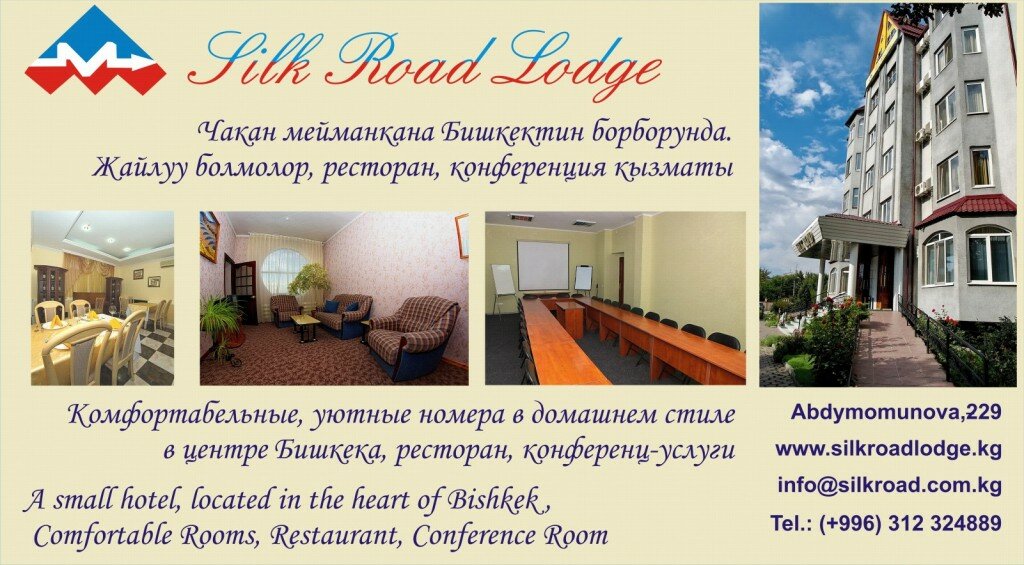
Ours is a small hotel, with just 28 rooms, and although we don’t need as many guests to be full as our larger competitors … but that also means that we don’t always have the same facilities, (we’ve got, for example, just one restaurant – not two or three) and cannot reap all the benefit that they do from the “economies of scale”.
The question of scale, however, works to our benefit in another way – enabling us to be adopt a small, friendly and comfortable, “home away from home”.




 Bishkek