The Great Silk Road
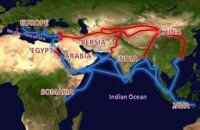
The Silk Road
The story of the Silk Road is a fascinating one – full of fearless explorers, military campaigns, religious pilgrims and great thinkers as well as humble and enterprising traders who risked both life and limb travelling in caravans across deserts, mountains and steppes.
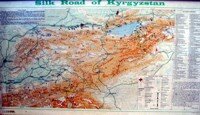
The Silk Road in Kyrgyzstan
There was no such thing as a single “Silk Road” – rather, there were a number of different routes used by ancient traders. Some of the main ones certainly ran through Kyrgyzstan, both in the North (coming over the mountains from China (for example, over the Bedel Pass) or down from what is now Kazakhstan past lake Issyk Kul then along the Chui river), but another variant ran over the Torugart Pass (Tuergate, Torugart) in Central Kyrgyzstan then through Naryn and down the Chui river, while a third (southern) variant came over the Irkeshtam or Talgyy passes in the South (then through the city of Osh, which celebrated its 3000th year in 2000). A spur of the southern route ran through the middle of the country to join with the middle route over Torugart Pass. Once in Kyrgyzstan, one route ran down the Chui River and then over the present day pass to Kazakhstan (which is today called “Zhibek Zholu” or Silk Road) and in the South ran from Osh through Uzbekistan and then westwards. Perhaps, no country in central Asia other perhaps than China has a better claim to represent the best of the Silk Routes.
These routes were given the collective name the “Silk Road“ because they were used to carry luxury goods between East (China) and West (most notably Rome). Silk was one of these luxury goods.
The name is quite a recent invention and was coined by Ferdinand von Richthofen to help explain the phenomena of the trade which brought silk to Rome and other exotic goods to Rome and, according to one ancient historian, practically bankrupting the Empire. It just happens to be one of a number of similar routes that have been given names after the event, for example:
- The Amber Road, between the Baltic and the Mediterranean and used to transport amber – hence the name;
- Hærvejen, variously translated as the Army Road and Cattle Way, connected the Denmark peninsular to Schleswig-Hollstein
- The Incense Route which served as a trade channel between India and the Arab world and Europe through the Red Sea;
- The Dvaravati–Kamboja trade route, which was a maritime route which extended the Silk Road though South east Asia and the numerous island nations, for example, that now comprise Indonesia;
- The Grand Trunk Road which has connected Calcutta in India to Peshawar in Pakistan for over two and half centuries
- The trade routes of the Hanseatic League which established German traders as a dominant force across the Baltic and North Seas in the fourteenth century;
- The King’s Highway linking Heliopolis in Egypt with the ancient city of Damascus and then on the Euphrates River, which was to be important to the local communities and [play a vital role during the Crusades that was to be important
- The Rome–India Sea lanes and The Spice Route – were maritime routes that brought spices from India and South East Asia to the Roman Empire
- The Persian Royal Road was constructed by Darius the Great in the fifth century BC to facilitate communication across his huge empire;
- The Old Salt Route which was a short but vital medieval trade route in Northern Germany which was used primarily for the transport of salt and other staples ;
- The Tea Horse Road between Yunnan province in China and India, which dealth primarily in the trade off between horses and Chinese Tea – hence the name;
- The Trans-Saharan trade routes - linking the communities the ringed the Sahara Desert carrying predominantly gold and salt;
- The Triangular trade routes which took advantage of the prevailing trade winds to take ships across the Atlantic, carrying slaves, sugar and other agricultural products connecting Europe with West Africa, and the Caribbean and the Americas;
- The road from the Varangians to the the Greeks connected the Scandinavian countries to the Black Sea;
- The Via Maris – Latin for the “Way of the Sea”, a route connecting Egypt with empires to the North, Syria, Anatolia and Mesopotamia, the use of which dates back as far as the Bronze Age;
- The Volga route which followed the course of the Volga river and provided a land route for the Vikings across what is now Russia down to Istanbul;
It is said that Silk was first discovered in China when a queen accidentally dropped a silkworm cocoon into a hot cup of tea … when she removed it she unravelled a fine, shiny, silken thread. When woven into a fabric a magnificent material resulted. Samples found their way to the West, and made a great impression on the Romans. Now that we are used to so many different fabrics, natural and synthetic, it is perhaps not easy to realize the effect that this material had on the psychology of the people of ancient Rome, used to much heavier cloths.
The first time the Romans encountered this new material was reputedly in a battle, when the opposing forces flew banners made of silk which shone brightly in the sunshine, creating havoc amongst the Roman forces – who eventually lost the battle. Many of the soldiers were taken as prisoners and were transported to the farthest reaches of the Persian Empire.
Once commercial trade in the material was established – it became the craze – the most highly sought after, prized and expensive textile. Some historians even attribute the profligate spending of the Romans on this commodity helped bring about the fall of their economy – and their empire. As well as several commentators bemoaning the lack of modesty and the impropriety represented by this material, Pliny certainly wrote about the massive trade imbalance in a number of goods (not just silk) imported from the East along the Great Silk Road.
And all the time their rivals to the East were growing rich at their expense.
The technique of manufacturing silk was kept secret for centuries. As was the process for manufacturing another Chinese invention – paper. The secret was revealed, however, in 751 AD, after one of the most influential battles in history – the Battle of Talas. The battle took place by the banks of the River Talas – but the site of the battle is just over the border in Kazakhstan. At the end of the battle, amongst the prisoners rounded up were artisans who knew – and revealed the secrets. It marked the end of Chinese expansion westwards, and as such was a costly defeat in military terms – but in economic terms it proved even more significant.
It wasn’t just silk, however, that was carried along the route. Other high value non-bulky commodities such as spices, jewellery, porcelain, furs, gems and other exotic commodities were traded. Just as today, in the days of the Great Silk Road, the border was carefully controlled. It was illegal to carry certain goods in, or out, of the Chinese Empire, (for example: silkworms or swords) and the export of Rhubarb was strictly controlled. Once the merchants had cleared their passage with the authorities they departed on the way to the next market where they could trade their goods. Goods were traded and ideas exchanged in market towns with such exotic names as Antioch, Babylon, Erzenum, Harnadan, Bukhara, Samarkand, Kashgar and Xian – as well as in many which have long since disappeared, (such as Nevkat, Suyab, Balasugin and Jul), and some whose names we no longer know.
As traders moved along the Silk Road, they not only took with them their merchandise. They also carried their culture, art, philosophy and beliefs. Buddhism, Zoroastrianism, Confucianism, Christianity and Islam were all carried along the Silk Road by itinerant travellers. The Silk Road could just as easily have been called something like the “Road of Ideas”.
Goods were traded and ideas exchanged in market towns with such exotic names as Antioch, Babylon, Erzenum, Harnadan, Bukhara, Samarkand, Kashgar and Xian – as well as in many which have long since disappeared and some whose names we no longer know.
These ancient trading routes operated 2000 and more years ago, and reached a peak in the second century AD. The trade was actively promoted by many of the intermediate kingdoms, such as the Parthians and Persian, which benefited from tolls and in return helped to maintain and protect the routes. Cities such as Ectabana, Merv, Palmyra, Petra, and Alexandria flourished on the trade. As one writer says “in the end, the horse and the Bactrian camel were the means by which the central Asian steppes were opened up as a great commercial route”. We should not, however, imagine a trader starting in Eastern China and making his way to Rome! Perhaps a few did so and of course we know that a few (such as Marco Polo, rather late on in the show) went all the way in the opposite direction from Italy to China.
Most traders would travel along a short part of the route, handing on their goods to the next trader in the next large town, and by such means goods swapped hands and increased in price many times before arriving at their ultimate destination. Apparently, according to accounts written at the time … a return journey between China and Western Territories – not even to Europe – took between three and eight years. According to several sources – the going rate for caravans was something like 25-30 kilometres a day – the sort of distance between the ancient towns of Balasugin (Bruana Tower), Suyab (Ak Beshim) and Nevkat (Krasnaya Rechka) in the Chui valley of Northern Kyrgyzstan.
Some of the Silk Routes through China skirted the Taklamakan desert, one of these running to the north and one to the south of this desert. There was also a more northern route towards the Altai Mountains. The different routes were used depending partly on climate and also partly on incursions from local tribes. Certainly one of the southern Taklamakan routes went through Yokand (Yarkand, Yarche, Schache) and then through Kashgar (Kashi or Kashi Shi) and these can easily be visited today from Kyrgyzstan. Some other routes also probably went down what is now the Karakoram Highway past lake Karakul and through Tashkurgan and then either through the huge and dramatic cleft in the mountain range where the Mintaka river links China and Afghanistan or possibly over the 4730 meter Khunjerab Pass into the Indian subcontinent (into what is today Pakistan’s Northern Territory). Tashkurgan is thought by many to be the “Stone Tower” which Pliny wrote about and today there is a large ruined site (Tashkurgan = “Stone City”), which dominates the lower valley. (There have also been suggestions that identify this site with Tashkent in Uzbekistan - “Tashkent” also means “Stone Town” - and even with the Suleiman Mountain which dominates the Kyrgyz city of Osh).
The heyday of the Silk Routes was in the period about 1800 years ago, and its use for the transport of rare items between China and the West tended to decline when sea routes later opened up or became more popular (having earlier been bedevilled by piracy).
Nevertheless, although the whole Silk Routes from China to Rome may not have been used continuously as a transcontinental route and parts of it fell from time to time into disuse, other parts remained open continuously, even if used for more local trading. The main threat to the routes were the northern barbarians (Huns, Hsiung-nu and others) who put pressure both on the Chinese – especially in the Tarim basin area where to the south the warlike Tibetans were also a threat – and later, even on Rome itself. But particularly with more bulky cargoes, the sea routes (for example, through the Red Sea and then the Mediterranean, or through the Persian Gulf, and then overland through Persia/Arabia) proved to be a more economical and reliable route – after the suppression of piracy – and this led to a decline in use of the land routes. But because there is not one road but many routes, and trading never ceased along at least parts of them, it is impossible to say that the Silk Road ever ceased to be used.


 Bishkek