Fire, FIRE!
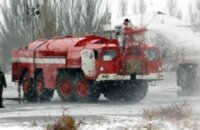
Fire truck at the Manas Transit Center
Tomorrow, June 15th, is another one of those Professional Holidays: the Day of the Fire Service of Kyrgyzstan, (Kyrgyzstandyn ortkokarshy kyzmatkerlerinin kүnү) .
The “holiday” was established by government decree in October 1994 and the date was chosen because it was on that day back in 1926 that the first professional Fire Brigade Service was established in Kyrgyzstan – in the city of Frunze.
For the record: the first recorded Fire Service was established in ancient Rome during the reign of the Emperor Augustus, although there is some evidence of specialist fire fighting equipment, including a water pump, being used in Ancient Egypt. It wasn’t, however, quite the set up that we would recognize today. In particular. Sometime earlier, around 115BC, Marcius Licinius Crassus had established a small private force of about 500 strong, which would rush to the scene of a fire but then stand around while Crassus would negotiate a price for their services … if he couldn’t reach what he considered a suitable fee, they simply let the building burn to the ground … and he would then make an offer to buy it at a fraction of of its previous value. Augustus built on the idea – but without the mercenary element.
That’s not to say that there was no provision for fighting fires before 1926. As Kyrgyzstan was absorbed into the Tsarist empire there was an influx of peasants and other settlers who brought with them the experience of volunteer fire fighting as well as some simple equipment.
In Russia, under an 1803 law, towns and cities with a population of more than 20000 had to establish a service which was subordinate to the Police. There was also some interest in ensuring that fire didn’t reap havoc and the community (especially the volunteers), together with insurance company staff, established a set of Fire Regulations that remained in effect until 1917. Then, in 1918, the Council of People’s Commissars of the Russian Soviet Federative Republic, (the forerunner of the USSR), established a special Commissariat with the responsibility of bolstering public and volunteer brigades, establishing legislation and the development of fire resistant construction, providing training and providing fire fighting equipment.
Incidentally, in December, 1924, a special three year training course was established at a technical school in Leningrad, producing the first graduates in 1928 – including a certain I. A. Vladimirov … from Kyrgyzstan.
It was with this background that, in 1926, the the Commissariat of Internal Affairs of the Kyrgyz Autonomous Republic, created the original professional Kyrgyz Fire Department service, which started in Frunze, (now Bishkek), and consisted of just nine people, with four horse drawn units … and a motor vehicle. Even in those days, the government was strapped for cash and ended up having to sell some of its assets in order to purchase the necessary equipment.
Apparently it was very much a family affair. The archives have preserved the names of the first firefighters and record that there were several sets of brothers in their ranks.
This was followed shortly afterwards when, in 1929, a unit was established with a crew based in Osh. More equipment was provided and in the 1940′s there were over 20 engines with water pumps, as well as 775 hand pumps. These days the service is operated by the Ministry of Emergency Situations, (MChS).
In 1934 the responsibility for the fire service passed to the NKVD – the forerunner of the KGB which is better known for being the Security Service – and, as elsewhere, the Kyrgyz service was transferred to the authority of the Security Services.
During the Second World War, many of the existing fire fighters were drafted into the army and sent off to the front … leaving a gap at home, that was filled by conscripting men. Despite this, there was a shortage of personnel – which remained about 30% understaffed. What’s more, many of the best suited recruits were drafted into the fighting forces and many of the rest worked in the plants supporting the defense industries. As a result, local fire chiefs had to rely heavily on volunteers to fill the ranks – which led to appearance of firewomen – who, (although they were mostly employed as drivers), according to the official records, gave valiant service.
In 1955 there was a further reorganization – and the service was organized along military lines, and today the service is still recognized as an alternative to conscription in the armed forces.
During the Soviet period, considerable funds were invested in the service; in staffing, training and equipment – with a lot of support coming from the center, that is, Moscow. With Independence, most of the support was lost and conditions deteriorated. A few years ago the Minister complained in a parliamentary hearing that fire service was often overlooked when it came to allocating resources. In the first eighteen years after Independence, he said, they had received no new equipment. That situation was rectified, at least in part, by the receipt of some 73 new engines – although he complained that this was not sufficient to meet the country’s needs.
Over the last decade they have attended an average of about 10 fires a day – that’s, 3000 incidents a year – a total of over 35,000 incidents. In that period they have rescued over two thousand people – unfortunately, something like 1500 others have also died in such incidents. But, he said, the Fire Stations themselves had also been neglected and salaries paid to the fire fighters, (mostly young, athletic men who put their lives on the line in the course of their everyday work), had not been raised for some time …
As with fire brigades all over the world, the fire service doesn’t just attend the scene of a conflagration and attempt to put out the flames – they are also involved in preventative work; education, explaining the causes of fire and rules of fire safety. In fact, this is a very important element of their work because it seems that something like 70% of all fires are the result of either of the “antics” of children, (which could be described as either ”childish pranks” or vandalism) and carelessness, (violations of “the rules of fire safety”).






 Bishkek