Taken to task
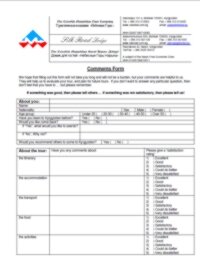
Comments Form
I recently got taken to task by a former client … she had come to Kyrgyzstan for a two week holiday which included a week of horse riding in the Terskey Ala Too mountains south of Issyk Kul and she wondered why we didn’t make much of this sort of tour in our advertising: “the people were so brilliant and such amazing scenery“.
In reply, I had to admit that she had a point … although we do feature horse riding as an option, I suppose that we don’t actually stress it. Perhaps we should.
That’s an example of ”feedback” and was all the more valuable because it was unsolicited, came some time after the tour was completed and gave a positive suggestion as to something we should do to improve.
Now, we usually give clients a “feedback form” when the tour is coming to a conclusion. The idea is to gather information about what went well … and what didn’t – things to which we need to pay attention so as to improve our service in the future but, to be honest, the forms are not always that helpful.
Many people seem to think that it is a chore and want to get it over and done with as quickly as possible, which is why we the form evl;oved into a simple “tick box” format, (with space for some “free text” in case someone wanted to add something like specific examples … or for someone, like me, who doesn’t like the “one size fits all” approach of “tick boxes”).
Unfortunately some people simply go down the form ticking “Excellent” all the way down.
In some cases the comments reinforce what we already knew, or suspected … for example, a visit to Tash Rabat, overnighting in a shepherd’s yurt and taking a horse ride into the surrounding mountains, as being the highlight of a particular tour itinerary.
It’s nice to be told that things went well, nobody likes to be criticized, but the most useful part of the form is when we ask which things could have been better – what do we need to pay attention to in order to improve. It is really gratifying to be told that everything went well, especially when you realize that most tourists don’t really know what goes into preparing a tour, although experience helps considerably – however, the pointers as to where we can improve our service are important to us.
When it comes to this section, some people make comments like ,”The toilets”, although, to be frank, there is little we can actually do in this respect apart from note their comments and bring it up as an issue every time and everywhere where the opportunity presents itself.
Occasionally there is comment like, “The packed lunches were too big” – which, (despite the implied waste), I take to be better than a complaint about them being “too small” – and in some cases an identical packed lunch seems barely to suffice – finding a happy medium is never easy.
Some of the comments amount to complaints, which we have to pay attention to. Once, for example, we told that the all the time estimates for the journeys were too optimistic … cutting down on the time available in the various destinations. As a result we looked at the timings again and revised them taking into account local road conditions and the building in provision for possible “photo stops”. (Incidentally, that’s one of the reasons I now, when I am away from the office and am asked for an estimate of a journey time, tend work on the assumption of an average speed of 60km an hour rather 90 – as I used to.)
In one way the the feedback forms are just a “formality”, but they are also an important aspect of customer relations and a development tool, help us to improve, (on what I hope and trust is an already satisfactory and successful service).
As I hinted above, I don’t particularly like such forms and I appreciate that there are others who want to express their opinions in another way. Sometimes that takes the form of a “debriefing” meeting, matching the “briefing meeting” at the start of the tour; sometimes it takes the form of a follow up letter once the tour is over and the group gets home.
One thing, however, is important – that, (one way or another), we do get the feedback.
So … a plea … when and if you get given a “comments form”, please take the trouble to fill it in … or at least give some feedback when you get home … even if everything was “perfect”, (although that’s a very strong word and I am sure that very few if any trips go “perfectly”). Perhaps one of the reasons it was so, is because other people before you helped us to make it so by giving us a pointer in the right direction.
If it was “perfect”, then tell us so that we can ensure that we continue to do the right things.
If there was something that was less than “perfect”, then tell us so that we can attend to it. I can’t promise an instant reaction in every case, as some things are out of our control … but where it is possible for us to deal with the situation we will do so. At the very least, your comments will help us by giving us the information that we need as “ammunition” in the case of debate within the country – for example, with the government when they are making their plans for further developments. The comments we received, for example, about the “visas rush” was helpful in discussions that led up to the introduction of the visa free regime.
Finally I came across the following advice about how to give effective feedback which I thought was worth passing on:
Feedback is problematic. Managers often dislike giving it and direct reports rarely get enough to change their behaviors. But feedback, both positive and negative, is an important tool for learning and career growth. Next time you have to talk with someone about their performance, follow these four steps:
- Be specific. Feedback needs to be actionable. Use concrete examples to back up your conclusions. Avoid generalised character attacks. Instead, describe the behaviour.
- State the impact. Tell the person how his behavior is affecting you, the team, or the organisation.
- Prescribe. Be specific about what needs to change. Often employees won’t know what to change unless you tell them.
- Do it often. Get in the habit of praising good performance and identifying troublesome behavior.
… and , as an aside: Notice that in that last point, almost hidden away and escaping attention “praise good performance” as well as “identifying troublesome behaviour“. It is relatively easy to criticize and we often overlook the value and importance of positive feedback …





 Bishkek