From our own correspondent
One of the podcasts I download each week is “From our own Correspondent” from the BBC. Their reporters based in different countries around the world prepare short background essays on events and life in the places where they are stationed and these are then compiled into a broadcast. As their webpage describes the programme, it provides “insight, wit and analysis as the BBC’s foreign correspondents take a closer look at the stories behind the headlines.”
Occasionally they feature an article from Kyrgyzstan: on Poverty and Pollution; on relationships between Kyrgyzstan and the US and Russia; on the effects of the demise of the Soviet Union on a small community and so on. There aren’t that many articles from here, but there are over 180 countries and territories around the world, and the BBC have hundreds of foreign correspondents … many based in places where there are interesting events happening and lots of material competing for a place in the broadcast.
Now, Kyrgyzstan is not the best known country in the world, and I can imagine a correspondent being posted here asking: “Where? …”. People are often confused about where Kyrgyzstan is, or what it is called, or how to say the name. I think there used to be a clip on one of the video sharing sites featuring an American President’s difficulty in saying the name…. I wish I had saved it. He’s not alone, however, there are several presenters on the television that have difficulty saying it. Even some of the ex-pats here seem to have a variety of ways of pronouncing the name. To be fair, however, the correspondents from the BBC never seem to have any difficulty.
On one occasion when I looked at a newspaper report on-line, (on the site of a very well-known and respected publication), about developments here in Central Asia. There was a graphic which claimed to be a map of the region. I say “claimed to be a map” because the artist had created a very pretty schematic, but had somehow forgotten about Kyrgyzstan. It just wasn’t there. There was Uzbekistan and Kazakhstan, but no Kyrgyzstan. I wish I had saved a copy, as I did with the travel guide, because people often don’t believe me when I tell them about it.
On another occasion I was filling in an on-line form and when I got to the “Country” box I was presented with a drop down menu which listed all the countries of the world … bar one, at least, that is: Kyrgyzstan.
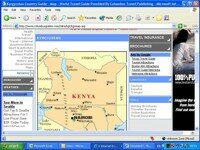
A few years ago I was browsing a travel encyclopedia website and got a bit of a surprise when I looked up Kyrgyzstan. There in the centre of each country page was a map – but I was faced with not of Kyrgyzstan, but of Kenya.
Although I felt a mix of emotions ranging from confused to outraged, I confess that I was also slightly amused and saved a screen dump for future reference … if you see the original, (not the reduced version here), then you can clearly see the address of the page.
Well, I cynically thought to myself, I suppose that both countries begin with the letter K … To be fair, however, it was probably just a simple programmer’s error … the files containing the two maps were probably stored close to one another … and the mistake has now been corrected.
So, you can imagine how my interest is piqued every time they mention Kyrgyzstan.
It’s not just the art6icles on Kyrgyzstan that are interesting, however, which is quite good, because there aren’t that many of them. Many of the other articles are interesting and provide insights. Sometimes they are about places I have visited, on others they give a background to items which are in the news, and yet others provide insights of a more general nature. This week, for example, I was intrigued by an article about Zambia. Their reporter, Jo Fidgen, (based in Lusaka) posed the question about “how much good does the plethora of NGOs do in Zambia?”.
As I sat listening to it, it all sounded so familiar. I couldn’t help thinking that in many places she could have replaced the Zambia with Kyrgyzstan and so much of what she said would apply.
Of course, the two countries are far apart – and not just in distance: Zambia is a lot larger than Kyrgyzstan, it is in Africa not Central Asia, was part of the British Empire not the Russian Empire and the Soviet Union … but there are many similarities as well. It is one of the least developed countries in the world, facing many challenges and as such attracts a large number of non-governmental organizations (NGOs) trying to help the local population in one or another. Transport can be difficult and few tourist or other outsiders make it to the more areas. The four pillars of the economy are: mining; agriculture; tourism and industry.
There is also a growth in the number of hotels in both countries. Jo Fidgen wondered how all these new hotels kept going in Zambia, where did they get their clients from? The answer, she suggested, was provided by the plethora of NGOs in the country, who needed to accommodate their international consultants and venues to conduct their workshops. The same is true to a certain extent here in Kyrgyzstan and, obviously I have a vested interest in this … as we have two hotels and the recent increase in the number of hotels opening in both Bishkek and Naryn means greater competition and keeps us on our toes.
She went on to review the vocabulary of NGO-ese; how their mission was often to “sensitize, empower and build capacity”; and the often chosen method of workshops, (here they are often called Forums, Seminars or Round Tables), and commented how they were often well attended for the first session, but with fewer participants staying after the coffee break. I have often commented how few people stay after the coffee break which follows the initial presentations, when the Minister and the press have left. This is usually the time when most of the real work gets done, and it always strikes me as a shame that important people – often major players in the topic under consideration – just “melt into the woodwork” and disappear when they really could make a difference.
She went on to give some examples of projects in Zambia – some good … some not so good … some involving inappropriate interventions such as recommending some foreign experience which is not suited to the local circumstances … and I thought of similar examples from Kyrgyzstan. Although the role of the International Consultant is to bring their wider experience and expertise to bear, to inform decisions, it can be frustrating when they appear to have been simply “parachuted” into the country, knowing little or nothing about the local circumstances and simply repeat a presentation which they have made before … sometimes not even changing the name of the country in the obligatory Power Point presentation.
That’s not to say that NGO’s aren’t effective. Here in Kyrgyzstan there are a number of particular examples that make a real difference and are worthy of respect, such as: CACSA – The Central Asian Craft Support Association; KCBTA – the Kyrgyz Community Based Tourism Association and Babushka Adoption.
Jo Fidgen’s conclusion was that Zambia was a bit like her car, that keeps breaking down and needing repair: it’s not in great shape … with plenty of people willing and trying to help fix its problems … with some, despite their good intentions, doing more “damage” than good, although the odd one making a real difference …
As I said, it all sounded so familiar! – even if it was about a country far, far away which I have never visited …
I look forward to listening to the next broadcast, and will keep a special watch for more of Jo Fidgen’s contributions.




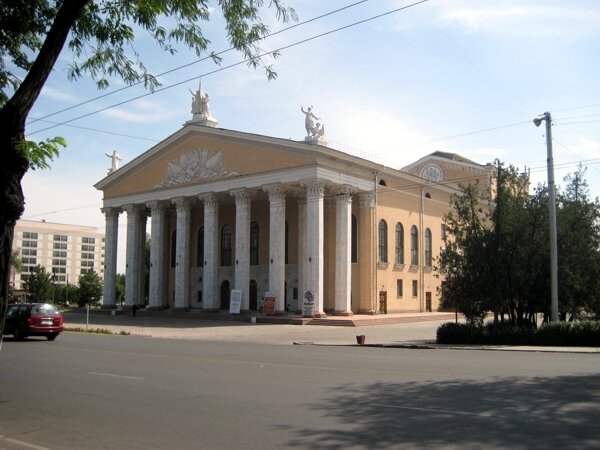
 Bishkek