Friendly Steppes
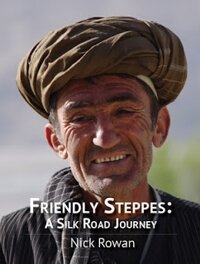
The book ...
The other day I was given the copy of a book, Friendly Steppes: A Silk Road Journey by Nick Rowan.

... and the author
I happen to know Nick, not very well – we both have connections with a publishing house based in the UK and, although I have met him a couple of time I have met him a couple of times, most of our communication has been by e-mail.
So I was a bit surprised when I saw the cover of the book: it features a smiling man in a turban … and my first thought was – that can’t be Nick … he’s not that old, (as I said, although I have met him, I can’t say that I know him well!).
Fortunately, on the back cover there’s another photograph – showing a much younger smiling face … and that’s the Nick Rowan that I remember.
You might wonder why he chose to put someone else’s face onto the front cover of his book – but the title really gives it away; he’s trying to emphasize the friendship and camaraderie that he encountered on his six month journey retracing the steps of Marco Polo along the Silk Road back in 2006.
Although, he doesn’t actually follow the route taken by Marco Polo, assuming that he did actually make the journey – but it comes pretty close. He sets of from Venice travelling through twelve different countries to end up in Beijing.
To be honest … I haven’t read the whole book. I read the introduction and I’ve dipped into several of the chapters, but I more or less dived straight into the chapter towards the end of the book about his time in Kyrgyzstan … after all, that’s what I know best. I can recognize his descriptions of Turkey, Tashkent and parts of China … but Kyrgyzstan – hey, that’s my home.
Now, Nick’s book fits into a well defined niche – travel writing. Frankly, I think it is one of the most difficult genres because it has to satisfy so many different tasks … it is not simply a guide book, although it shares many aspects with that particular genre. It must, for example, set the scene both in terms of geography and historical detail … but it goes further because it must also give an account of the author’s experiences and recount impressions received: giving factual information, narrative and providing sufficient evidence creating an atmosphere and evoking emotions.
I think that he successfully navigates this difficult course – there’s plenty of background information … and he’s even given me something to look up – I didn’t know, for example, that At Bashi had once been “the largest city in the Tien Shan area” … and, as he points out, given its current state and size, (“dusty and deserted”), that seems hard to credit.
There are a few moments I found more problematical – for example, he puts Kochkor about 100 kilometers southwest of Bishkek … which I take to be a simple typographical mistake – it’s to the Southeast. I wasn’t sure that I recognized his description of Kochkor … I don’t think I have ever seen the market square quiet
When he describes the journey along the main Bishkek-Osh highway he says that “the road crosses two treacherous 3000 meter passes”, which is true … but then he adds, “that are impassable in bad weather or during winter, effectively cutting off this part of country from the rest of Kyrgyzstan”, which is slightly overdoing it … again, it might have been true ten years earlier, but these days the road is closed, (and only for short periods), in order for work to prevent potential avalanches.
To be fair, there are other roads, (such as the one he wanted to travel on from Djalal Abad up to Kazarman and on to Naryn and then Tash Rabat), that are closed for several months of the year … but I am not sure that means that large areas of the country are necessarily isolated for considerable periods.
He also says they “drove on steadily, slowing down only slightly when the road disappeared into a dirt track.” I suspect that last example was an example of “poetic license” because the road is actually quite good … having been renovated and reconstructed well before 2006. It might have been a fair comment ten years earlier – I actually met a driver shortly after I arrived here in 1995 who refused to take his car along the road because of the state of the road, but by the time Nick was here it was already a remarkably good road.
To be fair, today, the road is showing signs of wear and in places it is need of some reconstructions work … but it doesn’t “disappear into a dirt track”.
As it happens, it is easy to be critical, and I don’t want to “nitpick” on what are small points, because I think he has done a good job in giving a narrative and evoking impressions. After all, it is the story of his journey … and the impressions he gleaned during that journey.
From the opening chapter where he describes getting lost trying to find his way around a labyrinth of alleyways in Venice, to his horse trek into the mountains above Tash Rabat and the remains of the stone city at Tashkurgan, (in China – South of Kashgar), he describes the scenery and the mixed feelings he experienced.
The main value of the 350-odd pages, however, are the hundreds of character sketches in the vignettes where he describes various encounters and conversations. I got the distinct feeling that these were real people, whether fellow travelers, officials or local people: their hopes and expectations, fears and apprehensions …
In his account, I got the feeling that he wears his heart on his sleeve and bares all: The Good, the Bad and the … well, not so attractive. Whether it’s a case of bluffing you way through a conversation on modern art to bribery and encounters with the police or “jailoo politics” … it’s all there, told with a plain honesty.
Whenever I read this sort of book, I always delight when I come across the “good” and cringe when I see the “bad” or the “well … not so attractive”, but I always try to remind myself that it is the author’s account of his journey, his recollections, how he understood his experiences and the impressions that he received. In this case it’s based on a journey made eight years ago … it takes time to sit down, gop through his notes and write his account – and then for the publisher to do their bit preparing the book for publication, marketing and promotion. In that sense – it represents “a snapshot in time”.
That’s a point that needs to be borne in mind when reading this book: The events described portray a visit to Kyrgyzstan shortly after we had undergone a “revolution” which led to the flight of the President and installation of a new government. Since then, however, the world has moved on … and Nick had to put in a one page “postscript” to explain that, in 2010, a second revolution had taken place.
Perhaps, this account will be useful as an important source for scholars in the future when trying to come to an understanding of the situation in Kyrgyzstan in the unique historical context in which we found ourselves.
Finally … just a few quotes which caught my eye:
- Whatever the story, it was impressive to witness …;
- the views were dramatic, and so was the driving …;
- it was an experience I did not want to end …





 Bishkek
Thanks for taking the time to read the book and for your comments, which are gratefully appreciated. I do hope you’ll at least forgive me putting Kochkor to the south west!! No matter how many times I, (and my editor), read and re-read the text I guess there will always be the odd error.
I also am glad that you picked up my main purpose of the book which is to try and show that the countries I visited are not faraway countries full of madmen shouting “death to America” and performing religious acts of madness but, rather, are great places filled with incredible people that are worth visiting and meeting. Of course there is some bad and ugly with parts, and these can’t be denied, but I do hope that the book will inspire at least a few to travel and explore the region.