International Mother Language Day
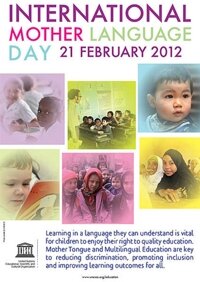
International Mother Language Day
Today’s postcard is dedicated to the fact that it’s International Mother Language Day.
Yes, it’s another one of those special, United Nations designated days. It’s been celebrated on 21st February every year since 2000 in order to promote linguistic and cultural diversity and multilingualism; multilingual education, and to develop fuller awareness of linguistic and cultural traditions based on understanding, tolerance and dialogue.
This year the chosen theme for events around the world is: “Mother tongue instruction and inclusive education”.
UNESCO highlights the importance of a person’s mother tongue as part of their right to education and it encourages its member states to promote instruction and education in the mother tongue. Hmmmm … it’s going to be interesting to see how Kyrgyzstan is going to commemorate the day given that language is somewhat a controversial and “hot topic” here at the moment.
In a way, that’s understandable.
The country is very much a melting pot of nationalities – and some of them represent quite substantial minorities within the community.
During the periods of the Tsarist Empire and the Soviet Union, Russian was very definitely the predominant language – the lingua franca, the language of government, administration and business. Kyrgyz was still widely spoken, written and studied … but the language for social advancement was Russian.
So much so, that when Kyrgyzstan declared its Independence there was a move to “Kyrgyzify” or “Kyrgyz-ize” all aspects of life … Kyrgyz was declared the official State Language in the republic although Russian was granted the status of an “Official Language”. Although candidates for certain state posts had to be fluent in Kyrgyz and pass an examination, official documents, reports, etc. could be prepared in either. Some saw in this an attempt to “square the circle” – strengthening and developing the language whilst at the same time offering reassurance to the Russian and other nationalities that lived in the country.
Those exams proved to be somewhat controversial … some candidates for the Presidency, for example, were not allowed to have their names on the ballot paper because the commission examining their fluency of the language judged it to be deficient. In response, some people have pointed out that there is no definite or standard version of the language – no equivalent of the “Queen’s English”. Although the Commission for the State Language attempts to be the official regulatory body in all linguistic matters, it has been argued that it is not an equivalent of the L’Académie française, (also called the French Academy – the pre-eminent French learned body on matters pertaining to the French language).
Some Ministers and Deputies have faced criticism because they conduct business in Russian and not Kyrgyz. There have been calls for the introduction of compulsory examinations for all civil servants.
For the record: According to the UCLA Language Materials Project, the Kyrgyz language is spoken by about 2 million people in the Kyrgyz Republic.
The first reference to the language is recorded in an eighth Century inscription – when the Kyrgyz lived in Northern Central Mongolia. The rise of the Mongol empire caused the Kyrgyz to migrate towards the Tien Shan, (i.e. the present day Kyrgyzstan). In the face of many different invasions Kyrgyz speakers often migrated to other parts of Central Asia and now Kyrgyz speakers can be found in China (mainly in the Xingjian-Uighur Autonomous region), Western Mongolia, Kazakhstan, Tajikistan and Uzbekistan and even as far afield as in Afghanistan, Turkey and Pakistan.
For the linguists to whom this means something … Kyrgyz is a member of the Central Turkic group of languages which also includes Kazakh and a number of other less well known, languages. (There is often some confusion in the West between Kazakh and Kyrgyz languages – as there was between the peoples themselves). Other Turkic languages include Turkish, Uighur, Uzbek and Tajik. Some experts think that there is also a relationship between these languages and both Korean and Japanese, but this point is not proven.
Grammatical functions are indicated by adding various suffixes to fixed stems, as in other Turkic languages. Separate suffixes added to nouns indicate both gender and number (but there is no grammatical gender). There are six cases – Nominative, Genitive, Dative, Accusative, Locative and Ablative. Like other Turkic languages, the word order in Kyrgyz tends to be Subject-Object-Verb. Also the sounds of word stem and suffix must harmonize (i.e. if the stem has a rounded vowel, then suffix must also).
The language can be divided into two distinct dialects – Northern and Southern. The Southern dialects can further be sub-divided into South-Eastern and South Western variants. “Standard” Kyrgyz as defined in the Soviet period is based upon the Northern variations of the language which have borrowed large number of words from Mongolian languages, whilst the Southern dialects have borrowed mainly from Uzbek, but also from Persian and Tajik. Modern Kyrgyz has also borrowed a large number of words from other languages, especially Russian.
Today, Kyrgyz is written in a modified form of Cyrillic which was introduced in 1940. Other modified alphabets were introduced for other Central Asian languages (such as Kazakh and Uzbek) at about the same time. Prior to this, until 1923 an Arabic script was used – as it is still for Uighur across the border in China. Following the standardization of the language, in 1924, a modified form of Arabic was used, but this was replaced in 1924 by the Unified Turkic Latin Alphabet (UTLA).
Transliteration into English using the Latin alphabet is sometimes a little confusing. This is partly due to the fact that in many cases Kyrgyz words have undergone a double transliteration – first of all into Russian and then into English. This means that names are sometimes recorded in different ways in different places – for example: Жалал Абад may be written as Djalal Abad, Jalal Abad, or (more recently) Jalal Abat. Also, many names in the Soviet period were written with a hyphen – Jalal-Abad, but the tendency is drop the hyphen (Jalal Abad) and sometimes even to join the two words together (Jalalabad).
There was no Kyrgyz language press before the Russian Revolution. By 1983, however, 61 newspapers and 16 journals were published in Kyrgyz. In 1983 there were 513 books published in Kyrgyz in the Kyrgyz SSR. Now there are a wide variety of publications in Kyrgyz as well as Radio and Television programmes and even films in Kyrgyz.
There are often differences between different dialects. The language used in the southern oblasts, (Osh, Batken and Jalal Abad), are often influenced by Uzbek. In the Northern regions the title often afforded to older men as a sign of respect is “baike” – whereas in the south it would be aka (or ake).
Although Russian is understood almost everywhere in Kyrgyzstan, and many Russian words have entered the Kyrgyz language. There are places (especially in the rural regions) where Kyrgyz is the definitive mother tongue and Russian is most definitely a second language. Kyrgyz is generally considered to be easier to learn than Russian, with a smaller vocabulary and lack of stress in spoken form.
As in English, the Kyrgyz employ many wordless sounds to express meanings:
- … as they listen to somebody else they make sounds like “un hun”, “aah” or “mmm”.
- … to indicate No, they may utter “uh uh” and shake their heads
- … “oy” is used like “oops” in English to indicate a mistake
- … “ahyee” or “oy voy yuy” is used to express surprise or amazement, equivalent to “really” or “wow” in English
- … “erah” is used to show disappointment,
- … “hunh” indicates pain,
- … “oof” suggests that they are tired, and
- … “erf” that something is terrible or disgusting.
My “mother language”, of course is English, and when I am asked why, (after living here for almost 18 years), I still haven’t learnt more than a few basic elements of Kyrgyz, my answer is simple: “I live in Bishkek, where everyone either speaks Russan or want to practice their English.” I am quite sure that if I lived in somewhere like Naryn I would now speak Kyrgyz because that’s the language spoken by most people there.
Some time ago, for example, I went to a conference up in Naryn and, at first, all the speeches were in Kyrgyz … but then the chairman pointed out that there visitors present who didn’t understand Kyrgyz and he switched to Russian … for which I, for one, was grateful.
In another conference, when the printed materials were handed out to the participants, someone pointed out that they were all in Russian – well, they had been prepared by people in Bishkek. Why weren’t they in Kyrgyz?, it was asked – they would have been far more useful for the locals if they had been.
Google Translate and Wikipedia are both examples of the tremendous that new information technologies have brought to the twenty first century … and offer tremendous potential for hel;ping the preservation and development of the language and language skills among the population.
Wikipedia have created a Kyrgyz language version which is growing in size … but still has a long way to go.
At the moment, Google Translate doesn’t offer Kyrgyz as one of the languages that are available but there is a growing pressure group that is lobbying for its inclusion. I certainly support this – I would find it invaluable. I don’t suppose that it will approach the efficiency of the Universal Translator in the Star Trek universe, but it will go a long way towards it.
At the moment there is a problem brewing in the world of education that it has been decided that in future the examinations for the school leaving certificate and university entrance will be held in either the State Language or the Official Language – that is in either Kyrgyz or Russian. Up until now, they have also been administered in other languages – for example Uzbek or Tajik. It has been suggested that this decision will discriminate against members of these ethnic communities and prevent them for seeking places in Higher Education … yet alone employment as Civil Servants.
To an outsider like me, it certainly seems to run counter to the provision in the Constitution that grants the right to education in the citizen’s mother tongue – yet alone to the high flown aims and objectives of International Mother Language Day.
We’ll have to see how events unfold and how things develop.




 Bishkek
Thankyou for reminding us that Thursday is International Mother Tongue Day.
You may not know Esperanto is also the mother tongue, or native language, for many thousands of people in the World. Details here. http://www.delbarrio.eu/2008/05/speaking-esperanto-like-native.html.
Your readers may also be interested in the website http://www.lernu.net
Thankyou for your support to International Mother Tongue Day.