KSE – The Kyrgyz Stock Exchange
The Kyrgyz Stock Exchange
January 21st , 2008, is known as “Black Monday” in worldwide stock markets. The London “FTSE 100″ had its biggest ever one-day points fall, European stocks closed with their worst result since 11 September 2001, and Asian stocks dropped as much as 14%.
Although it is a bit of a closed world to me, (I never did finish reading that Idiot’s Guide to the Stock Exchange that is sitting on my bookshelf … although I did try – several times – to make some headway with it), even I realize that the events of that day were pretty devastating.
I can’t say that it’s riveting television, but I normally get to see the Wall Street Stock Exchange Opening Bell in CNN each night, and the accompanying discussion about Stocks and Shares. It’s interesting to see how the release of one new statistic, (such as customer confidence, unemployment figures or a press release announcing better or worse than expected results), can influence movements in the world’s financial markets.
In a way, I feel that I have to show interest because so many locals turn to me asking questions about my prognosis as to what is likely to happen in this situation or another … and they don’t seem to accept my protestations of ignorance. I am a foreigner, a businessman, so I must have some “insider knowledge”.
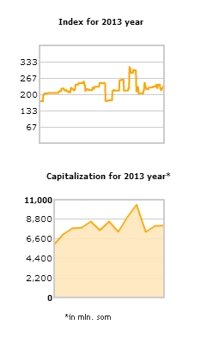
Statistics ... just as in other exchanges ...
Although I have never seen it quoted on any of those reports, Kyrgyzstan does have its own Stock Exchange, (the KSE).
A stock exchange is a form of exchange which provides services for brokers and traders to deal in stocks, bonds, and other securities. They also provide facilities for the issue and redemption of securities and other financial instruments, and capital events including the payment of income and dividends. Securities traded on a stock exchange include shares issued by companies, unit trusts, derivatives, pooled investment products and bonds.
The KSE was established in 1994 by a group of 10 private companies and banks, operating as a non-profit organization. During its first year it was involved mainly with setting up systems, establishing training courses and so on. Trading began as a part of the program privatization of state enterprises – at first dealing in “privatization vouchers” and then trading of actual stocks and shares.
A branch was opened in Osh providing information and a regional center for trading, as well as an internet portal. Work was undertaken to extend the number of companies listed and a special campaign in 1997, called “180 days”, increased the number of companies quoted on the exchange to 37. By 1999 there were 60 companies listed and although the vast majority were based in Bishkek or the Chui oblast, (as, in fact businesses are), there was also representation of the southern oblasts of Osh and Djalal Abad. There are currently about 160 companies listed.
The work of the exchange was recognized when it achieved the status as a Self Regulatory Organization, (SRO), in 1998.
In May 2000 it was transformed into a “Closed Joint Stock Company” – which basically means that membership is controlled by the existing members. There are currently 17 members, or shareholders – 14 of them are local and 3 foreign.
One of the major partners of the KSE is the Istanbul Stock Exchange, which has provided training as well as an entry into international markets, which was further extended when the KSE joined the Euro Asian Federation of Stock Exchanges, (EAFS), which united 25 Stock Exchanges throughout Eastern Europe, the Middle East as well as Central and Southern Asia. The Kazakh Stock Exchange also became a member.
All the time, (with the support of international agencies), training and modernization of the software and facilities provided by the exchange have been upgraded in order to keep up with developments in the Financial Services Market around the world. In 2007, for example, they started trading in Government Treasury Bills.
Of course, the Financial Services Market in Kyrgyzstan is small, (according to their website there were just over 2000 transactions last year – 2012), and subject to fluctuations on the world stage. As a result there have been periods when there has been a downturn in business, such as in 2001, (as a result of changing legislation here in Kyrgyzstan), and in 2008, (as a reaction to the Global Financial Crisis).
The exchange monitors and publishes a wide range of statistics concerning the financial markets in Kyrgyzstan and regularly issues statements through the media to inform investors of developments.




 Bishkek